Has anyone else noticed how the majority of illustrations depicting Earned Value Management methodology show projects over budget and behind schedule? Why the pessimism? I know it’s frequently how things work out, but why do we put up with what amounts to continuous failure improvement? Why don’t we – since we’re only depicting how measurements and calculations are made – show the positive side, e.g. under-spent and ahead of schedule?
It seems like it would make a difference if, rather than presenting failure in the abstract, we presented success in the abstract. Isn’t it better to be going in with a success-oriented mindset, tempered with a good dose of reality? Of course, this presupposes situations where we’re not driven by the dynamics to be overly optimistic and unrealistic at the front end of a project in order to win a bid or compete with others, especially in large programs/projects. A tall order methinks.
I finally decided to give ChatGPT a test drive. I made the following request: “Write a 500 word blog post about why Gen Z should vote in every election.”
Here’s the response I received. The response is actually 523 words. Close enough:
“Gen Z, also known as the iGeneration or the post-Millennials, is the demographic cohort born between 1996 and 2010. As this generation begins to reach voting age, it is important for them to understand the importance of participating in every election.
“Voting is one of the most fundamental rights and responsibilities of citizenship. It is a way for individuals to have a say in the direction of their country and to hold elected officials accountable. By voting, Gen Z can shape the policies and laws that will affect their daily lives, from healthcare and education to the economy and the environment.
“One of the most compelling reasons for Gen Z to vote is that their generation is uniquely affected by many of the current political issues. Climate change, for example, is a pressing concern for Gen Z, as they will be living with the consequences of current environmental policies for much longer than older generations. Similarly, the high cost of education and the increasing burden of student loan debt disproportionately affects Gen Z. By voting, Gen Z can make their voices heard on these issues and push for policies that align with their values and interests.
“Another reason why Gen Z should vote is that their generation is one of the most diverse in history, with a wide range of perspectives and experiences. By participating in the democratic process, Gen Z can ensure that their diverse voices are represented in government and that policies reflect the needs and concerns of all members of society.
“Additionally, by voting, Gen Z can help shape the future of the country. The decisions made by today’s elected officials will have a lasting impact on the future, and it is important for Gen Z to have a say in that future. It is also important for Gen Z to vote to ensure the continuation of democracy, which is the foundation of our country and it is something that should be protected.
“It’s also worth noting that voting is not just a right but also a privilege in many countries. Many people have fought and continue to fight for the right to vote, and it is important to exercise that right in order to honor their sacrifices.
“However, it is important to note that voting is not the only way to make a difference. Gen Z can also get involved in other forms of civic engagement, such as volunteering, organizing, and advocacy. But voting is an essential part of the democratic process, and it is the most direct way to make an impact on government policies and elected officials.
“In conclusion, Gen Z should vote in every election because it is their right and responsibility as citizens to shape the direction of their country. By voting, Gen Z can have a say in the policies and laws that affect their lives, ensure that their diverse voices are represented in government, and help shape the future of the country. Furthermore, it’s a way to honor the sacrifices of those who fought for the right to vote. It is time for Gen Z to step up and make their voices heard.”
We’ve taken voting a little too much for granted, methinks. That would include yours truly, though I have never missed a vote since June 4, 1968, my 21st birthday. I think I made the mistake of believing all that mattered was that I voted and I encouraged those close to me to vote as well. I’m pretty certain that’s no longer good enough; probably was never good enough, but it took the tender ministrations of the tangerine shitgibbon to make it clear we need to take the franchise a bit more seriously.
What, perzackly, that entails is unclear to me, but I’m sure a lot of us have ideas and many are already working on it. That’s what VR and GOTV are all about, no? But I am thinking a little beyond those two things, which we’ve been doing for a long time. We need to talk more about what it means to be an informed citizen. We need to find ways to present it that aren’t tres wonky. Therein may lie the greatest challenge.
When I was at Rocketdyne, my last job was to research, test, and (if warranted and reasonable) deploy social media and collaboration technologies. Part of the reason I took the early severance package they offered back in 2010 was because I didn’t believe the company was really commmitted to supporting what I was doing.
Now it looks like I’m going to have to resurrect my knowledge of those tools and platforms just so I can interact with my friends and family. For instance, anyone who sees a lot of my posts on Facebook knows I usually go to the gym on Fridays, then out to dinner and for a couple of craft beers with two of my former colleagues from Rocketdyne.
We can no longer do that for the next month or so, and we’ve already talked (texted) about how to get together virtually. Not sure how, but there are lots of options. I’ve been using Slack with Quantellia, but I’m really interested in something free. I’ve used Google Hangouts before and I’ve been reading some good reviews from Zoom users. I don’t think Zoom existed back then, but I’m going to find out about it.
The saying is “necessity is the mother of invention,” and I have no doubt the next few months are going to drive our innovative capabilities and our need to collaborate and work together. While I’m not looking forward to being essentially cooped up in my house with my wife and two teenagers (plus a dog and two cats) I am a little excited about discovering the positive things we can extract from the disruption. I expect there will be far more than most of us can contemplate. Hang in there everyone. Let’s expand that silver lining.
Although
the current move toward gathering, cataloguing, storing, and disseminating
information and data for widespread organizational use is a fairly recent
development, the basic concepts of Knowledge Management have been with us for
as long as humans have gathered in communities. Humans have always struggled
with the need to pass on information gathered through hard experience and
disastrous failure.
In
his new book, to be published this fall, Steven Denning sets forth a brief
synopsis of the human activities which have preceded our current drive toward
Knowledge Management. In it he states, “The pursuit of any significant
human activity typically leads to the acquisition by those involved of know-how
and expertise as to how the activity may be successfully conducted. Insofar as
what is learned in the process can be captured, and communicated and shared
with others, it can enable subsequent practitioners – or even generations – to
build on earlier experience and obviate the need of costly rework or of
learning by making the same repetitive mistakes.
“In the village, from time immemorial,
the elder, the traditional healer and the midwife have been the living
repositories of distilled experience in the life of the community.
“…
”
Interactive knowledge-sharing mechanisms
have always been used – from palavers under the baobab, village square debates,
and town meetings, to conclaves, professional consultations, meetings,
workshops, and conferences – all functioning to enable individuals to share
what they know with others in the relevant area of knowledge. “[1]
(emphasis the author’s)
In
1988, as the pace of change was accelerating with the rapid development and
deployment of large-scale information systems, Peter F. Drucker observed,
“Information responsibility to others is increasingly understood, especially in
middle-sized companies. But information responsibility to oneself is still
largely neglected. That is, everyone in an organization should constantly be
thinking through what information he or she needs to do the job and to make a
contribution”.[2]
Drucker
understood then the pivotal dilemma with respect to data and information now
being faced by many organizations, that of understanding its power and devising
the methodologies whereby it can be harnessed and used to the benefit of the
people who need it to perform their jobs properly.
In
referring to information specialists as toolmakers, Drucker said, “They can
tell us what tool to use to hammer upholstery nails into a chair. We need to
decide whether we should be upholstering a chair at all.
“Executives
and professional specialists need to think through what information is for
them, what data they need: first, to know what they are doing; then, to be able
to decide what they should be doing; and finally, to appraise how well they are
doing. Until this happens MIS departments are likely to remain cost centers
rather than become the result center they could be.”[3]
Today,
MIS departments are still struggling with the notion of becoming “result
centers”. Too frequently, they concern themselves with the infrastructure of
the organization’s data processing capabilities, and completely ignore the role
Knowledge Management (in its broadest sense) can play. Instead of leading the
way through the morass of competing needs, whether perceived or real, they find
themselves being led around by various departments seeking to have their agenda
legitimized, often to the detriment of the MIS department’s ability to serve the
company as a whole.
At
Rocketdyne, which employs a large percentage of well-educated, highly computer
literate individuals, there exists a great deal of enmity between the users and
the Information Systems (IS) department. There are many who feel the department
should fulfill the role only of providing the infrastructure, i.e. the
telecommunications backbone and the hardware, and maintaining its reliability.
These people believe IS has abdicated its responsibility of providing guidance
for software development and acquisition, through an historic ineptness in
performing this function.
Whether
this view is accurate or not, it demonstrates a division which has long been
developing and will not soon go away, especially without visionary leadership
schooled in the concept of Knowledge Management. Many knowledgeable workers at
Rocketdyne believe they must have the freedom to purchase software which will
support their needs, or to develop that software without interference and
second-guessing by the IS department.
The
question which looms now for most organizations, and certainly for Rocketdyne,
is how can the data which is both created and collected be harnessed for the
purpose of continuing a company’s pursuit of its goals.
What
we are experiencing, I believe, is a time of challenge and opportunity.
Historically, humans have always valued the hard-earned wisdom of our
forebears. We rightly believe in the inappropriateness of “reinventing the
wheel”, and we have continuously improved on our methodologies for categorizing
and memorializing the lessons we have been taught or have learned through
experience.
Knowledge
Management is merely the application of this historical pursuit of know-how and
expertise to the comparatively new tools we have developed. The concept itself
is nothing new, The question then becomes one of how do we go about harnessing
these tools to our advantage; how do we make that quantum leap into an entirely
new way of viewing an old problem.
In
the next section we will look at a little bit of the background of the present
day approaches to Knowledge Management, and see how companies are beginning to
recognize the necessity of understanding and utilizing this approach to
conducting business and running an organization successfully.
[2]
Peter F. Drucker, “The Coming of the New
Organization”, Harvard Business Review on Knowledge Management (Boston:
Harvard Business School, 1998) p. 11
I have no doubt I am a very lucky person. Although I do not have an education in any science, I was able to spend approximately two decades working on the Space Shuttle Main Engine (SSME) program at Rocketdyne (through four major aerospace corporations). I spent a lot of time working with some of the brightest rocket scientists (for realz) as well as world-class engineers and scientists in literally dozens of disciplines.
Since my retirement from (what was then) Pratt & Whitney Rocketdyne, I have worked intermittently with Quantellia, LLC, an artificial intelligence / machine learning software development firm. Needles to say, I have no formal education in any computer field, with the exception of two Visual Basic classes I took at a nearby Junior College. I was introduced to one of the co-founders of Quantellia shortly after my retirement. She showed me a tool they had been developing called “World Modeler”. It was the most exciting thing I’d seen in a long time, and I was especially impressed with how it brought a highly systemic approach to modeling and forecasting in complex situations. I ended up writing several papers and a bunch of case studies for them.
In 2015 I returned to work at what was then Aerojet Rocketdyne (still is, for now) where I worked on a small rocket engine program for a little over two years. After leaving, I started doing some selling for Quantellia and, beginning in March of 2018, I became the company’s Business Manager, a position I’m still working at.
Last year we held a summit, in conjunction with SAP Global Services, at their Labs in Palo Alto. It was called the “Responsible AI/DI Summit.” In this context AI stands for “Artificial Intelligence” and DI stands for “Decision Intelligence.” One of the main purposes of the summit was to discuss how we can develop artificial and decision intelligence such that we concentrate on using them to solve humanity’s most “wicked” problems, rather than merely work at developing apps, the main purpose of which is to make money for the developers, investors, and entrepreneurs involved in the business.
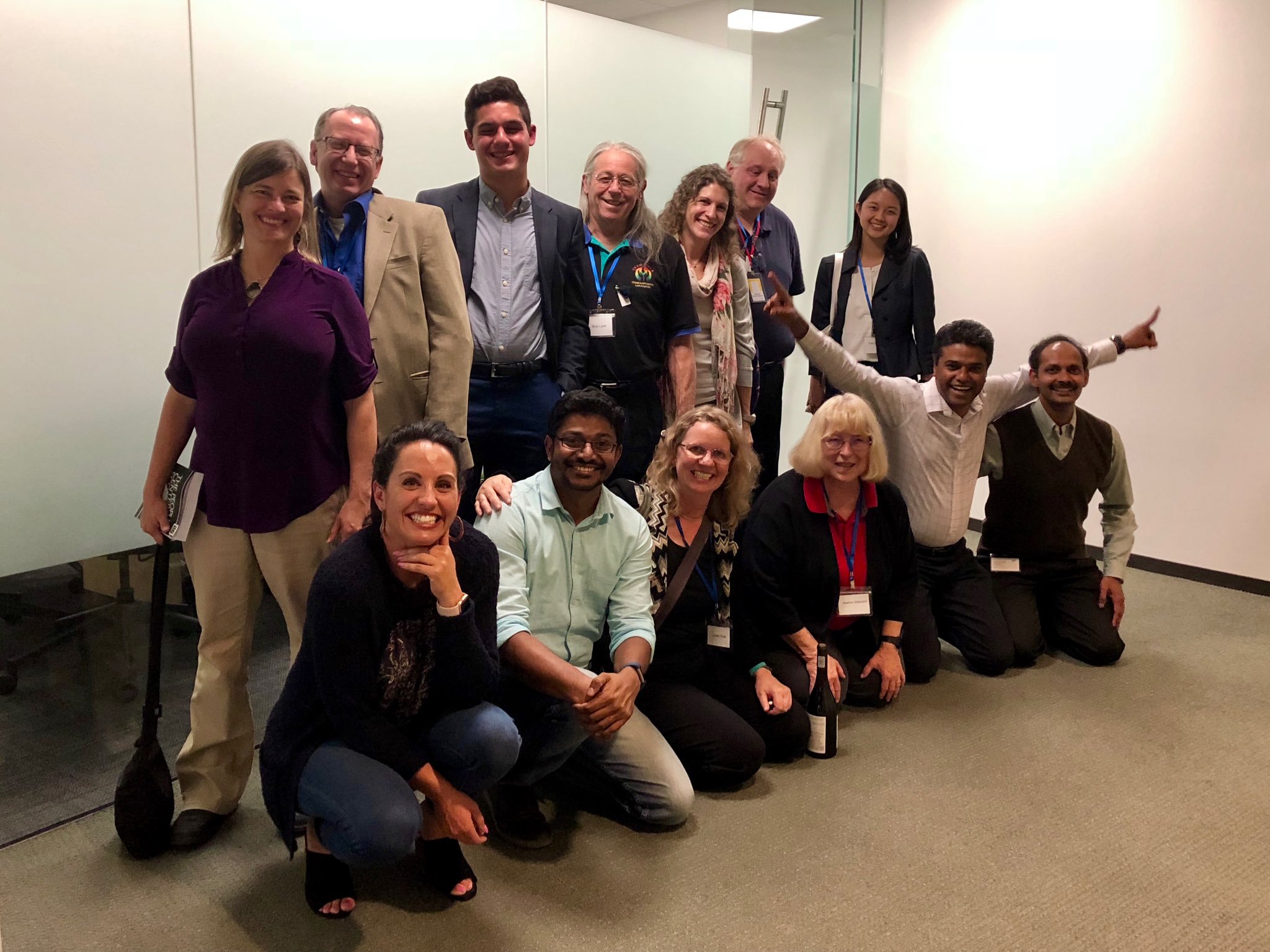
Below are some of the folks who worked on the Summit, including me (the long-haired guy in the middle of the back row). Also, here’s a link to this year’s second Summit – Responsible AI/DI Summit 2019, as well as a link to the RAIDI Blog.
Quantellia and SAP folks who worked on putting it all together
As I learn more about machine learning, artificial intelligence, and decision intelligence, I will work at sharing my knowledge and understanding of these tools, and the issues they raise. I know the people I’m working with are dedicated to serving humanity, not merely milking it for profit. That pleases me and I hope we’ll be able to prove we’re doing the right things to ensure such service continues to exist and grow.
The time has come for me to simplify . . . to apply some feng shui to my collection of old (ancient?) paperwork, some of which is more than several decades old. Paper is the one thing I seem to be a bit of a hoarder with; that and old clothing, I guess.
I am coming across papers, letters, and notes I’ve written over the years, many of them from my over two decades of service at Rocketdyne, where I was privileged to work on the Space Shuttle Main Engine program. In that time I worked for (without changing desks) Rockwell International, The Boeing Company, and the Pratt & Whitney Division of United Technologies. After I accepted an early retirement package in 2010, I returned as a contractor to work for Aerojet Rocketdyne in 2015, where I worked for a bit over two years.
Recently, I purchased a small, portable Brother scanner and I am slowly scanning old papers I’m finding. Inasmuch as I’m now publishing far more frequently to this blog, I’ve decided to save some of these things so I can throw the paper away and still have a record. It’s been over nine years since I retired and I find I’m forgetting what working in a large organization was like. Reading some of the documents I created helps me to remember what I did, as well as to feel reasonably confident I wasn’t just spinning my wheels.
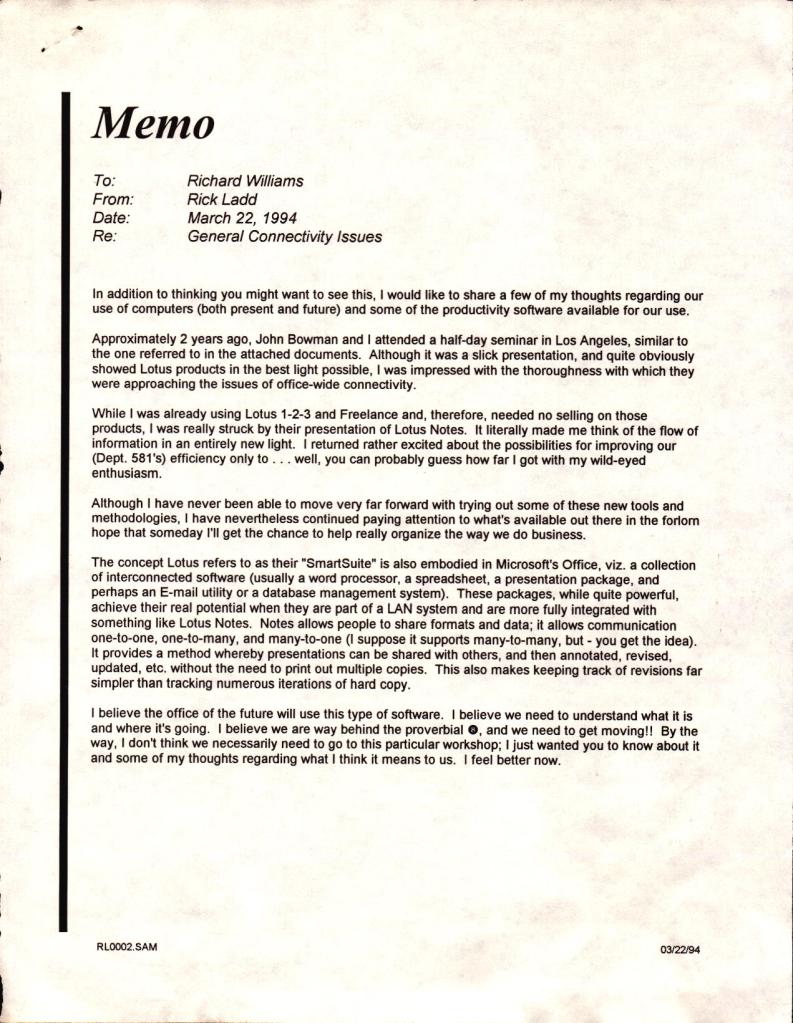
What follows should be somewhat self-evident. It’s a letter I wrote to my manager in 1994, now over 25 years ago. I think I sound pretty reasonable, and I’m gratified to know I was pushing—pretty hard, I think—for positive change back then. I’m not an IT person; never went to undergrad and, besides, the earliest PCs didn’t come into existence until I was nearing my thirties. However, I did recognize the value such tools brought to managing and operating a business and I have always been a big promoter of technology in the office. At any rate, this is more for me than my readers, but some may find it “amusing.”
PS – I scanned the original “memo” in .jpg format and the accompanying Lotus presentation materials in .pdf, which you’ll have to click on if you’re interested in what Lotus was doing 25 years ago, before its acquisition by IBM.
I know it’s been quite a while since last I posted here. I’ve been continuously active on Facebook and have begun tweeting quite a bit as well, but that’s not why I haven’t posted to this blog in the past nearly three months. As of March 1 I began a new career, probably not the kind of thing you hear about 70-year-olds doing all that often. Since then I have been working as the Business Manager for Quantellia, LLC. You may recall I’ve done work for and with Quantellia on and off for the past six years.
Quantellia is a small AI/ML software development house and, until now, one of the co-founders has been running the business. Inasmuch as she is also the organization’s Chief Scientist, and a well-known pioneer in Machine Learning, this was not exactly the optimal thing for her to be doing. I had been touching on the subject and, since she was having such a hard time getting someone competent to run the business, I pressed my offer to do so. She finally relented and things have been going swimmingly, although there have been times I was swimming against the current. I’m definitely climbing a steep learning curve, which sometimes has me questioning if I’m losing my edge.
Actually, at times I can’t quite tell if my intellect is slipping a little bit, or if I just don’t care as much as I used to and I’m not quite as arrogantly sure of myself. My memory seems to be intact, along with my ability to learn and adapt. I’m going to go with the “I just don’t care as much about things as I used to; I’m more sanguine about life, work, and the need to control everything.
At any rate, I’m having a lot of fun. I was once partnered with two CPAs, doing royalty accounting for some big acts: Jackson Browne, Joni Mitchell, The Cars, Dollie Parton, Ronnie Milsap, The Commodores, even Jimi Hendrix’s estate. I learned a fair amount about accounting back then, and now I’m getting the opportunity to revisit what I learned, applying it in different circumstances. I’m also learning about artificial intelligence and machine learning, and hope to convey some of what’s going on in these fields. Although not a data scientist, I am quite capable of seeing where AI can be applied in business to assist with all kinds of issues. I’m sure you can as well.
Having worked with Dr. Pratt and her company, Quantellia, I have long been convinced their approach to decision making is one of, if not THE, best methodologies I’ve encountered. After what I consider to be one of the most disastrous general elections in my lifetime, it would seem we need help in navigating the complexities of the world and our place in it. Lorien’s work can, I believe, help us understand the consequences of our decisions, before we make them. I urge you to watch this video and become more conversant in the issues Dr. Pratt raises. What follows below the video are some of the “liner notes” that go with her TEDxLivermore talk.
Making decisions based on invisible inputs is like building a skyscraper without a blueprint. Yet that is the norm, even for very complex problems. Contrary to how most of us think about making a decision as being the act of choosing, a decision is the last piece of a long, almost completely invisible, process. The good news: it is possible to make the invisible part of decisions visible.
In working with the Community Justice Advisor Program in Liberia, Africa, Lorien and colleagues helped The Carter Center (founded by Jimmy and Rosalynn Carter) use decision models to increase positive outcomes in the domain of civil justice, by identifying the most effective levers for change.
Using deep learning artificial intelligence, the interconnections between inputs become visible, and unintended consequences can be identified before implementation. Vicious cycles can be reversed, and virtuous cycles of improvement can be built in place and nurtured through intelligent decision metrics.
As co-founder of Quantellia, Dr. Lorien Pratt co-created the decision intelligence methodology and the company’s award-winning World Modeler™ software. She consults and speaks worldwide, and is known for her neural network research and the book Learning to Learn. A former college professor, Pratt is widely known as the former global director of telecommunications research for Stratecast, a division of Frost & Sullivan. A graduate of Dartmouth College and Rutgers University, Pratt holds three degrees in computer science. She received the CAREER award from the National Science Foundation, an innovation award from Microsoft, and is author of dozens of technical papers and articles.
This talk was given at a TEDx event using the TED conference format but independently organized by a local community. Learn more at http://ted.com/tedx
Since I don’t have anywhere near as much time to write as I used to (now that I’m back working) I thought I would start sharing some of my favorite writers and posts. Here’s one from Dave Winer that he posted on the 25th anniversary of the Web. Dave knows of what he speaks, having been one of the earliest bloggers and developers. Here’s a piece from yesterday, August 23, 2016.
~ Rick
Perhaps not many people will see the connection between today being the first day Gawker is gone, it being the 25th Anniversary of the Web, and the message all Facebook users were greeted with this morning.
Gawker is gone because Peter Thiel financed its murder-by-lawyer. It’s legal to do this in the US, but until now as far as I know, no one has crossed this line. Now that the line has been crossed, it’s fair to assume it will become standard practice for billionaires like Thiel to finance lawsuits until the publication loses and has to sell itself to pay the judgment.
It’s the 25th Anniversary of the Web because 25 years ago a generous visionary named Tim Berners-Lee invented something that would benefit humanity more than it would benefit him. And many other visionaries saw it, and because it was open, were able to build anything they could imagine using it as a basis. And they did, making something like Facebook possible.
Facebook is a silo for web writing. And while it would be easy for them to create paths for ideas to flow in and out of Facebook, at very low cost, and they have the features already developed, and use them internally, they refuse to share them with users. I suppose we could just explain this as they’re a very large tech company and that’s what tech companies do, but they also have the chutzpah to pretend to support the open web. They have been happy to accept its bounty and have done nothing to return what they’ve taken from the commons to the commons.
And finally, remember Peter Thiel, the guy who thinks his wealth entitles him to shut down publications he doesn’t like, not only did he make billions from Facebook stock, he’s still on the board of Facebook. Zuckerberg has had plenty of time to ask him to leave, or to fire him, and he hasn’t done it. Again, you could just shrug it off and say Zuck is like Thiel, but he’s extra special in that he wants you to believe he appreciates the gift of the open web, as he strangles it.





 I know it’s been quite a while since last I posted here. I’ve been continuously active on Facebook and have begun tweeting quite a bit as well, but that’s not why I haven’t posted to this blog in the past nearly three months. As of March 1 I began a new career, probably not the kind of thing you hear about 70-year-olds doing all that often. Since then I have been working as the Business Manager for Quantellia, LLC. You may recall I’ve done work for and with Quantellia on and off for the past six years.

 Systems Savvy