Category Archives: Knowledge Management

For My Eyes Also (Part 3)

https://www.linkedin.com/pulse/30-knowledge-management-insights-stan-garfield

The Impetus Toward Knowledge Management

Whether it is called Knowledge Management, knowledge sharing, intellectual capital management, best practice management, the learning organization, or innovation management, there are powerful reasons to learn about knowledge and the process of communicating complex change and ideas in order to achieve rapid action in their integration into the organization.

There are also many reasons proposed for adopting a method of managing the growing volume of information gathered and accessed by various organizations. While these reasons are numerous and varied, they generally share some of the same characteristics. This is true with respect to both governmental and commercial organizations. Two disparate examples are the Directors of Information Management of the United States Army on whose website appears a lengthy presentation regarding Knowledge Management, and the Rochester, New York SGML/XML (Structured General Markup Language/Extendable Markup Language) User’s Group.

The Army’s presentation speaks to two of the basic issues addressed by KM, viz. how an organization can remain effective in the face of a diminished workforce, and how that organization can provide some form of logical continuity to its operations despite the possibility of frequent retirement and turnover.[1]

The SGML/XML User’s Group addresses the same general problem the Army faces, speaking in terms of “Leverag[ing] Work Already Done” and “Stop[ping] Knowledge ‘Walking out of the door’ “.[2] These are two of the most critical issues faced by all organizations today, and have been a continuing problem, the solution of which may now be possible through the use of new technology and new thinking. Much of the new technology has become available recently due to the continuing growth and development of the Worldwide Web and other forms of rapid communication and widespread dissemination of information.

Examples of tools which are commonly in use today, and which did not exist 5 – 10 years ago, are search engines, data mining software, the development of portable data format (pdf) and distillers, Internet and intranet portal sites, desktop dashboards, and knowledge organizing agents.

There are also two basic tracks, or methodologies, with which to approach the concept of Knowledge Management. The first treats knowledge as an object which can be identified and handled using information systems. These systems include artificial intelligence, reengineering, and groupware, among others. The second track looks at people and their management. To the people involved in this track, knowledge is seen as processes to be changed and improved [3]

The former is developing rapidly, as new technology comes on line, whether it be faster processors, wireless communications, new forms of data storage and retrieval, or new software for organizing and comprehending information and data. The latter, however, is where the real developmental difficulty lies. There are several problems inherent in teaching people new methods for acquiring and, especially, for sharing knowledge.

Nevertheless, companies like IBM and Lotus are investing a great deal of time and money in supporting the move toward Knowledge Management. In a recently published paper, these two organizations assert that “Knowledge Management will soon pervade business practices in the same way that eBusiness pervades commerce. Similar to eBusiness, this trend started out on the fringe of computing and gained incremental credibility from the successes of early adopters.

“…

“Similar to eBusiness, Knowledge Management will play a critical role in corporate longevity and ultimately distinguish the winners from those companies that merely survive. It will enable companies to apply their intangible assets, and in the spirit of eBusiness, revolutionize the way they do business. In fact, elements of Knowledge Management are already manifest in many successful eBusiness practices such as electronic procurement where knowledge accelerates and bolsters the entire procurement process.”[4]

The number of organizations, including Universities around the world, which are discussing, teaching, or extolling the virtues of Knowledge Management are too numerous to chronicle in so short a paper. To emphasize the point, as of this writing a search at http://www.altavista.com, typed in as “why do we need knowledge management” (without the quote marks surrounding the phrase) produces 1,274,124 pages or “hits”.

Of those, only the first 200 are available, and my experience is that the last of the pages will generally not be on point, that is their relationship to the original search phrase will only be ancillary. In this case, the 198th page is, although not responsive to the question “why do we need” it, nevertheless directly on point regarding Knowledge Management. Furthermore, it isn’t the website of some college kid who has a passing interest in the subject, it is a page from the Cap Gemini Ernst & Young Center for Business Innovation.[5]

Other organizations whose sites appear in the first six pages of hits are Rutgers University, Oklahoma State University, the Xerox Corporation, Compaq, and the Anderson School of Business at UCLA. I believe it can be safely said that Knowledge Management has come in from the fringe of computing, and is gaining steam with every day.


[1]Using Knowledge Management for Mission Success“, [on-line presentation] 1999 U. S. Army DOIM (Directors of Information Management) Conference; available at http://doim.army.mil/dc99/presentations.htm; accessed 30 October 2000

[2] Jerry Ulbricht, “Turning Information into Knowledge” [on-line presentation]Rochester, New York SGML/XML Users Group; available at <http://www.rnysxug.com/> (1999)

[3] Sveiby Knowledge Management – http://www.sveiby.com.au/KnowledgeManagement.html (accessed October 27, 2000)

[4]Lotus and IBM Knowledge Management Strategy“, [on-line white paper], (Lotus Development Corporation, 2000); available as “Knowledge Management Strategy” at http://www-4.ibm.com/software/data/knowledge/reference.html

[5] Cap Gemini Ernst & Young Center for Business Innovation, [on-line business site] (last updated August 21, 2000); available at http://www.businessinnovation.ey.com/


For My Eyes Also (Part 2)

https://www.sonhslks.com/knowledge-management.html

A (very) Brief History of Knowledge Management

Although the current move toward gathering, cataloguing, storing, and disseminating information and data for widespread organizational use is a fairly recent development, the basic concepts of Knowledge Management have been with us for as long as humans have gathered in communities. Humans have always struggled with the need to pass on information gathered through hard experience and disastrous failure.

In his new book, to be published this fall, Steven Denning sets forth a brief synopsis of the human activities which have preceded our current drive toward Knowledge Management. In it he states, “The pursuit of any significant human activity typically leads to the acquisition by those involved of know-how and expertise as to how the activity may be successfully conducted. Insofar as what is learned in the process can be captured, and communicated and shared with others, it can enable subsequent practitioners – or even generations – to build on earlier experience and obviate the need of costly rework or of learning by making the same repetitive mistakes.

In the village, from time immemorial, the elder, the traditional healer and the midwife have been the living repositories of distilled experience in the life of the community.

“…

Interactive knowledge-sharing mechanisms have always been used – from palavers under the baobab, village square debates, and town meetings, to conclaves, professional consultations, meetings, workshops, and conferences – all functioning to enable individuals to share what they know with others in the relevant area of knowledge. “[1] (emphasis the author’s)

In 1988, as the pace of change was accelerating with the rapid development and deployment of large-scale information systems, Peter F. Drucker observed, “Information responsibility to others is increasingly understood, especially in middle-sized companies. But information responsibility to oneself is still largely neglected. That is, everyone in an organization should constantly be thinking through what information he or she needs to do the job and to make a contribution”.[2]

Drucker understood then the pivotal dilemma with respect to data and information now being faced by many organizations, that of understanding its power and devising the methodologies whereby it can be harnessed and used to the benefit of the people who need it to perform their jobs properly.

In referring to information specialists as toolmakers, Drucker said, “They can tell us what tool to use to hammer upholstery nails into a chair. We need to decide whether we should be upholstering a chair at all.

“Executives and professional specialists need to think through what information is for them, what data they need: first, to know what they are doing; then, to be able to decide what they should be doing; and finally, to appraise how well they are doing. Until this happens MIS departments are likely to remain cost centers rather than become the result center they could be.”[3]

Today, MIS departments are still struggling with the notion of becoming “result centers”. Too frequently, they concern themselves with the infrastructure of the organization’s data processing capabilities, and completely ignore the role Knowledge Management (in its broadest sense) can play. Instead of leading the way through the morass of competing needs, whether perceived or real, they find themselves being led around by various departments seeking to have their agenda legitimized, often to the detriment of the MIS department’s ability to serve the company as a whole.

At Rocketdyne, which employs a large percentage of well-educated, highly computer literate individuals, there exists a great deal of enmity between the users and the Information Systems (IS) department. There are many who feel the department should fulfill the role only of providing the infrastructure, i.e. the telecommunications backbone and the hardware, and maintaining its reliability. These people believe IS has abdicated its responsibility of providing guidance for software development and acquisition, through an historic ineptness in performing this function.

Whether this view is accurate or not, it demonstrates a division which has long been developing and will not soon go away, especially without visionary leadership schooled in the concept of Knowledge Management. Many knowledgeable workers at Rocketdyne believe they must have the freedom to purchase software which will support their needs, or to develop that software without interference and second-guessing by the IS department.

The question which looms now for most organizations, and certainly for Rocketdyne, is how can the data which is both created and collected be harnessed for the purpose of continuing a company’s pursuit of its goals.

What we are experiencing, I believe, is a time of challenge and opportunity. Historically, humans have always valued the hard-earned wisdom of our forebears. We rightly believe in the inappropriateness of “reinventing the wheel”, and we have continuously improved on our methodologies for categorizing and memorializing the lessons we have been taught or have learned through experience.

Knowledge Management is merely the application of this historical pursuit of know-how and expertise to the comparatively new tools we have developed. The concept itself is nothing new, The question then becomes one of how do we go about harnessing these tools to our advantage; how do we make that quantum leap into an entirely new way of viewing an old problem.

In the next section we will look at a little bit of the background of the present day approaches to Knowledge Management, and see how companies are beginning to recognize the necessity of understanding and utilizing this approach to conducting business and running an organization successfully.


[1] Stephen Denning, “The history of knowledge management-The idea of sharing knowledge is not new“, in “The Springboard“; available at http://www.stevedenning.com/history_knowledge_management.html (accessed October 27, 2000)

[2] Peter F. Drucker, “The Coming of the New Organization”, Harvard Business Review on Knowledge Management (Boston: Harvard Business School, 1998) p. 11

[3] Drucker, Op, Cit, . pp. 11 – 12


For My Eyes Also

California Lutheran University Campus

I’ve begun work on something I have wanted to do for a long time but, for numerous reasons (some of which actually make sense in retrospect) have not been able to accomplish. I’m speaking of writing a book. Actually, I’ve had three books in mind for a few years: One sharing my blog posts; one about the years I spent in the Peace & Justice movement, with special emphasis on the movement against the war in Vietnam; and, my memoirs. I can say with reasonable objectivity, I have had a rather unconventional and interesting life.

Since the beginning of March of 2018, I have been working part-time as the business manager for a small AI software development firm. In doing so, I transitioned from my Mac to a PC laptop in order to comply with the company standards. Today I moved my Mac out into a place in our living room where I can sit quietly and write. Since this is the first time I’ve actually spent a while at the Mac, I have been going through my files and am somewhat pleased to discover there are a lot things I’ve written over the years that should prove helpful in writing (at least) my memoirs. Some of the things I’ve written are only a couple of sentences or a paragraph or two, but they convey the essence of a thought I can expand upon. On the other hand, some of them are completely unintelligible.

What I’m going to do here, however, is use this blog to publish a term paper I submitted 19 years ago, when I was attending classes at California Lutheran University, in their Center for Lifelong Learning offering, ADEP (Adult Degree Evening Program.) It’s 22 pages long, so I’m going to post it in sections, as I wrote it. Today I’m sharing the intro. As I’ve re-read parts of it, I’m reasonably certain some will end up in at least my memoirs, as they are part of my unusual education.

Introduction

Although this paper is being written as part of the requirements for a grade in Organizational Management, its impetus and content are driven by a real life situation at the company I work for, Rocketdyne Propulsion and Power, a business unit of the Space and Communications Division of the Boeing Company. As suggested in the course syllabus, I selected a subject which I felt had some relevance to my company’s activities and my position within it.

As with many organizations throughout the world, mine is struggling with understanding and implementing the concepts of Knowledge Management. These concepts, and the issues surrounding them, are numerous and complex. As an example, one question which must be asked is how does an organization determine the importance of the information it uses and how does it weight that importance? How does it determine who needs it, who wants it, who might benefit from knowing of its existence, or whether or not it should be available to everyone who might wish to make those determinations for themselves?

Furthermore, there are numerous software developers who are touting their particular method of capturing data and making it available to a company’s workforce. Each of these developers will attempt to convince you their method is best for your application. Of course, this situation is hardly different from that faced by anyone who has to determine what method they will use, or what software they will purchase, for any task. Nevertheless, at this early stage of the game it doesn’t make the task any easier.

I propose, in the following pages, to set forth some of the history of Knowledge Management, from tribal times to today, and the perceived need for Knowledge Management, both in general, and with particular emphasis for my company, Rocketdyne. I will look at what knowledge management means, and briefly mention some of the tools which are being used to develop its use. The definition of tacit knowledge, and the importance of understanding it when implementing Knowledge Management will be discussed, along with a brief look at how we acquire and share knowledge. I will close with a glance at what is probably the most daunting task facing a company which desires to utilize Knowledge Management to its advantage, the need for dramatic cultural change.

Before beginning, however, I would like to quickly explain the nature of this paper’s subtitle, “Breaking the Information Bottleneck”. Here, the word bottleneck has the same meaning we use when speaking of a traffic jam. Most of us have experienced being caught on the freeway when suddenly we come to a crawl or dead stop. Usually there is an explanation for the delay. Sometimes, however, there is no apparent reason.

In the same way that freeways experience bottlenecks, so too does any system which requires the smooth flow of some activity or commodity. On the shop floor, it is generally components, though it can also be tooling, raw material, or usage hardware. In the office it is generally data or information, and when its flow is restricted the organization suffers.

I believe, with the advent of computers, and their widespread use through Local Area Networks and intranets, and with our increasing dependence on technology to solve our problems, we have forgotten how sharing knowledge actually works and, in the process, created huge information bottlenecks which will not go away until we learn once again how to manage knowledge.

Unfortunately, the scope of this paper is woefully inadequate to fully treat all the issues involved in this major change now occurring. It is my hope that I will be able to expand upon and use it to help melt the glacier of resistance which surrounds my organization at present and makes change painful and tedious.


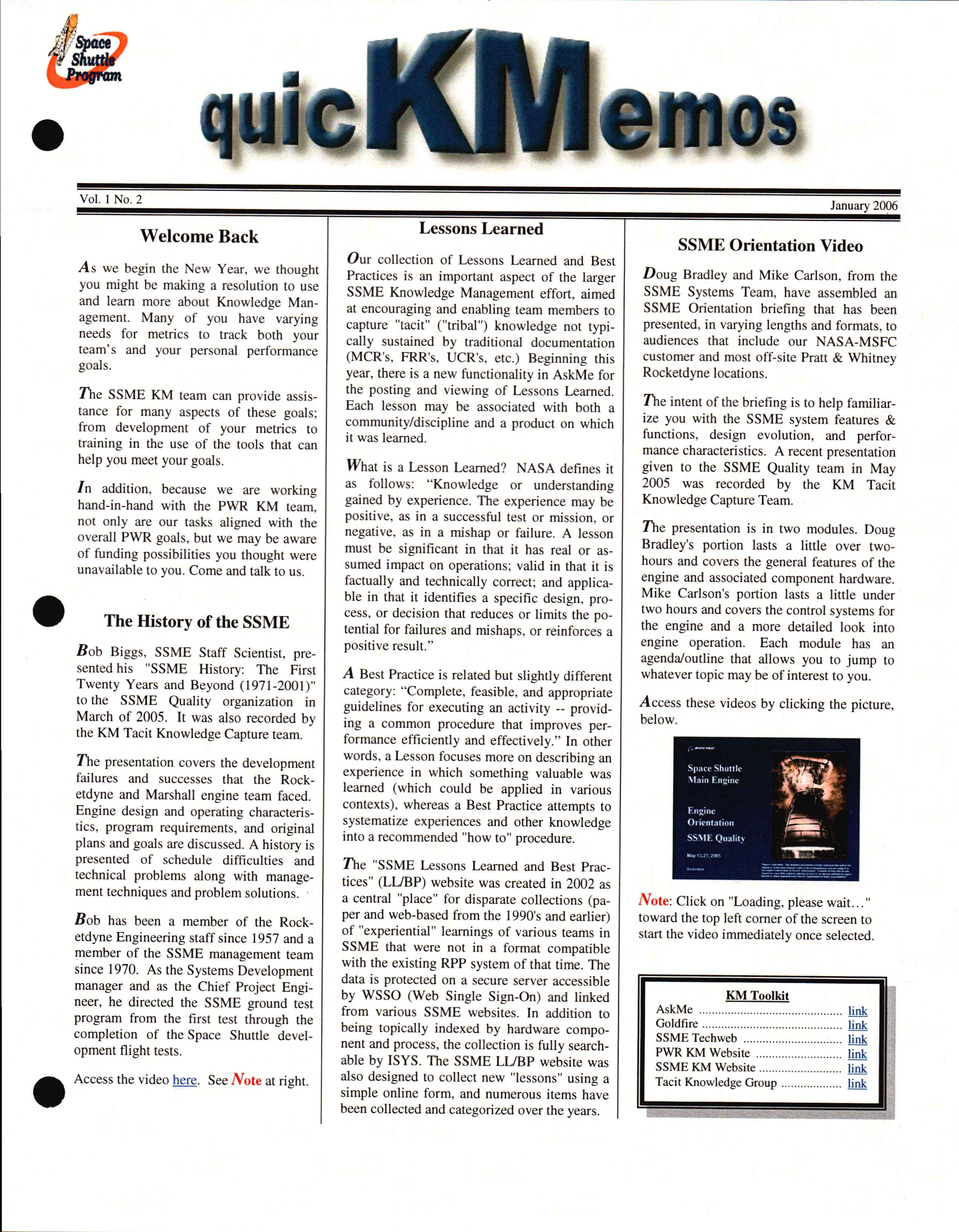
quicKMemos Vol. 1 No. 2

Here’s the second issue of the KM newsletter I wrote and published for the SSME KM team. This one was for January of 2006. The middle column has a couple of decent descriptions of “Lessons Learned” and “Best Practices.” What it doesn’t address, which is something many of us came to understand later, is that we don’t actually want “Best” Practices; which implies there won’t be any room for improvement, as “best” is a superlative adjective, which means it just doesn’t get any better than best. We, therefore, preferred to talk about “Better” Practices, which also fits rather nicely into the philosophy of continuous improvement. My apologies if this is boring.


Another Newsletter

At the end of 2005, I was still five years away from accepting an early severance package from Pratt & Whitney Rocketdyne and then retiring a couple years early. I don’t think the Shuttle program had yet been cancelled, so everything appeared to be full steam ahead. I had been deeply involved in developing the concept of Knowledge Management (KM), primarily to the Space Shuttle Main Engine (SSME) team—for which I was the lead—as well as for the entire organization, from its ownership by Boeing to a subsequent purchase and merger with United Technologies’ Pratt & Whitney Division.

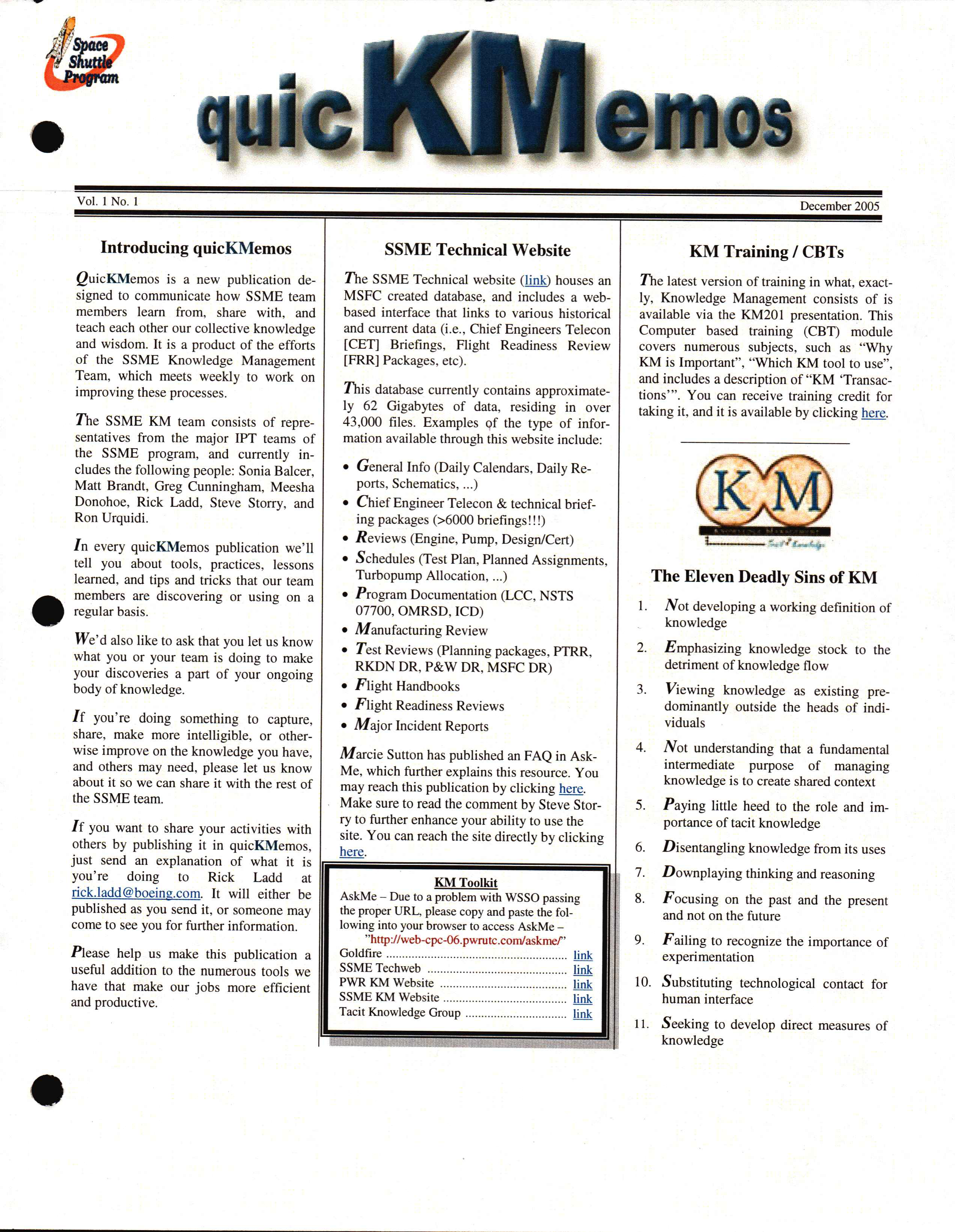
So, there were two teams I was involved with: the corporate, enterprise-wide team, and the SSME team. I had convinced my management to start the SSME team before I knew there was a corporate team, and it was my primary focus of attention at the time. Starting in December of 2005, I published a newsletter for the team; a KM newsletter, ostensibly by the SSME KM team for the entire SSME program team.

When I returned to work for a couple of years at Rocketdyne in 2015, I was able to find pdf files of every issue of that newsletter, which we called “quicKMemos.” I’m am converting these pdf files into png files so I can upload them here. I’ll post them somewhat sporadically, no doubt, as I have several duties and obligations that are always tugging at my sleeve and demanding my attention. So . . . here’s the first one; Vol. 1 No. 1, December 2005.

NB – Check out the Eleven Deadly Sins of KM. They still seem relevant to me, though it’s hard for me to tell as it’s been nearly 10 years since I’ve been in a large enterprise environment.


The Strategic Complexity Framework – for Dummies

Based on a post from my friend, John Husband, I came across this great article by Vinay Gupta, which simply and (I think) quite elegantly lays out an understanding of an issue I have long sought to internalize . . . but which I’m loathe to claim I actually understand or can clearly articulate. Part of the reason I’m posting this is so I have access to the two simple explanations of the framework. What follows is a bit of Gupta’s post, with a link at the end to the original.

I recently pestered my friend Noah Raford to summarize his understanding of Cynefin and complexity in a single page document. Noah called it the Strategic Complexity Framework.

I, being still a bit dyslexic, can never keep the “simple, complicated, complex, chaotic” thing from Dave Snowdon‘s Cynefin framework straight in my head. And I think about complexity as having three domains (but that’s another story.)

So I’ve taken advantage of open licensing to produce a version of Noah’s Strategic Complexity Framework, called the Strategic Complexity Framework… for Dummies.

A translation guide:
Simple (= Simple): put stuff in boxes.
Hard (= Complicated): build a rocket ship.
Fickle (= Complex): weather, economy, farming.
Borked (= Chaotic): war zones, collapses, volcanos.

There’s a ton of great work out there on the background to all of these models, but I have conveniently filed knobs off. Simple!

Source: The Strategic Complexity Framework – for Dummies | The Bucky-Gandhi Design Institution


Just A Little Reminder To Me

Sometimes I forget the work I’ve done. I mean . . . it’s over, lessons learned have been internalized and generalized . . . time to move on to something else, right? So I move on. My entire career has consisted of learning, sharing, and moving on. I’ve known people who held onto their knowledge like a life vest, scared silly for anyone to even know precisely what they do or how they do it. In my corporate experience there’s a phrase that perfectly embodies that kind of attitude: “Knowledge is Power.”

I’ve never agree with that concept. In fact, when I was doing Knowledge Management work for Rocketdyne, I used to say “If knowledge is power, then knowledge shared is power squared.” Unfortunately, becoming a sharing and learning organization requires a major cultural change and — especially in aerospace and other conservative industries — change is difficult to effect; certainly not within a short window of time.

At any rate, I was looking at the blog and web sites I am an admin for and realized I had written a couple of blog posts for a local business that was a client of mine for a very short while. I thought I would share it, only because I want to preserve as much of my work as possible. I want this in large part because almost everything I did at Rocketdyne is the intellectual property of the organizations that were the mother ship for Rocketdyne in the over two decades I was there.

I have a few presentations I did that are on SlideShare, but they don’t come close to the amount of content I produced over that time, and that includes a couple of years worth of monthly newsletters that were researched, written, and published almost entirely on my own. I even did the graphics for them. As I said, I don’t own them and, frankly, they were written for my colleagues and much of it wouldn’t make a great deal of sense to anyone outside the organization. Nevertheless, it’s a bit sobering to know you did a lot of work you cannot now take credit for . . . at least not easily. What follows is the blog post I wrote for Choice 1 Cleaners.


Your Tortured Garments

Red Wine Stain on White Blouse

Oops!

Many things in this world are a lot more complex than first meets the eye. Dry cleaning happens to be one of them. Actually, when it comes to today’s garments, any kind of cleaning is far more complex than one might imagine. This isn’t true of all garments, but it is true of garments in general.

Take, for instance, the variability in both materials and the things that stain them. There are basic differences, e.g. fabrics are made out of plant-based (cotton, linen), animal-based (silk, wool, leather), or synthetic (polyester, acrylic, nylon) materials. Stains come in different varieties as well; they’re either plant, animal, or synthetic. Proper cleaning requires an appreciation of the science involved when trying to remove those stains without harming the fabric.

In addition to the variations in material and the things that stain them, consideration needs to be given to the method of construction and the existence of adornments or embellishments, such as pearls, beads, chains, etc. Each of these creates different challenges that need to be addressed before the garments they’re attached to can be safely cleaned. Some require gauze to be hand-stitched over them in case they come loose. Some designer clothing can contain materials that need four to six different treatments to be thoroughly cleaned.

In order to get your garments truly clean – as clean as you expect them to be – we need to test spots as well, many of which you aren’t aware exist. For instance, sweat, alcohol, and perfume stains may not show up for a while. Your skin’s oils may leave stains you don’t notice either. However, when we clean your clothes we will discover them.

Rest assured, no matter how difficult the challenge, our mission is to clean your garments so they look and feel brand new. We can’t do much about the effects of time, but we can do an awfully good job removing the things that get on your clothing and render it stained and dirty. We pride ourselves on being the best and we think you’ll agree we are!


The Consequences of NOT Seeing Systems

Senge on Seeing Systems

Want to understand Systems better? Check out Peter Senge, Russell Ackoff, W. Edwards Deming, or just search Google for some info

When I first started this blog, one of my goals was to bring a systems perspective to my posts. Circumstance made that goal a bit difficult at times, and my interests are a bit too eclectic for me to stay in a single lane, but it is a perspective I feel most comfortable with and believe is useful in understanding the world and human society and relationships.

It’s long been clear to me that many people haven’t the faintest idea how systems work and how not understanding the interplay of their aggregate parts makes it virtually impossible to make quality, informed decisions.

In order for democracy to be spread and actually implemented in ways that are meaningful to ordinary people (who are often really afterthoughts to our institutions and those who lead them) I am convinced we need to become not merely critical thinkers, but also “systems thinkers”, i.e. we need to learn how to “see” systems. We, meaning “the people”, need to recognize how all things are parts of systems and that smaller systems are parts of other, more encompassing systems. Whether closely or remotely, we need to recognize how things are related to each other, such that we can appreciate the ways in which they affect and sometimes transform each other.

When this happens without our fully (or even partially) understanding these effects, we call them “unintended consequences.” However, these generally come about not because we failed to appreciate their possibility, but because we didn’t even see how they were related. It is our ignorance — in the non-pejorative sense — that’s causing us harm, because we just don’t see the subtle interplay of forces or the way they interact with each other. I plan on continuing to touch on this subject, as well as the other things that interest me. Stay tuned!


Restarting A Knowledge Management Program

Tseng College at CSUN Logo

My Alma Mater

I received my Master’s degree in Knowledge Management from the Tseng College of Extended Learning at California State University Northridge (CSUN) in 2009. Shortly afterward, the University decided to cancel the program. Recently, I received a request to participate in a survey being used to determine if it was time to reinstate it.

 
As a result, I not only took the survey, but also shared some of my thoughts about the program and its importance. Today I am meeting with the person at CSUN who is leading the effort to make the determination of whether it’s worthwhile to start up again. I also expressed my interest in teaching a class or two.
 
I’m still quite convinced (at least my interpretation of) Knowledge Management is an important part of how organizations can make the most of what they know and how they use it to further their efforts. It may need to be re-branded, as KM seems to be a term too loaded with baggage, especially the concept of “managing” knowledge. Frankly, I’m not sure, but I’d like to be part of the conversation.
 
I’m not expecting much, but it would be nice if they brought the program back and, even better, if I can play a role in making it truly meaningful and relevant. Far too many think of it as something like library science on steroids . . . and I think that characterization misses the point. I’m of the opinion connecting people day-to-day is far more important than developing a repository of lessons learned and better practices. Not that they aren’t necessary; I just believe facilitating continuous conversation aimed toward more useful collaboration and greater innovation (especially wrt internal processes) holds more promise for most organizations.

Empathy: The Core of Complex Decisions

Having worked with Dr. Pratt and her company, Quantellia, I have long been convinced their approach to decision making is one of, if not THE, best methodologies I’ve encountered. After what I consider to be one of the most disastrous general elections in my lifetime, it would seem we need help in navigating the complexities of the world and our place in it. Lorien’s work can, I believe, help us understand the consequences of our decisions, before we make them. I urge you to watch this video and become more conversant in the issues Dr. Pratt raises. What follows below the video are some of the “liner notes” that go with her TEDxLivermore talk.

Making decisions based on invisible inputs is like building a skyscraper without a blueprint. Yet that is the norm, even for very complex problems. Contrary to how most of us think about making a decision as being the act of choosing, a decision is the last piece of a long, almost completely invisible, process. The good news: it is possible to make the invisible part of decisions visible.

In working with the Community Justice Advisor Program in Liberia, Africa, Lorien and colleagues helped The Carter Center (founded by Jimmy and Rosalynn Carter) use decision models to increase positive outcomes in the domain of civil justice, by identifying the most effective levers for change.

Using deep learning artificial intelligence, the interconnections between inputs become visible, and unintended consequences can be identified before implementation. Vicious cycles can be reversed, and virtuous cycles of improvement can be built in place and nurtured through intelligent decision metrics.

As co-founder of Quantellia, Dr. Lorien Pratt co-created the decision intelligence methodology and the company’s award-winning World Modeler™ software. She consults and speaks worldwide, and is known for her neural network research and the book Learning to Learn. A former college professor, Pratt is widely known as the former global director of telecommunications research for Stratecast, a division of Frost & Sullivan. A graduate of Dartmouth College and Rutgers University, Pratt holds three degrees in computer science. She received the CAREER award from the National Science Foundation, an innovation award from Microsoft, and is author of dozens of technical papers and articles.

This talk was given at a TEDx event using the TED conference format but independently organized by a local community. Learn more at http://ted.com/tedx