Forty years ago I was working for a litigation support firm in a high-rise in Century City. I heard about the Challenger exploding and rushed down to the bar & grill downstairs, where I knew they had a television.
Little did I know that a year later, almost to the day, I would begin working as a temp on the Space Shuttle Main Engine program, where I mostly did data input on the FMEA/CIL document (Failure Mode and Effects Analysis/Critical Items List) prior to the shuttle being certified to return to flight.
A year after that I was hired in as a regular employee. I accepted an early severance package and retired 23 years later. I’ve never lost track of the reality that such a tragedy turned into the best job I’ve had in my life. I still mourn the loss of those seven brave souls who were lost that day.
Rest in Peace:
Francis R. “Dick” Scobee (commander) Michael J. Smith (pilot) Ronald E. McNair Ellison S. Onizuka Judith A. Resnik Gregory B. Jarvis Sharon Christa McAuliffe.
Sometime in late January of 1987, almost one year to the day after the Space Shuttle Orbiter Challenger was destroyed as it ascended to orbit, I was assigned by the temp agency I was using at the time to begin work on the Space Shuttle Main Engine team at Rockwell International’s Rocketdyne Division in Woodland Hills, CA.
Prior to that fateful date I had, with one exception, never worked at a company with more than a dozen employees. My family’s wholesale food business, at its peak, was only my father, brother, me, and one employee and most of the numerous jobs I had held over the previous 20 years or so were similarly small.
Rocketdyne employed several thousand people, most of whom labored at our campuses in Woodland Hills and Canoga Park, CA. It was a division of Rockwell International, which employed over 100,000 people world-wide. It was a jarring transition to go from small (really small) businesses to a multi-national aerospace conglomerate. However, having been somewhat of a space-cadet, i.e. enthusiast most of my life, I was thrilled with the opportunity.
A year later on 1 February 1988, I was hired to work in Engineering Computing on the Flight Ops team – a position I would not have dared to dream of filling. Nevertheless, there I was helping our nation’s space program get back on track. It was truly a dream come true.
At the same time, I was becoming aware of the unique way in which large organizations conduct themselves. Some of it wasn’t pretty. I first encountered the business philosophy of W. Edwards Deming soon after I was officially hired as I was lucky enough to have a colleague who was a student of his. Deming had written a book (he wrote many) in which he laid out a fourteen-point explication of his concept of TQM (Total Quality Management).
I was enamored of his positions, as they coincided with my growing understanding how things worked in virtually any organization. I had long been someone who looked for and found ways in which to improve the processes and procedures of any organization I was involved with, and Deming’s philosophy made a great deal of sense to me.
At the same time, I was becoming increasingly aware of the reality that many companies, including Rocketdyne, were honoring those principles in their breach, not their adherence to them. As I was studying Deming’s 14 points I began to realize just how thoroughly many of the managers I encountered were oblivious to the virtues Deming laid out.
Somewhere around 1990 I decided to see if I could capture the differences between what Deming offered and how Rocketdyne was actually doing things. I captured Deming’s 14 points and then created Rocketdyne’s 14 counterpoints. I’ve kept them over the years and am here sharing my understanding with two screenshots of those differing points of view. Please keep in mind not all managers were as controlling as the worst of them. I was lucky to work under the supervision of several truly wonderful managers in my nearly quarter century of employment there. Regardless, I think my analysis was reasonable, even after over 34 years. You?
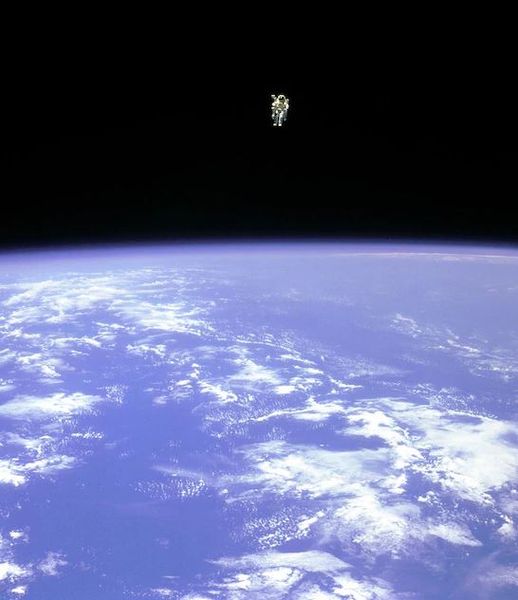
This photo is often shared and referred to as a “frightening picture”. From the first time I saw this (which happened 40 years ago this Feb. 7) I found it both thrilling and a testament to what human ingenuity can accomplish. To me it also represents how, despite his apparent loneliness in the vastness of space, it took his crew, the NASA team below, and thousands upon thousands of people to make that one act happen.
It should be noted that another astronaut, Bob Stewart, completed a similar mission while both of them were aboard Challenger, flying mission STS-41B. There does not seem to be a photo of Stewart’s space walk.
He may look lonely out there, but the reality is he’s a member of a huge team of fellow humans who make such a feat possible. I suspect that’s true for just about all of us if we’re to be successful.
I must confess to being a bit of a pack rat, primarily with papers and a few collectibles or mementos. For instance, I have official NASA mission patches for all the Mercury, Gemini, and Apollo missions, as well as numerous patches for significant events and test activities, including for Vandenberg launch facilities that were never built. I also have two commemorative seat cushions from sporting events I attended; Superbowl XIX, between the San Francisco 49ers and the Miami Dolphins, and the 1981 World Series between the Los Angeles Dodgers and the New York Yankees. I don’t remember which game of the WS I attended, but it had to be either 3, 4, or 5 since it was at Chavez Ravine (Dodger Stadium).
Recently, I came across a binder I’ve had for at least forty years that’s filled with business cards neatly preserved in plastic pages specifically made for such things. I had forgotten I had it out in the garage, but I encountered it recently. Most of the cards are from either when I was in the wholesale food business with my family, or when I was in the music business pretending I knew what I was doing. SIDE NOTE: As it turned out, despite a propensity to be a bit of an asshole, I was nowhere near the kind of asshole one needs to be to succeed in the business end of the music biz.
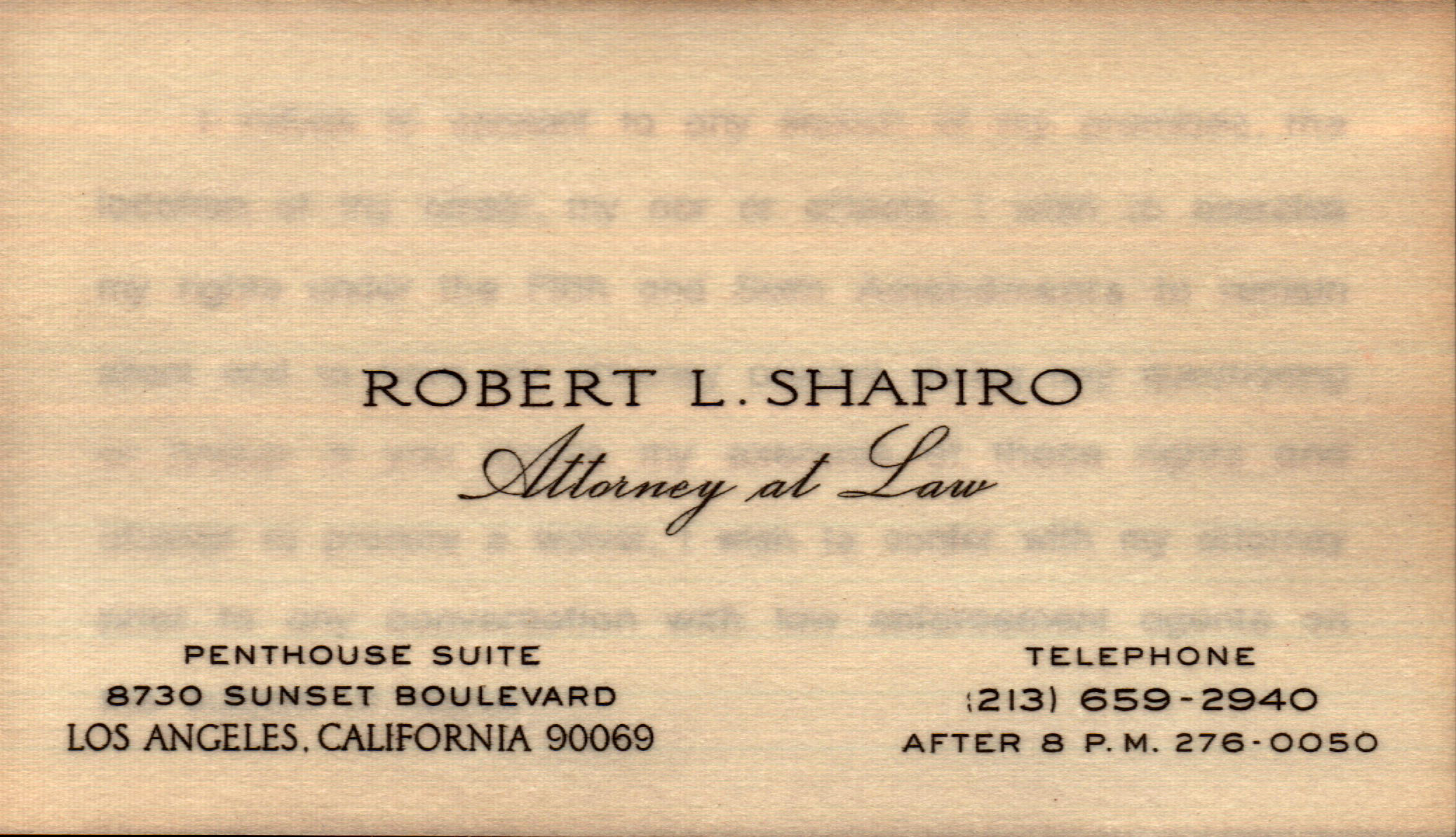
One of these cards is particularly interesting to me. It’s from the lawyer we engaged to keep a friend out of prison for possession for sale of cocaine. This is part of a much longer story which I am writing about in my autobiography/memoirs (have yet to decide the final format). A little over a decade after our engagement with this lawyer, he became far more well-known due to his representation of a famous athlete, who was accused of murder. The card is somewhat unique, as it is a parchment fold-over, with a script inside for people to use if they come under the scrutiny of law enforcement personnel. Do you remember this guy?
Yesterday I noticed I had a voicemail from late Friday. It turned out to be from someone at PRO-Unlimited, the organization that handles temps for Aerojet Rocketdyne. She said she was calling about the position I interviewed for a week ago last Thursday. I won’t know for sure until I can return her call tomorrow, but I’m pretty sure this means I’m getting the job I really wanted.
I’m beyond excited to think I may return and work on the same engine (RS-25, formerly the SSME) I worked on for over 20 years and that it will once again be hurling humans into space.
Jordan Spieth at the 149th playing of the British Open
I watched the last two rounds of The British Open at Royal St. George last month. One one particular hole there was a large bank of wind turbines visible in the background. I thought of how some people complain that wind turbines are a blight; that looking at them is disturbing, in-artful, etc. However, knowing they are contributing to the long-term habitability of our planet, I’m fine with it. In fact, it’s beautiful. It’s reminiscent of how I, and many artists, envisioned the worlds of science fiction.
An Artist’s conception of a space habitat
While much of the artwork to be found in science fiction can be pretty dystopian, there are also a lot of concepts that are truly beautiful and evoke human capabilities far beyond those we’re able to employ nowadays. This is especially true of artwork depicting habitats built to exist in space. Like the art depicted above, these habitats are invariably curved, since a “station” that slowly rotates around a central axis will create a gravitational simulation that should suit the human body as much as “real” gravity on our home planet.
At least, that’s what I think would happen. Nobody’s done it yet, though I believe the science is pretty sound. It’s conceivable to me this future awaits us; surely not in my lifetime, but within the next hundred or so years. That being the case, I find it easy to put up with a bank of windmills off in the distance. The reality is, if we’re ever going to be a space-faring world—I mean really able to move off the planet—we first have to ensure Earth remains reasonably habitable … and we don’t seem to be doing a very good job of that right now. More about that later.
Alan Watts suggested that belief is stagnant and unyielding to change, whereas faith is open and accepting of what is. I often say I have faith the universe is unfolding just fine no matter what any of us believe. We are such insignificant little tubes of matter, constantly ingesting, inhaling, and absorbing stuff that isn’t us, then exhaling, excreting, and sloughing off that which once was us but is now something else. We exist for a moment, comparatively so brief as to be virtually non-existent to anything but our pitiful little selves. Calm down and enjoy the ride. As Jim Morrison said, “No one gets out of here alive.”
I was raised in the San Fernando Valley. Sputnik 1 was launched exactly four months after my 10th birthday. I remember lying outside on our front lawn, watching it go over. It was exciting and mysterious at the same time. I have a vague memory of seeing the United States’ first satellite, Exlorer, go over and I have a real vivid memory of seeing Echo as it orbited our planet. Echo was a giant aluminum balloon that, when inflated in orbit, was 100 feet in diameter and reflected the Sun, making it the brightest object in the sky except for the Moon.
I also have vivid memories of rocket engine tests in the Santa Susana mountains, just slight northwest of where I lived. Many of the tests were conducted at night, and I could see the sky light up over those mountains. As I grew up, I had friends whose parents worked at Rocketdyne, the company that built just about every liquid-fueled rocket engine used to power America’s space program, including Mercury, Gemini, and Apollo, not to mention the Space Shuttle.
Little did I know that many years later I would, quite serendipitously, get sent on a temporary assignment to work at Rocketdyne. I had been working at a company that manufactured what were, at the time, high density hard drives. This was in 1986 – 1987, and high density meant something like 5 Gigabytes! It was, for some reason I still can’t quite fathom, a seasonal business and when demand dropped all the temporary employees got laid off. That was me. I lost my job on a Friday. Later that evening I got a call from Apple One, the organization I was temping through, telling me to show up at Rocketdyne’s Canoga Park facility the following Monday.
To make an exceedingly long story short, I started work on the FMEA-CIL (Failure Mode & Effects Analysis-Critical Items List) the document that would prove Rocketdyne’s RS-25, SSME (Space Shuttle Main Engine) was safe for the Shuttle’s return to flight almost a year to the day after Challenger exploded during the ascent of STS-51-L. (For clarity, I think it important to note those engines were not responsible for the loss of Challenger; they had worked just fine.) I had long been a space cadet (in far more ways than one) but I never imagined I could end up working there, as I wasn’t an engineer. Silly me. I just hadn’t realized it takes a lot more than engineers to run a business that large and complex.
I was hired in after a year as what they referred to as a “job shopper.” I was forty years old. I retired 23 years later and it was the best, most fulfilling job I ever had, though dealing with a huge corporation (and “the Rock,” as we called it, was part of Rockwell International, the Boeing Company, United Technologies’ Pratt & Whitney Division, and Aerojet) was why I left early. The Shuttle program was winding down and P&W offered everyone over 60 a severance package I just couldn’t refuse, even though it wasn’t terribly generous.
Nevertheless, I’ve remained deeply interested in space exploration. I have long believed it’s important to the survival of humanity we get off the surface of this planet. I believe we need to establish not merely a scientific, but also a cultural presence off-planet in case of an extinction-level event. Frankly, it’s my opinion if we don’t do something about climate change and our contribution to it, we may be the ones causing such an event.
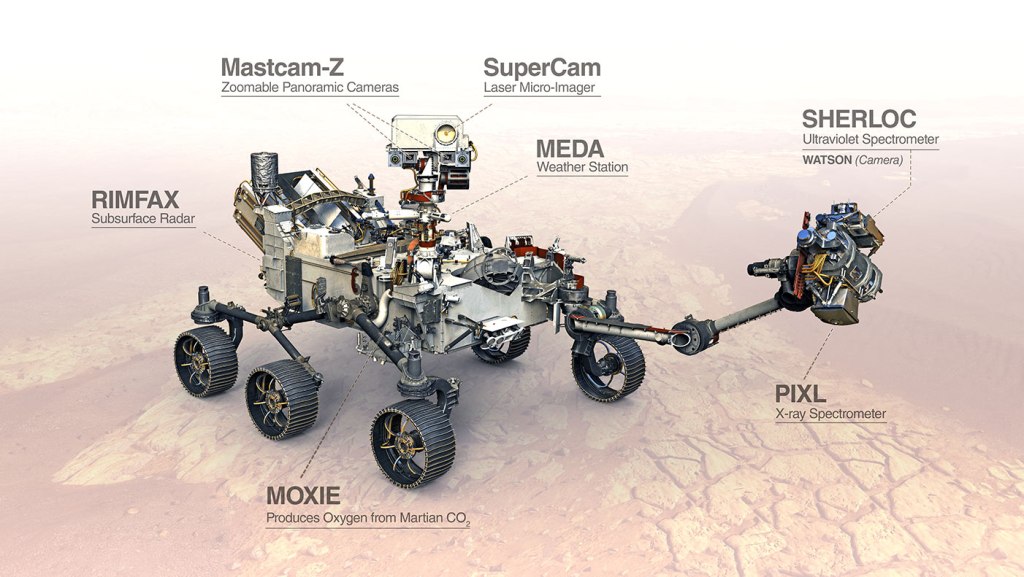
At any rate, all this is to say I am happy Perseverance landed safely on Mars this afternoon (PST) and appears to be functioning as designed. I’m looking forward to learning more about the Red Planet. I’m especially keen on learning how well the Moxie instrument (see graphic, below) accomplishes its mission of producing oxygen from Martian CO2. Congratulations to JPL and the Perseverance team. Job well done!
PS – I’ve also posted a graphic depicting one of Perseverance’s scientific missions, the Ingenuity helicopter which, if successful, should dramatically improve our ability to send rovers to the most fruitful (scientifically) locations, after they’ve been scouted out by Ingenuity and its successors.
Thirty-four years ago next month I showed up for work at Rockwell International’s Rocketdyne Division. Having grown up in the San Fernando Valley in Southern California, I was familiar with Rocketdyne, as during the Mercury, Gemini, and Apollo programs the rocket engines they made, which powered the vehicles used to launch our astronauts into space, were all designed and manufactured not far from where I lived.
The factory was in Canoga Park, but the engines were tested at the Santa Susana Field Laboratory, which was in the hills to the west of my home. I have vivid memories of seeing the night sky light up and hearing the roar of those engines as they were being tested. I also remember going out at night and lying down on our front lawn to watch Sputnik 1, the world’s first artificial satellite (launched by the Soviet Union on October 4, 1957) go by overhead. I was ten years old at the time.
While these experiences didn’t cause me to pursue a career in engineering, they did serve to pique my interest in astronomy and space exploration. They also had absolutely nothing to do with my ending up working at Rocketdyne. My beginning there was entirely serendipitous. I was working for the temp agency, Apple One, where I had been temping at a hard drive manufacturer called Micropolis. Their business model, perhaps the industry itself, was somewhat seasonal and work for temps was boom and bust there. As had happened many times before (we’d heard about it and weren’t surprised when it happened) business slowed down and they decided to lay off the temps, who comprised the majority of the workforce.
That was on a Friday. That evening, my contact at Apple One called me and asked if I could show up at Rocketdyne the following Monday. I don’t remember the exact date, but it was in the middle of January, 1987, almost exactly a year after OV-099, Space Shuttle Orbiter Vehicle Challenger, exploded as it was ascending to orbit, killing all seven crew members.
I was to turn 40 years old later that year and of course I would show up. I needed to work. However, that it was Rocketdyne I was to show up at was something of a bonus, as far as I was concerned. I had known people who worked at Rocketdyne over the years, and it never occurred to me I could work there. I wasn’t an Engineer or a Scientist. I didn’t even have a college education, though I did have a Juris Doctorate, which I had earned eleven years before. I was the only person in my law school without a baccalaureate. None of that mattered as a temp (or what they called a “job shopper”.) They didn’t ask anything about my background or my capabilities. They just needed a warm body who could perform data input.
So, that following Monday I showed up to work at the plant on Canoga Ave. in Canoga Park. I had never worked at a really large organization before. In fact, with the exception of the temp job I had previously been working at, I had never worked anywhere that had more than a dozen or so people. Most places I’d worked only had five or six, at the most. Rocketdyne had armed guards at the gates. There were at least four entrances guarded by men with guns. It was actually a bit heady.
I ended up hiring in a year later and worked there until May of 2010, when I accepted an early severance package offered to everyone over the age of 60. I turned 63 the next month, June. I’m writing several memoirs, and my time at Rocketdyne will play a big role in at least one of them. However, my purpose here is merely to introduce one of the “awards” I received when I worked there.
I was not a big fan of individual performance awards, believing they tended to pit people against each other when, in fact, we needed to find ways to improve our collaborative and collective abilities. This particular award was given to each of the members of the Space Shuttle Main Engine High Pressure Fuel Turbo-pump team, who labored mightily to manufacture, test, and deliver 10 additional pumps for the program when Pratt & Whitney was unable to certify their alternate design. As our contract ran out, and we knew there would be no new business, the team had to wind down and members had to find other places to hang their hats.
You should note that everyone on the team received one of these shadow boxes, with a flag, a turbine blade, several mission buttons, and these inscriptions (see below.) I’m including the back, because our managers took the time to personally thank each person on the team; there were well over fifty, if memory serves. This “award” hangs in my home office. This coming May it will have been 20 years since I received it, and I’m every bit as proud of it now as I was back then. Plus … how often do you get to have a piece of rocket engine hardware and other space memorabilia?
PS – In case you don’t get to it (it’s on the back of the shadow box) that turbine blade traveled a total of 27,600,000 miles, mostly doing nothing after MECO (Main Engine Cut Off) on each flight.
PPS – Just to be clear, in these two photos (below) I’ve superimposed the award (from the front) on a picture of a shuttle night launch. It has a glass door, which I opened because it’s reflective and I didn’t want that in the photo, and digitally removed with Photoshop. I’ve separately added the two pieces of text from the back, without including the box, and superimposed them on that same night launch photo.
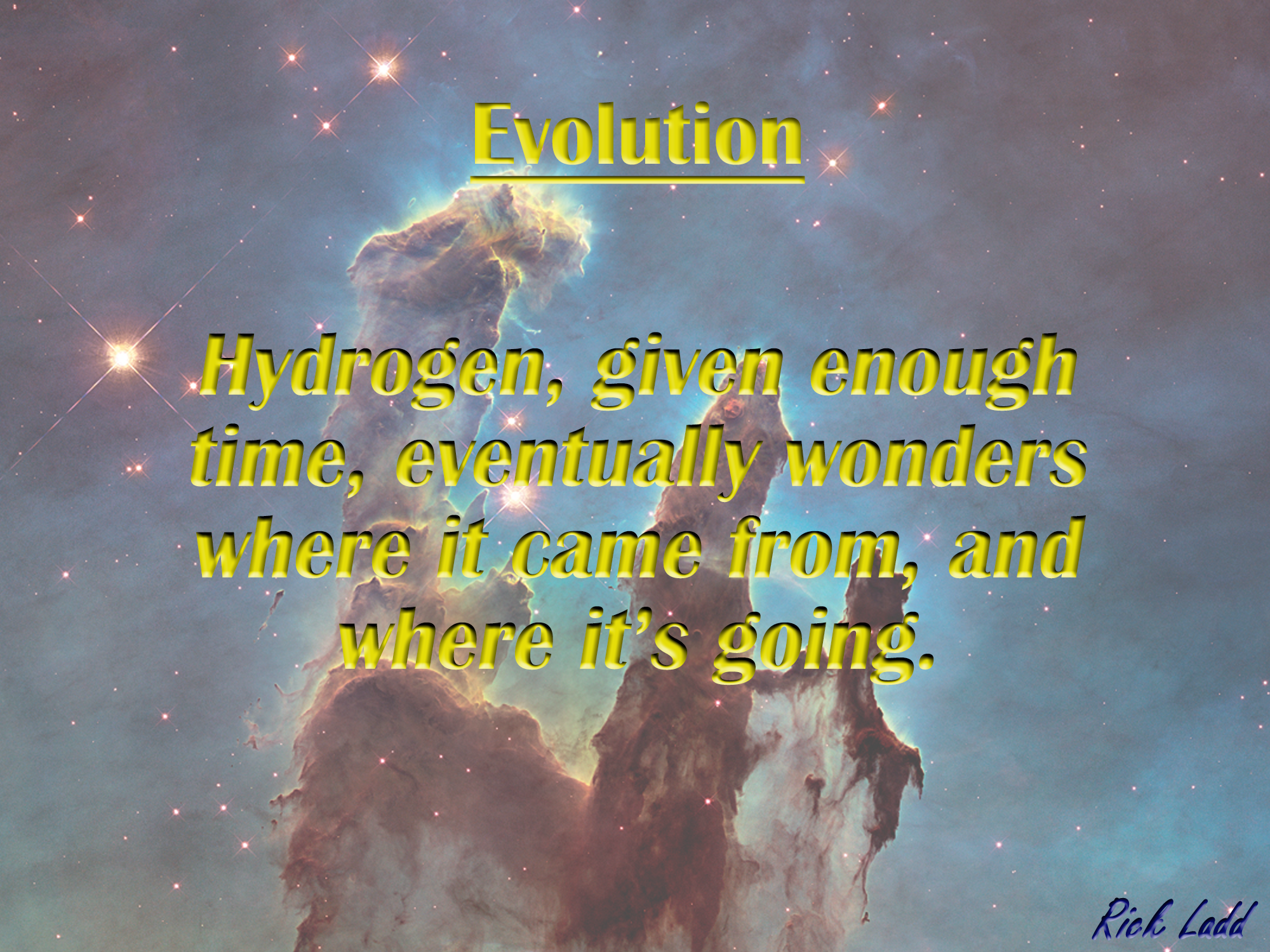
Another quite simple Photoshop effort, though all this is is a compilation of a quote I’m fond of and a photo of what is referred to as the pillars of creation, located in M16, the Eagle Nebula, over thataway.
The Pillars of Creation
If you study cosmology, and you’re not blinded by any particular religious dogma, it becomes clear that our evolution as a species (the human one) draws a gravity-assisted line from the first hydrogen atoms to who we are now. That we have reached a point in our evolution where we have been able to understand how we and our universe came about and developed over billions of years, I find every bit as awesome as the thought of some bearded white dude thinking us up out of nothing. Actually, I find it more awesome.
Understanding cosmological (read, primarily, stellar) as well as biological evolution is, to me, far more beautiful and compelling than anything I’ve learned from all of the world’s religions, including the one I was raised in (Judaism) and the one I was surrounded by (Christianity). I find it far more compelling and reasonable and, again for me, all the proof I need that we don’t need a “God” or “Gods” to explain how we came to be and where we’re headed.









 Systems Savvy