There’s a little sort of game going on in Facebook lately. Someone is challenged to list three things they’re thankful for for seven days, at the same time tagging a friend each day (or something like that) to do the same. I haven’t been asked to do it, and I have no plans of doing it either, as it just seems too spread out and broad to do justice to the recognition of those things we might be thankful for. Nevertheless, it does give me pause and I have been thinking about what I would say should I choose one or two specific things for which I’m thankful. There is one seemingly mundane thing that keeps popping into my head. My ability to type.
I can’t imagine how different my world would be if I had to use what an old girlfriend of mine called the “search and destroy” method of typing. Most people use the more pastoral term “hunt and peck”, but she spent several tours with the USO in Vietnam and her life was colored by her exposure to that war, the military, and her involvement in the movement to end it. If I were hampered by that inability, my social presence and my ability to communicate would be virtually non-existent.
I was fortunate. In Junior High School I took a typing class; instead of what I haven’t the faintest, but I recall it seeming to be the most useful option at the time. As a result, I learned to touch type. Later on, when I was in Law School, I secured a position as a legal secretary for a sole practitioner who did a lot of contract and property damage work for several of the largest car rental agencies in the country. We were very busy and my workload was challenging enough that my speed increased. I’ve never been as prolific as the best, but I was up to a little over 80 wpm, with few if any errors. That’s not quite as fast as the average person can speak, but it’s a respectable clip.
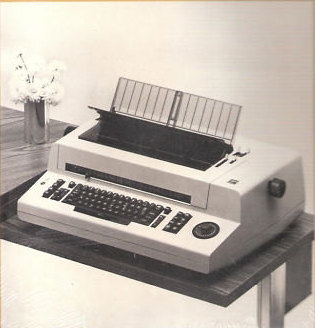
The IBM Memory Typewriter
The job turned out to be a major turning point in my life, as I was introduced to the early stages of office computing and word processing. We ended up getting an IBM Memory Typewriter, the one built on the correcting Selectric, but with a dial providing memory for 50 separate pages. We moved up shortly to an Artec Display 2000, which used two 8″ floppies and had a scrolling display of approximately 30 characters. I don’t remember if it was LED or LCD, but the characters were red. We used it for pleadings, and wills and trusts.
Back to typing speed and how critical it is to communication in today’s world. I don’t really have to imagine what it would be like, because I had an experience with a colleague that pointed it out rather clearly, though it took months for me to recognize what was happening. I was working with the Director of our newly formed Program Management Office at what was then the Rocketdyne Power & Propulsion business unit of The Boeing Company. We were at almost opposite ends of the main office building in Canoga Park and I was upstairs in what was called The Annex. The distance between his office and my cubesickle was around 400 yards; not a huge distance, but it took time to walk back and forth. Plus it meant passing through the Executive Office area and there were always distractions.
I can’t recall the exact dates, but it was very early in our use of Instant Messenger; so early that I had to point out its value, as most of the older staff (which meant all of the Executives) perceived it as only a toy their kids used to communicate with each other. I kept sending IMs to this Director, but he never answered them, nor did he respond in anything resembling a timely manner to emails, so I was forced to walk to his office repeatedly during the day.
It wasn’t until a couple of months had passed that I happened to be sitting with him in his office and he was answering an email. Watching him type . . . ever so slowly and painfully . . . made it clear why he never responded to me. He had to hunt anew for each letter and, with his two index fingers, peck them out in a long, excruciatingly difficult session. He clearly hated it. I know I was cringing as I watched. I never sent him an IM after that day.
I’m thinking the ability to type is one of those essential tools we seldom think about — perhaps take for granted — without which our world would be far less rich and fulfilling. I can type this post, tweet, post to Facebook, engage in lengthy, spirited debates with dozens of widely dispersed people, and participate in a plethora of other forms of communication or collaboration relatively easily, all because of my ability to type quickly and accurately. I imagine this is true for almost all, if not all, of my friends and acquaintances.
I saw a video yesterday of a dog figuring out how to drink from a device set on the ground. It had to be stepped on and held down, but the dog would stomp on it a few times before finally standing on it to keep the water flowing. It reminded me of one of my favorite stories.
Many years ago, when I first started working at Rocketdyne, we had a couple of buildings on the other side of Canoga Ave. from the main office and factory structure. People were always having to cross the street and there was a controlled crosswalk there for that purpose. I was always amazed to find engineers repeatedly pushing the button (like this dog’s doing) to get the light to change.
I kept thinking – though I never said it out loud – “you know that’s a switch, not a pump.” It might be expected of the dog; but, rocket scientists? Maybe they were accountants.
Farewell, Beth. You touched a lot of lives and will be sorely missed
I posted the following on Facebook two days ago and I want to share it here as a tribute to my friend and former colleague:
I am beside myself with grief. A couple hours ago I received a message from a friend who wanted to confirm what he had heard – that our former colleague and good friend, Beth Thompson, had passed away. I started frantically contacting as many people as I could think of, all the while hoping it was just some stupid Internet screwup. It was not to be. Apparently, while preparing to leave for work this morning, Beth suffered a heart attack and passed.
Beth was one of my first friends when I joined the Program Office on the Space Shuttle Main Engine program at Rocketdyne. Her good humor and iconoclastic attitude helped me ease into the corporate world, a world I didn’t join until I was 40 years old, and was ill-suited for. Along with many others I’m proud and happy to still call good friends, Beth was family. I still have the card she picked out for me and had everyone sign when I left for what turned out to be a short stint back in my family’s business. That was about 17 or 18 years ago.
She moved up to the Seattle area with her husband, Paul, and their three children, where she continued to work for Boeing, one of several major players that passed Rocketdyne around like a financial hot potato. This is tough to digest. My kids have seen me cry for the first time in their memory. People who are younger than you aren’t supposed to die before you do. It’s just not right.
We hardly saw each other in the past few years, but we liked and commented on each other’s FB posts now and again. At least I knew she was there and I got to see a little bit of her life and happiness. That is now gone and my world is poorer for it. Goodbye, Beth. I love you and will always remember how you brightened my world and the world of so many others.
Funny how some things seem — given enough time — to come full circle. Although I have always seen patterns and complexity, as well as the intricacies of their interplay, I wasn’t introduced to the concept of Systems Thinking until I worked on the Space Shuttle Main Engine program at (what was then) Rockwell International’sRocketdyne division. That introduction included being exposed to the thinking of Dr. Russell Ackoff, a recognized authority in the field. I was fortunate enough to spend some time with him, twice in Philadelphia, prior to his death in October of 2009.
Shortly after retiring from Rocketdyne in 2010, I was introduced to Dr. Lorien Pratt of Quantellia, LLC, who showed me a tool her organization had developed called World Modeler. I was excited at what I saw and hopeful I could somehow become involved with Dr. Pratt and her team. However, that was not to be at the time. I was provided the opportunity to more thoroughly investigate the tool, but I had made a conscious choice to refamiliarize myself with Apple products (after over two decades of living in the PC, DOS, and Windows environment) and World Modeler was not written to be run on a Mac. Furthermore, the PC laptop I had wasn’t powerful enough to do the math and drive the graphics required for running models in real time. I was hosed.
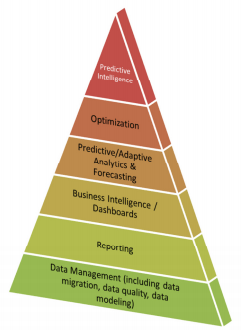
Decision Intelligence Technologies
Finally, about six months ago I was contacted by Dr. Pratt, who asked me if I wanted to assist in writing a paper that described an effort in which they were involved with the Carter Center. I enthusiastically said “Yes!” I’ve done a couple of other things with Quantellia since then but, beginning a few weeks ago, I took on an entirely new and (for me) exciting role as a referral partner.
Right now I’m spending a fair amount of time learning Decision Science in general, and the process and tools Quantellia uses to help organizations understand complex interrelationships and make better decisions based on that understanding. As I’m doing this I watch videos, read blogs and articles, look for original research, and work on presentations that will help me educate others in this important approach to business and organizational operations.
So . . . here’s the full circle part. As I’m looking for definitions, or explanations, of Decision Science and its origins, I Google the term. The first two hits I get are to The Decision Sciences Institute and to Carnegie Mellon University’s Department of Social and Decision Sciences. The third link is to a Wikipedia article on that same Department. In that article, there’s a link to Decision Science, specifically. However, it redirects to an article on Operations Research, which is where Systems Thinking originated. At the bottom of the page is a list of researchers under the heading “See Also”. One of the researchers, unsurprisingly, is Russell L. Ackoff. To me, that’s a combination of serendipity and years of working on better understanding how an understanding of systems can work to the benefit of any organization; actually, anyone.
I’ll be writing a lot more about Decision Science, including my understanding of some of its constituent parts, Decision Intelligence, Decision Engineering, Decision Modeling, and the power and value of our tools, World Modeler and DEEPM (Decision Engineering for Enterprise Project Management). I hope I will be able to clearly explain what it is we have to offer and, more importantly, what everyone has to gain by understanding it. The value exists independently of me or even Quantellia. We’ve just been at it for a while and can apply and employ the discipline both efficiently and effectively. Stay tuned.
Have you ever watched the International Space Station pass by in orbit? I don’t know about you, but there’s something majestic, even magical for me just watching it fly overhead. A bright object moving at nearly 5 miles a second appears very fast, even at a distance of hundreds of miles away, and it is awe-inspiring to look up and know there are humans aboard. Several years ago I remember seeing the Station, a Soyuz capsule, and the Space Shuttle all pass overhead as they moved toward a rendezvous and docking. During that mission there were something like a dozen people silently flying by far above my house.
Since my retirement from Rocketdyne, and the cancellation of the Shuttle program, my interest has drifted away some. After all, there’s nothing quite like watching a large, powerful vehicle’s engines roar to life and lift it off the pad into orbit in less than ten minutes. The Station is almost invisible by those standards. It’s already up there and it’s passage is almost mundane. There’s no smoke and fire. It’s swift, but it’s silent.
Recently, I decided to add an app to my phone so I could find out when the Station was flying overhead. Not sure why my interest returned, but it did. The app I chose is called ISS Spotter. It’s free and has everything I need to observe the station. Here are the three views I use the most, though there are settings and a help screen available as well. The first one shows the Stations position and direction of travel (along the thick yellow line) from above and against a map of Earth. It also shows (the blue dot) your location; in this case, near Los Angeles. It has a couple of other bits of functionality, but they’re not relevant to this post.
Map shows current orbital position in real time
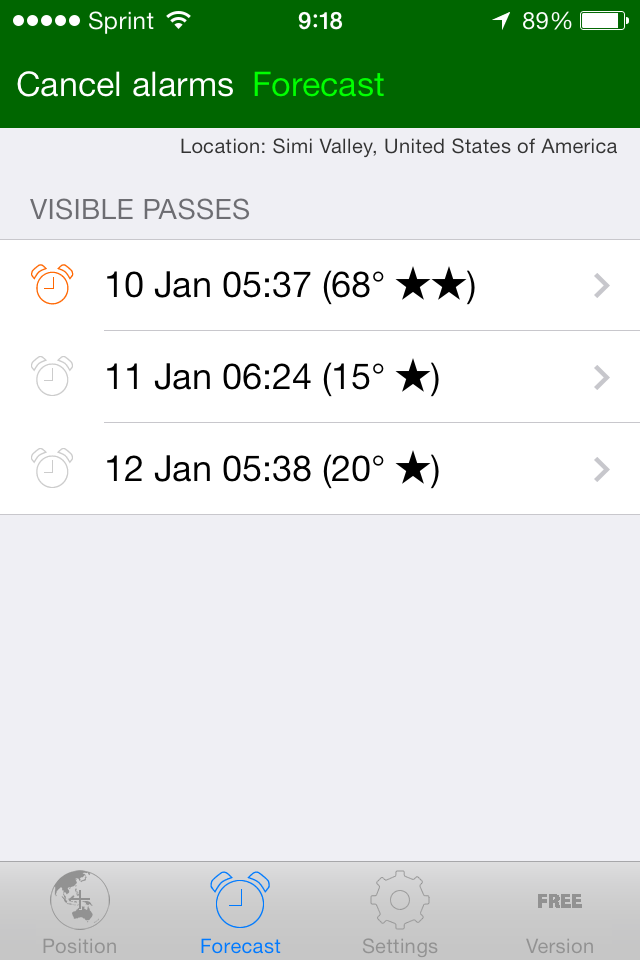
The second view shows upcoming passes over your location (which, btw, it determines automatically using your phone’s GPS, though you can also customize it on the setting page [not shown] if you know your coordinates [and you care]). I use the auto setting and it works just fine. It even adjusts if I’m somewhere else. There are other settings available for time prior to passage for alarms, minimum peak elevations, and others. There’s also a star rating to help you decide how much effort you may want to exert getting outside to view the pass. One star means a pass you might find meh, while three stars indicates even the Magi might be impressed. Note, the next one I’m planning on getting outside for has two stars. As you can see on this page, it will be at a visible altitude (at its highest) of 68° and will shine at a magnitude (visible on the third view, below) of -2.9.
Automatic listing of visible passes in next 7 days with settable alarms
The third view provides everything you need to know to actually find the station, even if you don’t make it out when it first appears. You can also see here that this pass will last a total of six minutes and thirty-eight seconds. Plenty of time to freeze your ass off if you’re anywhere affected by the Polar Vortex, which I’m not.
Compass view provides direction, maximum elevation, magnitude, and more
I had forgotten, but I got an alarm this morning just in time to go out around 0630 and watch it pass. There were two things that struck me as I stood out in the backyard. When I first spotted it, the Station was well out over the Pacific and, minutes later, it was well over Nevada as I went back inside. In the approximately three minutes I spent observing, that orbiting outpost of humanity and science traveled nearly a thousand miles. The other thing, and it happens every time I observe it silently passing by overhead, was I could swear I was able to make out her warp nacelles.
Before I go any further, I want to explain why I use only the name Rocketdyne in the title of this post. During the time I worked there, it was owned by Rockwell International, The Boeing Company, and Pratt & Whitney – a Division of United Technologies. The video was produced by Pratt & Whitney Rocketdyne (PWR), but the flights and the engines depicted are from those three organizations, as well as others that preceded them. In reality, they are from the people of Rocketdyne; those folks who worked tirelessly to help boost humans and human artifacts into space and out into the cosmos. Without them, none of this would have been possible.
It’s important to note that Rocketdyne engines have powered virtually every American astronaut, with the exception of those who have ascended on Russian vehicles, into Low Earth Orbit and beyond. A large portion of the robotic exploration of the Solar System and its planets have depended on Rocketdyne’s engines to get to their destinations. The Hubble telescope owes its usefulness to the Space Shuttle, and the Apollo Moon explorers were returned from the surface of the Moon thanks in large part to Rocketdyne engines. Simply put, our Space Program would not exist were it not for Rocketdyne propulsion.
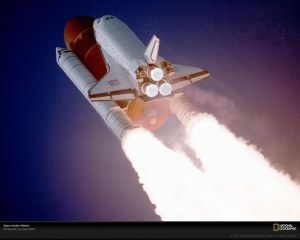
Now PWR has just released a new video and I would like very much to share it. I don’t know if others will get from it what I do. After all, I worked there, on the Space Shuttle Main Engine program, for over two decades. I could not watch the Shuttle ascend off the launch pad without having to choke back a tear or two every time. As a matter of fact, watching old launches still excites the hell out of me. I am proud. So sue me.
Even if you don’t resonate with the “hurling humans into space” part, the sheer taming of all that power should give you a little bit of a chill. Or you’re dead. Who knows?
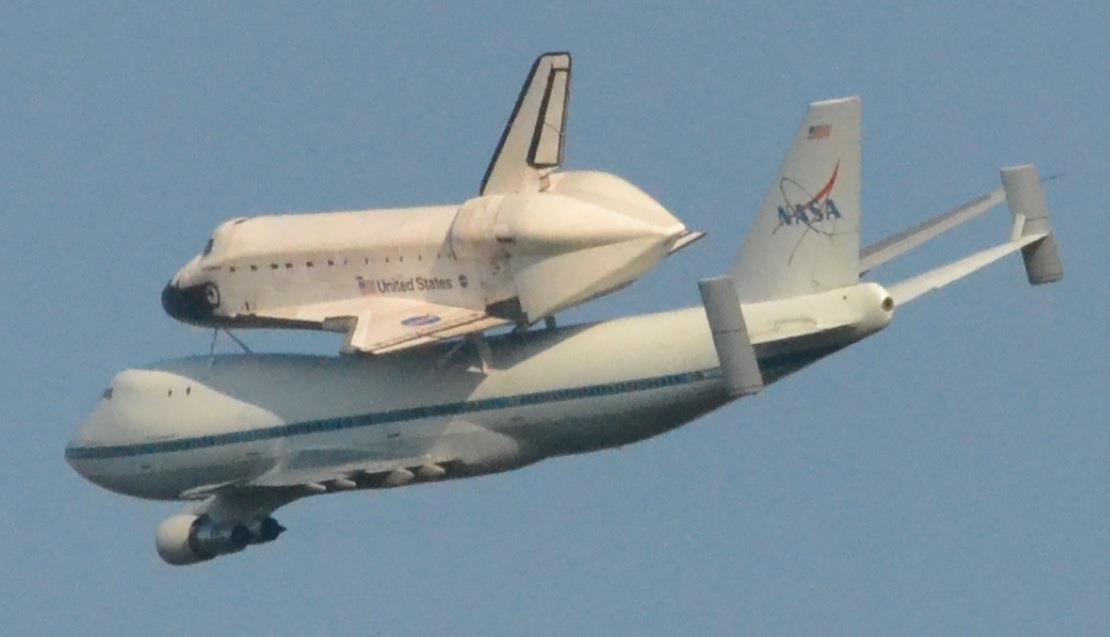
The SCA, Endeavour (OV-105), and chase plane shortly after departing Edwards AFB
I must admit to being a little mystified that NASA hasn’t chosen to fly over and salute Rocketdyne today. Every main engine that powered every Shuttle flight into orbit was designed, manufactured, and assembled primarily at the Canoga Avenue campus. I know they couldn’t fly over every place where components were made in the country, but they’re flying over the freaking Hollywood sign and Universal Studios! Rocketdyne’s campus is just a few miles to the Northwest of those locations. How hard would it have been?
I have often lamented the fact that Rocketdyne never saw fit to advertise itself much. Whenever there was a launch of an Atlas or Delta vehicle, the vehicle manufacturers and integrators always had their names and logos prominently displayed. I am willing to bet very few people in this country even recognize the name Rocketdyne. Do they know every American Astronaut (other than those who’ve flown on Russian missions) was lifted into space by a Rocketdyne engine? I doubt it.
Mercury, Gemini, Apollo. All those flights were powered by Rocketdyne engines. The Lunar Excursion Module (LEM) was powered off the Moon’s surface by a Rocketdyne engine. The Space Shuttle Orbiters would never have made it to LEO were it not for the Space Shuttle Main Engines. The SRBs (Solid Rocket Boosters – or Motors, SRMs) only burned for 126 seconds before separation from the vehicle stack. The Main Engines continued burning for approximately six more minutes, depending on the mission. The SSME was – and still is, as far as I’m aware – the only reusable and fully throttleable rocket engine ever designed and flown.
Anyway, today marks what for me is a very sad day. It should be sad for all of us, IMO. This is the final flight (albeit strapped to the back of the SCA, a specially modified 747) of the last of the Orbiter Vehicles that served us for well over two decades and, unfortunately, we currently have nothing to replace it. The ISS is still on orbit, but we now have to hitchhike there aboard Russian rockets. There’s really no way to tell how long it will be before we return to space.
It also reminds me that I was put out to pasture, though nobody’s suggested ensconcing me in a museum 🙂 I didn’t realize how much retirement would affect me. I’ve enjoyed having time to be with my children, who are eight and eleven. I’ve also enjoyed working at building a modest service business supplying social media marketing for small businesses. However, in this economy that has turned out to not be a very useful business model and, once again, I find I must reinvent myself. Today I’ve decided to wallow a bit in my grief. Grief for the symbolic end of the Shuttle program, on which I labored for over two decades and grief for the symbolic end of my usefulness as a human being, which is what retirement sometimes feels like.
The Original Rocketdyne Logo
One more thing. In my opinion Rocketdyne deserves better. I know people whose entire lives were dedicated to the space program. They worked tirelessly; lived and breathed the concept of space travel and exploration. And those engines played a major role in putting Endeavour (OV-105) on orbit. Just sayin’.
Endeavour flying over Stennis Space Center on her way to Los Angeles
Space Shuttle Endeavor (OV-105) is on the way to her new job at the California Science Center. She is scheduled to arrive at LAX on Friday after completing a flyover of several landmarks, including The Griffith Park Observatory and Disneyland (Disneyland?). I’m conflicted over whether I should drive to Griffith Park or, perhaps, to Malibu – where she is also scheduled to fly over. Parking could be a real pain.
As a young man I used to go to LAX, park in the lot of the Proud Bird Restaurant, and walk down Aviation Blvd. to the East end of the runway. I could stand there and watch the planes come in for a landing, at times only a hundred feet or so over my head. It was exhilarating. Maybe I’ll do that.
I spent nearly half of my adult life working on the Space Shuttle Main Engine (SSME) program at Rocketdyne in Canoga Park, California. I grew up in the San Fernando Valley and have vivid memories of the many rocket engine tests that took place in the Santa Susana Mountains to the West of where I lived. I would go outside and could hear the roar and see the sky lit up. Those engines helped take us to the Moon. It was magical.
I came to Rocketdyne quite by accident and, even after I started as a temp (what they called a “Job Shopper”) working on the return to flight efforts after the Challenger disaster, it took a while for me to realize I could work there. Not being an Engineer, it somehow never crossed my mind that I could find a place in the organization. I ended up spending 21 years there – in a 23 year period (taking two years off in an ill-fated attempt to return to a family business) – working primarily on the SSME program. Endeavour was the replacement vehicle for Challenger, so I am somewhat emotionally tied to her. Half my working life!
In 2010, I accepted an offer of early retirement, which was made to those of us who were sixty years of age or over because the Shuttle Program was coming to an end. It wasn’t quite over, and I had always joked that I would be the one to turn the lights out at the end. I expected to work until I dropped dead, maybe around 80. It didn’t work out that way. I still miss being a part of the space program and seeing Endeavour on her last flight is dredging up a flood of emotion I’m not sure I’m prepared to handle.
Thankfully, she’ll be very close by and I can take my two girls to see her. Fare thee well, Endeavour. I am eternally thankful I was able to play a small role in your voyages. I wish you well on this, your final mission.
Two failures in less than 10 days? Pretty ironic this would happen almost immediately after America’s Shuttle program comes to an end, forcing us to depend almost solely on Russian spacecraft to resupply ISS. As it now stands, I don’t believe we will have the domestic capability to launch supplies, let alone human beings, for at least a couple of years and, if NASA doesn’t pull the trigger on a new heavy lift configuration for the nation, it will be even longer. This may just be a speed bump but, as I said, it’s rather ironic given Russia’s long history of success.
A rocket blasts off from the Russian leased Baikonur Cosmodrome in Kazakhstan on July 18.
(CNN) — A Russian space freighter carrying cargo to the International Space Station has crashed in a remote area of Siberia, Russian emergency officials said Wednesday.
The unmanned Progress cargo craft, which launched at 7 p.m. in Kazakhstan (9 a.m. ET) from the Baikonur Cosmodrome, was due to dock with the ISS on Friday.
“The situation with the loss of the Progress is not good, of course, but there are stocks of necessities aboard the ISS to support the cosmonauts that will be sufficient to last out until the arrival of the next Progress” cargo ship, Russia’s Space Mission Control executive Vladimir Solovyov told Russia’s Interfax news agency.
Space experts said Wednesday’s crash was the first failure of a Progress cargo unit in more than 30 years of operation.
However, it is the second failed space launch in Russia in less than 10 days.
On August 18, Russia lost a sophisticated Express-AM4 telecommunications satellite when the launch vehicle put it into the wrong orbit.
He said the six people currently living on the ISS are “well supplied — actually oversupplied” since the delivery of goods by the final U.S. shuttle mission, carried out by Atlantis last month.
NASA is now reliant on the Russian space agency to ferry U.S. astronauts to orbit, since the grounding of the U.S. shuttle fleet has left the United States with no way to lift humans into space.
Plans are in the works for private companies to begin shipping cargo to the station, and eventually to carry astronauts as well.
As long as I worked at what is now called Pratt & Whitney Rocketdyne we referred to NASA and the Air Force as our “customers”. For nearly twenty years I worked on the Space Shuttle Main Engine program and we always called NASA our “customer”. In the last few years of my employment there, when my awareness of – and interest in – social media brought me to learn as much as I could about what was available and how it might be of benefit to my company, I began arguing for a different approach. I believed, still do, that the real customers of companies involved in space exploration are the American people, those who pay the taxes that were used to pay our salaries. I still believe this is the case, and I still await the evidence of an enlightened approach to engaging them.
In the meantime, I just received an email request to take action and I want to pass it on in the hope some of you who read this will consider taking action; very simple, virtual action. I believe it is imperative for the human race to establish not merely a technological presence in space, but a strong cultural presence as well. I don’t believe it has to be dominated by the United States. In fact, I would prefer it be an international, world-wide effort to ensure the long-term survival of our species. Nevertheless, what is currently happening here is the gradual wasting away of our talent and our industrial base to continue leading the effort. I will no doubt write more about this as it is near and dear to my heart.
What follows is the text of the email, which comes from the website I’m asking you to visit and consider using to send a letter of support to the President, your U.S. Senators, and your Congressional Representative. I’m also including the link below the text so you might take action if you’re so inclined.
I’m concerned about the future of the United States’ role in space. Investments in our nation’s space programs will have a direct impact on our future economic strength and ability to remain a space-faring nation on the cutting edge of technology. I urge you to make a strong commitment to maintaining the U.S. as the unsurpassed leader in space.
For decades, U.S. leadership in space has been recognized across the globe. However, that position is perishable, and continued national leadership will be vital for our future. Therefore:
It is important to establish a long-term national space strategy that factors in civil, national security and commercial interests in space. Our national strategy must also cut across all agencies that have a stake in space. Without a national strategy, America risks a future where the workforce and industrial capacity needed to maintain U.S. leadership and competitiveness in space is seriously – and in some cases irreversibly – degraded.
It is important for our future global competitiveness, leadership and innovation in space that budgets and funding remain stable and robust. Appropriate funding must accompany strategic goals to meet established objectives and sustain a strong and progressive space industry.
It is important to support policies that maintain a healthy and vibrant space industrial base that employs technically-skilled American workers. Modernizing our nation’s export control policies – so that U.S. industry can compete on a level playing field – is one step in the right direction.
It is important to recognize that the space industrial base drives technological development important to our economy and national security. Our national strategy must identify and seek to preserve the space capabilities critical to meeting our national goals.
The United States stands at a critical juncture between past accomplishments and future ambitions in space. The rest of the world is not waiting. Yet there is uncertainty about the future of U.S. leadership in space; our workforce is facing upheaval and layoffs and the U.S. space industrial base is at the brink of losing our competitive and innovative edge.It is absolutely critical that our nation’s decision-makers work together to show the leadership needed to keep our space efforts robust. I urge you to make addressing these issues a national priority.







 Systems Savvy