In early 2009 I was privileged to spend a weekend with Dr. Russell Ackoff thanks to a friend and former colleague. I recall one incident where, while we were at Russ’s home, I mentioned my belief there was a similarity between the philosophy of dialectical materialism and the concept of systems thinking. As I recall, he was pretty upset with me for saying this. It’s stuck with me over the years.
Thanks to another friend on Facebook, I now have access to a set of AI tools, one of which is Google’s Bard. The other day, in an effort to test drive it, I proposed the following task and received the following reply:
Me:
Compare the philosophy of dialectical materialism as expressed by Karl Marx and Friedrich Engels to the concept of systems thinking as expressed by Russell Ackoff and others.
Bard:
Dialectical materialism
• Dialectical materialism is a materialist philosophy that emphasizes the role of conflict and change in history.
• It is based on the idea that the world is constantly changing and evolving, and that this change is driven by the conflict between opposing forces.
• These opposing forces can be social, economic, or political, and they can be found at all levels of society, from the individual to the global.
• Dialectical materialism is a dynamic and evolving philosophy that has been used to explain a wide range of historical events, from the French Revolution to the fall of the Soviet Union.
Systems thinking
• Systems thinking is a holistic approach to understanding the world that views it as a complex system of interacting parts.
• It is based on the idea that the whole is greater than the sum of its parts, and that it is impossible to understand any part of a system without understanding the system as a whole.
• Systems thinking has been used to understand a wide range of problems, from environmental degradation to economic inequality.
Comparison
• Both dialectical materialism and systems thinking are complex and sophisticated philosophies that have been used to understand the world in different ways.
• Dialectical materialism is more focused on the role of conflict and change in history, while systems thinking is more focused on the holistic nature of the world.
• Both philosophies have their strengths and weaknesses, and they can be used to complement each other.
For example:
• Dialectical materialism can be used to explain how conflict between social classes leads to social change, while systems thinking can be used to understand how the different parts of a society interact with each other.
• By combining these two approaches, we can gain a more complete understanding of the world and how it works.
Not quite as in-depth as I would have liked, but it does kind of jive with my understanding of the overlap of the two outlooks.
In retrospect, I should have seen it coming. However, like the proverbial frog in the pot I didn’t realize the water was boiling until it required a drastic intervention. In the past nearly seven weeks, I’ve had the time to reflect on what was happening to me and realize the peak of the problem came up somewhat suddenly, but the signs and symptoms were there for quite some time. The farthest I can consciously go back as of now is to July of 2022.
I believe some of my symptoms were masked by the fact I’d been lifting weights for several years and I was working at a job that was physically demanding, which kept my heart rate up and lulled me into thinking what was happening was normal for someone my age. Every morning when I got ready for work I would pull on my zip-up boots. They were snug and it was a bit of a struggle to slip into them. I usually had to pause for a couple seconds to catch my breath before finishing my preparations for work. I also had to walk between two warehouses at times and was always a bit winded and tired when I got to my destination, which was only about 1,000 yards. Same with climbing one flight of stairs. Some of my problem I also attributed to the fact I was born with club feet, which required major surgery to correct and made walking more difficult than it ought to be.
I lived with these issues for about six months before I experienced what felt like a sudden, drastic change. I was sitting in the lounge of our local Planet Fitness, waiting for my youngest daughter to finish working out. I hadn’t worked out myself and was just biding my time while she was getting in her exercise. When she finished, she came in to let me know and I stood up to leave. I was hit with an overwhelming wave of exhaustion and my knees nearly gave out on me. I didn’t realize it at the time, but I was likely experiencing syncope (fainting). I was able to make it to the car, but it wasn’t a walk in the park.
We made it home (I have lots of experience driving under, shall we say, impaired conditions, during my well-spent youth) and, checking my heart rate with my Fitbit Charge 5, I noticed it was wildly erratic. The next day I contacted my doctor at Kaiser here in Simi and, although he was not available, I was able to get an appointment with another physician. As a result of that exam, I began a series of tests, including wearing a Holter monitor for seven days. I was also scheduled for a cardio stress test a couple of weeks later.
When I finally (it took longer than I thought it should, but that’s another story) got the results from the monitor I’d worn, they were published for me to read on the Kaiser website and their mobile app, which I have on my phone. Reading the results was sobering and alarming. My heart rate had, at one point, dropped down to 27 beats per minute and I had experienced numerous instances of tachycardia. I also had experienced numerous incidents of AV (atrial ventricular) Block. There was enough jargon in the results that I was able to look up and get enough of an understanding to be quite concerned about my heart. This was exacerbated by the overwhelming exhaustion I was beginning to experience when walking from the bedroom to the kitchen or from the house to my vehicle.
The results were published on February 8, but I wasn’t scheduled to consult with a cardiologist until the end of the third week of March. As I read more about my results and experienced longer and more difficult periods of exhaustion, I became increasingly concerned that I might not make it to the consult. I started agitating for things to speed up. After an phone conversation with a cardiologist, I decided to purchase a KardiaMobile personal EKG device. It turned out to be difficult to get good readings because I have essential tremors in my hands and the shaking is accompanied by electrical activity in the muscles of my forearm, which confused the EKG device. When I could get a good reading, it wavered from normal sinus rhythm to bradycardia to possible atrial fibrillation. This somewhat paralleled my experience, as there were times when I felt quite normal and did not tire easily from a short walk.
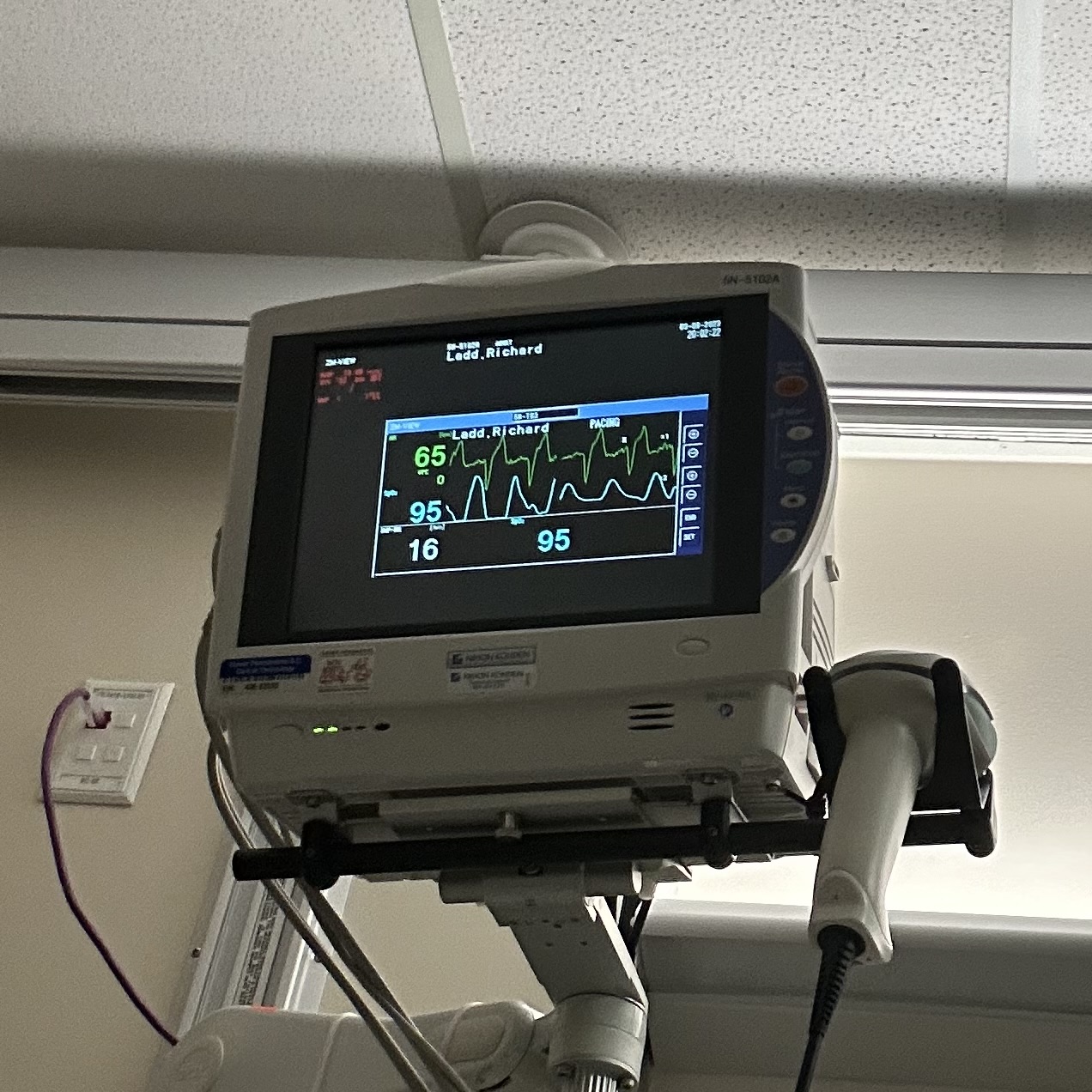
My Newest AccoutrementShortly After SurgeryNormal Sinus Rhythm!
I sent some of the results to who was now my cardiologist and, after several phone conversations, we determined there was a good chance I needed a pacemaker. My condition continued to deteriorate and we finally decided an implant procedure was indicated. On Friday, March 3 my cardiologist informed me he had a time slot open the following Wednesday, March 8 in which to perform the procedure. I agreed immediately.
On the 8th my wife drove me to the Kaiser hospital in Woodland Hills, CA and I was admitted for surgery that afternoon. All went well, I stayed overnight for observation, and was discharged in the afternoon of the 9th. My wife and youngest daughter picked me up and we stopped for some Chinese food on the way home. I felt great and continue to heal and recover. I was told not to raise my left arm above shoulder height for six weeks and did not do so. My next goal comes on June 8, when I will be able to swing a golf club again. A week and a half after the surgery I attended an air show at Pt. Mugu NAS and walked over two miles without experiencing any shortness of breath. A week later, I want to Arizona to attend to spring training games and walked over two miles on each of the two days I was there, again with no discomfort or deleterious effects.
It’s difficult to say how long I’ll live with this device and, of course, my aging heart. I’ve already outlived my father—who I was told I was “exactly like”—by 16 years. I have numerous comorbidities as well. The battery in my pacemaker, according to the Nurse Practitioner who runs the pacemaker clinic at Kaiser, has over 12 years of life remaining and it can be replaced if necessary. A review of the available information on the remaining lifespan for men like me range from 5 to 15 years or more, depending on numerous factors, including lifestyle. I have to balance my desire to enjoy the life I have left in a fashion that suits me, or live longer by changing my habits and desires. I’m working on that now. My outlook and philosophy are undergoing a transition and I’m not quite sure where I’ll end up, but I’m still here for now and I intend on living each day to the fullest.
I have been working (read “struggling”) on my memoirs/autobiography for longer than I care to think about. I’ve managed to write close to 90,000 words and am sure I need to write another 90,000 (at least) in order to feel I’ve accomplished what I set out to do. Some of what I’m including comes from blog posts I’ve authored over the past decade and a half. Now I’ve decided to take a slightly different tack and publish some of my work here in my blog, in the hope I can get some feedback—at least from my friends who sometimes read what I write here. What follows is the first draft of my Preface to what I’m tentatively entitling “A Stunning Display of Intelligence”, the meaning of which is contained therein. If you read this, and have a mind to, I would greatly appreciate your thoughts, suggestions, etc. Thank you.
I’ve not been one to toot my own horn, preferring to let my actions speak for themselves. This is, in part, because I suffer from impostor syndrome, or something similar to it. My particular iteration of this syndrome isn’t a cause of great anxiety. It’s more like I’ve always felt everyone knew everything I did and what I knew or was capable of wasn’t all that special. It’s only in the last decade I’ve come to understand how this affected me and began to throw off whatever constraints it placed on my progress and enjoyment of life.
It was the blog of an online friend, someone I have never met in person but, because of our mutual interest in the advent of what was called Web 2.0, as well as social media and its application to the enterprise, that brought me my first glimmer of a deeper understanding. He named his blog “The Obvious” and, when I asked him why that was so he told me it was because his impostor syndrome led him to believe the things he wrote about were “obvious” to others; hence the name.
This work of mine is my way of not necessarily showing off, or displaying my accomplishments, but of sharing my experiences, many of which for numerous reasons I have been reluctant to talk about at all with nearly anyone save for those who were with me when they happened and who helped me plan or plot to accomplish. Some of the things I’ve done, especially when I was young and impetuous, not to mention bullet-proof and invincible, were illegal. My virtue is never having been caught, not necessarily being a good citizen. Although, in my defense I will argue much of those activities might have been illegal, but they were hardly wrong. Enjoying the pleasures of Cannabis is one of them. I will discuss this in greater detail a bit later.
My life, while reasonably normal, has not been all that conventional. By that I mean I’ve done most of the things normal people do, I just haven’t done them in the same order others normally have. I have long suggested I’ve lived a great deal of my life in reverse and I believe I am accurately depicting how I’ve done it. For instance, although I did not attend undergraduate school, I was admitted to law school eight years after I graduated high school, graduating with a Juris Doctorate three years later. Many years after that experience (33 to be exact) I earned a Master’s Degree in Knowledge Management. It was shorty after my 62nd birthday. I have considered getting a Bachelor’s Degree just to complete the backward educational hat trick, but at this stage of my life it’s unlikely. I did some undergrad work at the University of Phoenix and Cal Lutheran when I was working on the Space Shuttle Maine Engine (SSME) program at Rocketdyne. I think I finished a semester at the University of Phoenix and a year or more of work in an adult evening degree program at Cal Lu, but it was difficult to reconcile taking classes designed primarily for 18 – 22 year olds still wet behind the ears. The knowledge I could have taught some of those classes was a bit aggravating too. I will discuss these efforts a little later.
I didn’t become a father until I was 55 years old, when my wife and I, after trying to get pregnant, traveled to the People’s Republic of China to adopt our oldest child. It was a two-year, difficult, and amazing adventure. A few years later, in what I’ve often thought of sarcastically as a stunning display of intelligence, we adopted another child from China. Hence the title of this memoir. Later on I will introduce you to my girls, Fooshie and Typhoon Girl.
A word of caution. As I am writing down my recollections I am also researching dates and locations to ensure my memories are as accurate as one can expect from a seventy-five year old man. I have never been one to exaggerate my experiences, but I know that time can play tricks on one’s memory. I am making every attempt to be accurate, but I realize a few of these memories may be slightly distorted. For instance, I know I was five years old when I had surgery to correct my clubbed left foot, but I’m pretty certain (based on my research of when he played for the Los Angeles Angels) I was five years old when I picked up a foul ball during batting practice and, at his request, returned it to Chuck Connors. I’m not sure I can reconcile being mobile enough to get that ball with having some fairly major surgery done to my foot and ankle. Nevertheless, I have managed to slog through what remains of my mind and am presenting what I remember as best I can.
It is also nigh on to impossible to refer to many of the organizations I worked for or the places I visited and which meant something to me and my development or experience back then, because some of these memories are from a long time ago. As an example, one of the companies I worked for and which played a bit of a role in making my visit to Cuba somewhat strange was purchased long ago and, in fact, was re-branded sometime after that purchase-and that was a long time ago.
A substantial portion of this memoir was written over the past 10 – 15 years and posted on one of the two blogs I’ve maintained since early 2006, when I published my first post at The Cranky Curmudgeon (http://crankycur.blogspot.com/). I posted there for a few years until 2014. I did not publish very often the last few years because I had started another blog with WordPress, which I call Systems Savvy (https://rickladd.com/). My first publication there was at the beginning of 2008. I have since published there sporadically and continue to do so; currently a bit over 700 times, not including saved drafts. Some of those posts were simple, short, and sweet while others were somewhat lengthy and more complex and nuanced. Several of them recount experiences of mine, while other reflect on lessons I believe I’ve learned from work or life.
Long ago I came to the conclusion the only thing that mattered for me, in terms of what I accomplish in my life, was that I gained wisdom. When I first began to feel that way I was only in my thirties and I knew that you can’t just hang out a shingle and declare oneself a wise person. I also knew that wisdom comes with time and experience; some would say after a great deal of false starts and failures too. Whether or not I’ve reached that particular plateau will be for others to decide and I am hopeful you will find a nugget or two buried in my remembrances, especially those that are from the more seminal experiences of my now fairly long life. I’ve struggled to find my voice for, well, pretty much forever and I’m not sure I’ve managed to do a good job with this memoir.
However, I don’t think it’s hyperbole to believe I can at times sense the hot breath of the grim reaper on my neck and I feel a strong need to get this done before it’s too late. As well, I want to leave some coherent (ha!) record of who—and why—I am for my daughters. They lost two fathers before they were old enough to understand what was happening to them and I want them to have something to hang on to after I’m gone. I am, for the most part, the only father they can remember.
For years I considered writing memoirs about certain parts of my life and experience; mostly my political and counter-culture activities and my becoming a first-time adoptive father so late in life. However, various circumstances militated against my doing so, not the least of which was my inability to just sit down and write, as well as organize my thoughts and memories. In this work I have decided to go through my life and get as much of it down as possible. As I began outlining and organizing my thoughts I found it increasingly easier to link various parts, the sum of which can be confusing when taken all at once.
I have therefore attempted to organize my thoughts in such a way the reader can get a sense of what I have learned from a particular part of my life without having to understand the entirety of it, the gestalt if you will. I think you will find it easy to skip over portions that aren’t terribly interesting to you and still get something of value. At least I hope that is the case. I know my life has been unconventional. Not all of it, but substantial chunks of time and experience. I’ve tried to convey what I’ve learned from those periods, as well as the more normal everyday experiences we all seem to go through. I hope you’ll find it of interest, if not enlightening.
The DOJ’s OLC policy of not pursuing criminal investigations or prosecutions into or against a sitting president needs to change! Their argument that it would ” … unconstitutionally undermine the capacity of the executive branch to perform its constitutionally assigned functions”—in light of the serial criminality of the former President—no longer holds up, IMO. Look how thoroughly it screwed up every aspect of public life and how much it’s cost us in both treasure and prestige. This raises some thorny questions I will try to tackle in the future. I’m just spitballing right now in light of what we’re learning (and many of us knew long ago) about the criminality of the former President, Donald John Trump.
She Shouldn’t be Blind to Outright Criminality by Anyone!
To be clear, If the evidence warrants it (and all but the most partisan know it does) I want to see an indictment—actually several—of Trump. He remains innocent until proven guilty and I want to see the “rule of law” upheld by our court system. If he’s so fucking innocent, let him prove it to a judge and jury. He’s been treated more “fairly” by our justice system than millions of our poorest citizens. Neither he, nor his supporters have ever uttered a single word about the unfairness of that system. Now, all of a sudden it’s rigged and unfair. Screw them and him. Let’s see it play out.
Tucker Carlson, Ben Shapiro, and whoever-the-hell the other misogynist numbskull is on this video are raging examples of right-wing snowflakes and “less than” men. Talk about being triggered. This is what happens to bois who think tanning their nuts will somehow add to what little masculinity they might serendipitously possess.
“If you know the enemy and know yourself, you need not fear the result of a hundred battles. If you know yourself but not the enemy, for every victory gained you will also suffer a defeat. If you know neither the enemy nor yourself, you will succumb in every battle.”
~ Sun Tsu
The Republican party consistently fails to understand the left and their political and economic philosophies. Here’s a perfect example of how wrong they get it; a tweet from Gym Jordan’s House Judiciary Committee.
How the Left thinks you can combat rising prices in Joe Biden’s America:
Though I don’t believe there’s a monolithic set of beliefs on the left, there are many characteristics that are fairly well aligned, and what is so wrong about this tweet is how clueless it is in terms of what those on the left, from moderate Democrats to left-wing progressives, want for society. Think about how stupid these talking points are; how patently ridiculous they are when viewed alongside what is common knowledge about leftist thinking and aspirations.
For instance, those on the left have been fighting for decades to provide adequate, nutritious breakfasts to children and healthy, affordable meals to all. The idea that they would suggest skipping a meal to somehow counter rising costs of food is abject numbskullery. Given that it’s Gym Jordan who’s behind this stupidity, that does seems par for the course.
“Just get two jobs!” What the fuck are they talking about? People on the left have been champions of unions and fair working conditions for decades, if not centuries. The last thing they’re going to be wishing for the working class is that they work harder.
Lastly, the only people who have continuously suggested the age of retirement be moved up are Republicans. It’s their “kinder, gentler” method of removing Social Security entirely, which is their secret goal. They may complain—as they did during the latest State of the Union address—that’s not their position, but they’re liars. It’s something they’ve wanted since at least the Reagan administration.
The Republican party—at least the MAGA Republicans—have proven themselves to be the party of lying liars. They’ve completely given up on governance and have devolved into a bunch of whiny little bitches, devoid of solutions and providing nothing but phony gossip and innuendo instead of actual positions or viable proposals to improve our lives. They deserve nothing more than to be assigned to the trash heap of history, where it’s clear they are headed. We don’t even have to do anything to help them get there save to campaign and vote for their progressive adversaries. They are the architects of their own demise. The nation, and the world, will be far better off when they have finally disappeared.
How many of my friends know what a schlemiel or a schlimazel is? These two words came up quite frequently in my youth. The simple explanation I received to help me understand the difference between the two is as follows (btw, mazel mean “luck” in Yiddish):
A schlemiel is a person who, while walking through a large, mostly empty dining room with a bowl of hot soup, nevertheless manages to spill the soup. A schlemazel is the person on whom the soup lands, perhaps the only one in the entire room.
I finally decided to give ChatGPT a test drive. I made the following request: “Write a 500 word blog post about why Gen Z should vote in every election.”
Here’s the response I received. The response is actually 523 words. Close enough:
“Gen Z, also known as the iGeneration or the post-Millennials, is the demographic cohort born between 1996 and 2010. As this generation begins to reach voting age, it is important for them to understand the importance of participating in every election.
“Voting is one of the most fundamental rights and responsibilities of citizenship. It is a way for individuals to have a say in the direction of their country and to hold elected officials accountable. By voting, Gen Z can shape the policies and laws that will affect their daily lives, from healthcare and education to the economy and the environment.
“One of the most compelling reasons for Gen Z to vote is that their generation is uniquely affected by many of the current political issues. Climate change, for example, is a pressing concern for Gen Z, as they will be living with the consequences of current environmental policies for much longer than older generations. Similarly, the high cost of education and the increasing burden of student loan debt disproportionately affects Gen Z. By voting, Gen Z can make their voices heard on these issues and push for policies that align with their values and interests.
“Another reason why Gen Z should vote is that their generation is one of the most diverse in history, with a wide range of perspectives and experiences. By participating in the democratic process, Gen Z can ensure that their diverse voices are represented in government and that policies reflect the needs and concerns of all members of society.
“Additionally, by voting, Gen Z can help shape the future of the country. The decisions made by today’s elected officials will have a lasting impact on the future, and it is important for Gen Z to have a say in that future. It is also important for Gen Z to vote to ensure the continuation of democracy, which is the foundation of our country and it is something that should be protected.
“It’s also worth noting that voting is not just a right but also a privilege in many countries. Many people have fought and continue to fight for the right to vote, and it is important to exercise that right in order to honor their sacrifices.
“However, it is important to note that voting is not the only way to make a difference. Gen Z can also get involved in other forms of civic engagement, such as volunteering, organizing, and advocacy. But voting is an essential part of the democratic process, and it is the most direct way to make an impact on government policies and elected officials.
“In conclusion, Gen Z should vote in every election because it is their right and responsibility as citizens to shape the direction of their country. By voting, Gen Z can have a say in the policies and laws that affect their lives, ensure that their diverse voices are represented in government, and help shape the future of the country. Furthermore, it’s a way to honor the sacrifices of those who fought for the right to vote. It is time for Gen Z to step up and make their voices heard.”