Category Archives: Spiritual

Understanding Empathy

One of the ways I’ve been working on upping my writing game is by paying attention to what people are reading here on my blog so I might get an idea of what moves my readers. I have now posted well over six hundred times and about 90% of these posts are essentially essays regarding my thoughts about various things, e.g. politics, religion, life, the universe, and everything. The other 10% are tests and sharing things I’ve come across but have little to say about. I also occasionally have reason to look back myself, even if no one has recently read a particular post of mine I find interesting.
Suspension of Disbelief
To Open Up And Believe

Because there have been many highly emotional news stories lately, and emotions are high to begin with, I’ve been giving a lot of thought to the role of emotions and, especially, how they relate to empathy. Turns out I had written about empathy over eight years ago, long before Donald Trump’s presidency. Since the reality has hit us that he is entirely without empathy, I would like to share a concatenation of the two posts I wrote in late September of 2012. It’s my hope these two are as pertinent today as they were when I wrote them; perhaps more so because I was only writing then about my feelings and now what I wrote seems so pertinent to what we’re all experiencing in the waning days of this disastrous presidency.


The willing suspension of disbelief. What a powerful, magical, and exceedingly frightening thing it can be – at least for me. Not always, though. It’s been quite a while since my last venture into the genre but, a long time ago – in a galaxy far, far away – I read a lot of Science Fiction. Reading it can’t possibly be enjoyable if you aren’t able to suspend your ability to think critically. Nevertheless, I enjoyed the hell out of what many an author hated being called Sci-Fi.

I’m normally somewhat cynical and am a fairly skeptical person, so I’m continuously surprised at how easily I can get sucked into a compelling story, especially if the characters are even moderately complex. I think it actually frightens me to realize how deeply I have disappeared into many a television drama.

This tendency has no doubt been exacerbated by my becoming a father at the ripe old age of 55, when my wife and I culminated a decision we had made a couple of years earlier and traveled to the People’s Republic of China to adopt our first child. We repeated the process four years later and, at the tender age of 59, I once again became a new father.

I now find myself immersed in shows where children are involved (it happens far more often than one might think) and I can’t help but identify with the parents, which sometimes brings me to tears – occasionally racking sobs of grief.

It has always been this way. I’ve been told the men in my family – many of them – were blubberers. Though I couldn’t have been older than five or six at the time, I recall the first time I saw my father cry. He had just received news that my Bubbie Jennie, his mother, had died. He hadn’t seen much of her since moving to Southern California. She had remained in Chicago, where both my parents were born. It was eerie, and not a little unsettling to see my father, a young boy’s tower of strength and resolve, break down like that.

It was made more difficult because I had only met her once, when she came to visit for a week, and she was unfamiliar to me. On the other hand, my maternal grandparents lived with us and I felt a strong emotional tie to them I could not summon up for her. She was by Bubbie, though. My mother’s mother was just Grandma.

I frequently ask myself, however, why I am so deeply and painfully drawn into these stories. I’m not entirely certain I have the answer, but I’m pretty sure it’s not so much the story itself as it is the relationship those stories bear to my own life.

Dictionary.com defines empathy as follows: the intellectual identification with or vicarious experiencing of the feelings, thoughts, or attitudes of another. That seems pretty straight-forward, yes? I am a fairly empathetic person and I tend toward the second part of that definition, i.e. I feel the pain of others vicariously. However, I don’t think this captures the essence of what is happening when I am fully immersed in a story.

Perhaps it’s too fine a point and the distinction isn’t all that great, but it seems to me what’s really happening is I’m overlaying the experience in the story onto my own life. I’m not so much experiencing the feelings of another as I’m experiencing the feelings I would have were I to be in that situation. I don’t think they’re the same. Then again, maybe that’s the mechanism that actually facilitates empathy.

This is a minor conundrum that comes to me most every time it happens and, usually, I forget about it within a minute or two. Lately I decided to try and get a descriptive handle on it and this is my first attempt.

Empathy is a valuable and deeply human trait. It is one of the five traits listed as characteristic of emotional intelligence which, in turn, is seen by many as a valuable business and leadership skill. It’s important to understand and to cultivate in order that we may better understand the people in our lives, whether at work, play, or home.

I want to understand what is moving me when this happens. On some levels it seems patently ridiculous to get so emotionally involved in a fiction story. On the other hand, perhaps it is really what makes us human. I’m wondering if someone with a more classical education than I have knows more of the thinking humans have brought to the subject. I’m sure some in the Arts (especially the Theater Arts) have tackled it. I’ll have to do more research. In the meantime, I’m glad there’s plenty of tissue in the house.

As it turns out, thanks to a friend I discovered an interesting answer through a wonderful TED talk by VS Ramachandran, a Neuroscientist who has studied the functions of mirror neurons. It would seem there is overwhelming evidence we humans are more closely connected than I was hinting at.

In his talk he says, “There is no real independent self, aloof from other human beings, inspecting the world, inspecting other people. You are, in fact, connected not just via Facebook and Internet, you’re actually quite literally connected by your neurons.” I find this resonates in many ways with my understanding of Systems Dynamics, Quantum Theory, and Zen and goes a long way toward answering my question. Frankly I find it a meaningful addition to my understanding, but still find myself wondering why it manifests itself so powerfully in some . . . and not at all in others. After all, the world is filled with people who are anti-social in varying degrees of severity from mild conduct disorders to outright sociopathy or APSD.

Regardless, there is much value in this talk. He speaks of the wonders of the human brain and, with respect to the issues I raised yesterday, uses words like imitation and emulation, ultimately winding his way to empathy. Rather than repeat any of his talk, I urge you to listen to it. There’s at least one very cool surprise a little more than halfway through. At less than eight minutes, it’s really engaging. Here’s the video. I’d love to hear what others think of this:

Evolution

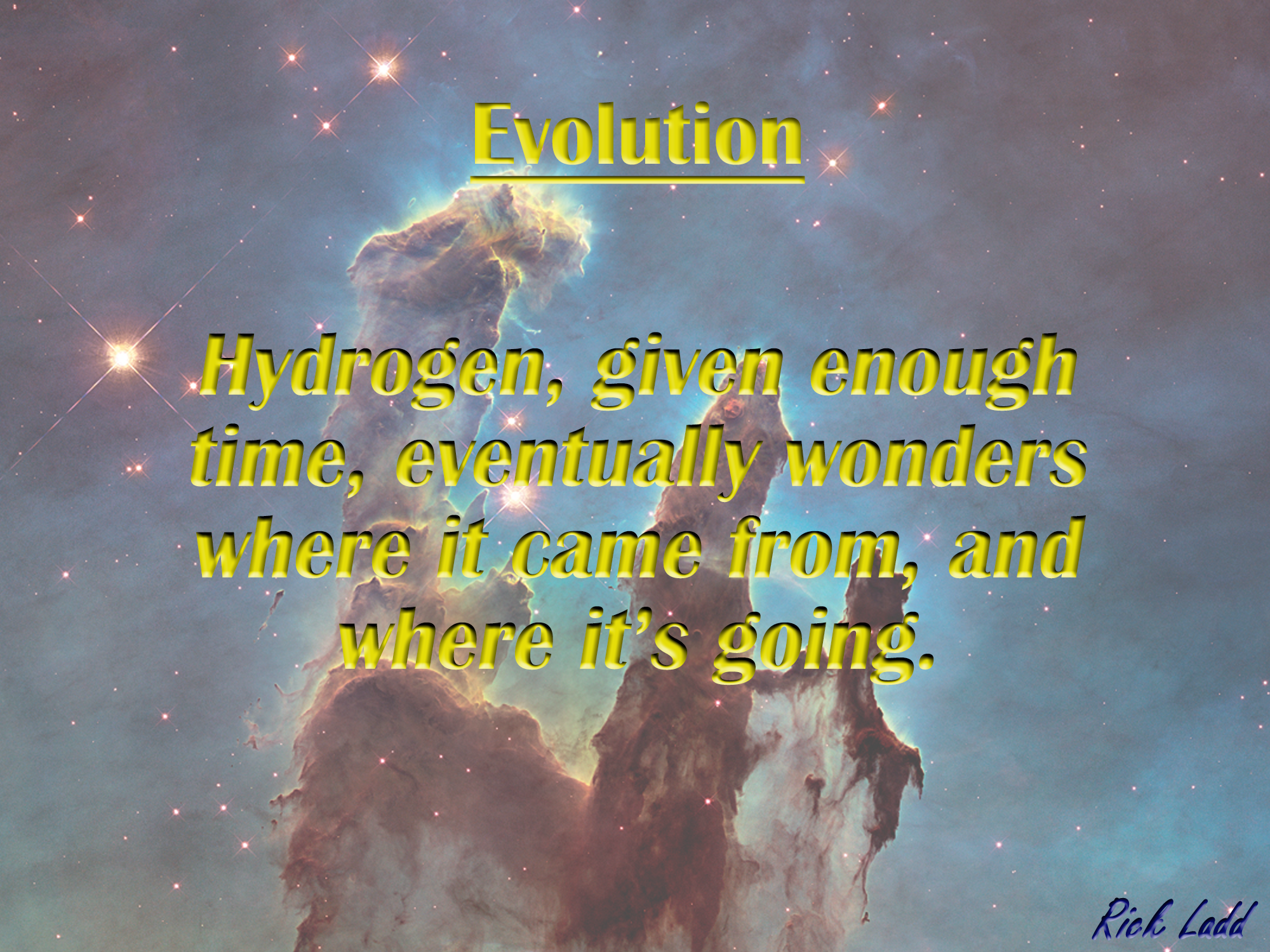
Another quite simple Photoshop effort, though all this is is a compilation of a quote I’m fond of and a photo of what is referred to as the pillars of creation, located in M16, the Eagle Nebula, over thataway.

The Pillars of Creation

If you study cosmology, and you’re not blinded by any particular religious dogma, it becomes clear that our evolution as a species (the human one) draws a gravity-assisted line from the first hydrogen atoms to who we are now. That we have reached a point in our evolution where we have been able to understand how we and our universe came about and developed over billions of years, I find every bit as awesome as the thought of some bearded white dude thinking us up out of nothing. Actually, I find it more awesome.

Understanding cosmological (read, primarily, stellar) as well as biological evolution is, to me, far more beautiful and compelling than anything I’ve learned from all of the world’s religions, including the one I was raised in (Judaism) and the one I was surrounded by (Christianity). I find it far more compelling and reasonable and, again for me, all the proof I need that we don’t need a “God” or “Gods” to explain how we came to be and where we’re headed.


How Long?

Dinosaur bones and desert mountain background
Photo by Brett Sayles on Pexels.com

There’s a “tripwire” somewhere
Out there, downstream
Where . . . I’m not sure

Some discover its presence early
For some the revelation is a surprise
Everyone’s waiting for it
Our entire lives
Some wait with dread and trepidation
Some with simple resignation
Many in anticipation
Of what lies on the other side

Are there any who give it no thought?
Like our animal brethren
Who live their lives on a daily basis,
Not as an ongoing saga

Many of us prepare
In numerous ways
Some useful
Some not
I know I’ve been waiting
For as long as I can remember
Now, however, I’m beginning to
Sense its presence more acutely
I feel its approach
Though it’s still amorphous and indistinct

And each time someone younger than me passes
I swear I can feel its hot breath on the back of my neck


Originalism is Bullshit!

The Founders … Founding.

Amy Coney Barrett considers herself a “Constitutional Originalist.” What, exactly, does that mean? According to Merriam-Webster, it is “a legal philosophy that the words in documents and especially the U.S. Constitution should be interpreted as they were understood at the time they were written.” (https://www.merriam-webster.com/dictionary/originalism)

Think about what that means. If we are to interpret the Constitution based on the realities of the day in the late 18th century, then shouldn’t the only people allowed to vote in national elections be white, property-owning men? What do we make of the 3/5 clause of Article I, Section 2 of the Constitution and how do we reconcile the 14th Amendment (passed in 1868) with the “original” intent of said Article?

In my less than humble opinion, this concept of originalism is as flawed as belief in the Bible being the infallible word of God. Both require one NOT believe in evolution; I don’t here mean biological evolution (which many Bible believers don’t recognize as real) but the natural evolution of society and its economic, political, and general attitudes toward what’s good and just for a people. Our laws, our habits, our customs, our culture, even our morals change over time; sometimes imperceptibly and others rapidly and definitively.

When the Constitution was written, the framers included (Article V) the ability to amend it and, in fact, the first ten amendments—the Bill of Rights—were needed to ensure adoption of the nascent Constitution by some of the States who wanted more guarantees of freedom from unnecessary restrictions on the States and individuals.

Inasmuch as there is a method by which the Constitution can and, in fact, has been amended how can a logical argument be sustained that it must be interpreted in light of the reality of nearly two hundred fifty years ago? This makes absolutely no sense. Two hundred fifty years ago virtually none of the structures, organizations, and technologies we currently enjoy existed. How do we interpret their use and ownership if they weren’t around when the document was written?

Originalism is a sham argument and should be completely ignored. Any jurist taking such a position is, IMLTHO, an intellectually dishonest poseur and should be ignored . . . if not ridiculed. This includes Amy Coney Barrett who, if she had any integrity at all, would not allow this raw power grab and farce of a nomination process to continue.


Secular Religion. WTF?

The United States’ rogue Attorney General, Bill Barr, gave an interview to right wing dick bag, Mark Levin, the other day and I came across this tweet and response that highlights what I think is a deeply troubling reality about religion in today’s United States.

Faith in another context

Putting aside Barr’s constant projection, what Soap And Science, PhD says about how much of the religious world views science seems on point. Science is based, above all else, on provable facts and reproducible evidence. Conclusions may be reduced by some to dogma, but they will not be able to withstand the scrutiny of others who can show reality is otherwise. We’re constantly updating our scientific knowledge as we learn more.

Not so with religion. Most all religions, certainly the major religions of the world, are built on dogma. For Judaism it’s the Torah, the Old Testament. For Christians it’s the New Testament with a nod to the Old Testament. For Islam, it’s the Koran with a nod to both the New and the Old Testaments. For Hinduism, it’s the Bhagavad-gita, and for Buddhism it’s the Sutras of Buddha, as well as others. I certainly don’t hold myself out as a religious scholar, so please don’t hold me too strictly to my list. I’ve likely missed quite a few and, perhaps, mis-characterized one or more of the others. All these books might as well have been written in stone, as they are accepted (mostly) as the word of the Almighty. (NB – I don’t think the Buddha was seen as a God, per se, but I think the basic theme here is correct.)

What concerns me most about the point Soap And Science is getting at is the concept that religious nutbags like Barr are, indeed, jealous of how well science works and, in fact, that it serves to explain the world far better than any religion has or is capable of doing.

While it pains me to do so, I don’t see any other conclusion than that the right—representing, in part, fundamental Christianity—will not hesitate to use violence when they realize they’re not getting their way. They are more than capable of perpetrating every vile thing they accuse the left of currently doing. In fact, that it’s in the very nature is proved by their accusations when there’s no evidence to substantiate them. They are hateful and violent; ergo so is everyone else, especially those they fear the most.

As Rachel Maddow is fond of saying, “watch this space.”


Dialectical Zenosity

The Interpenetration of Opposites

My philosophy of life has been informed by two people, both of whom I was first introduced to (not personally, but via their writings) in my early twenties. They helped me understand the meaning of the dialectic of life; the yin yang of our corporeal (and intellectual) existence.

The former brought me an understanding of spirituality that did not require the existence of a supreme “being,” while the latter helped me to see how our thinking is shaped by the material world we live in, and how our thinking can then help us act to change that world for the better.

The former brought me “The Wisdom of Insecurity” and taught me to accept the tenuousness of existence and the need to slow down and enjoy life absent regret for the past or anxiety for the future (not that I am proficient at it always,) while the latter gave me a much clearer understanding of both biological evolution and the evolution of human society.

These two people are: Alan Watts, who many considered the western world’s foremost authority on Zen, a philosophy I believe reflects our place in the universe; and Karl Marx who, along with Friedrich Engels, developed and promulgated the philosophy of dialectical materialism, which I believe accurately reflects how the physical world informs our existence and how our ability to understand that physical world gives us the ability to significantly alter it.

It’s been over fifty years since I first encountered these two aspects of what I consider to be a somewhat “unified” theory of existence. Nothing in the interim has dissuaded me from following their teachings. I find the physical universe to be infinitely more beautiful and mystical than any of the Gods humans have worshiped over millennia.


Happy Holidays!!

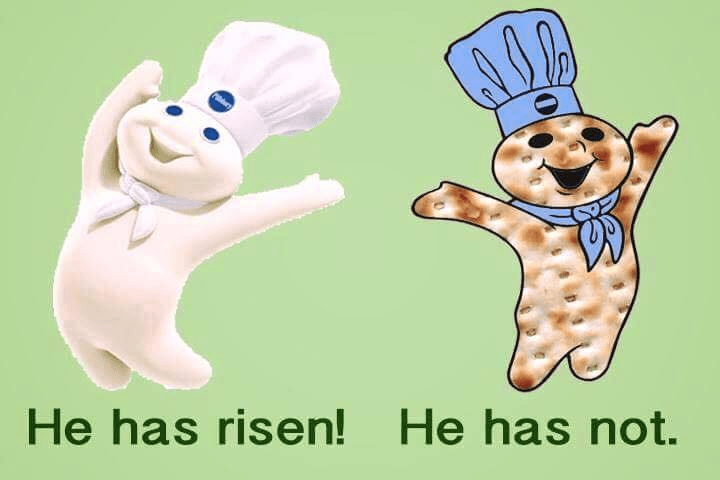
Although I am an atheist, I was raised in a predominantly Christian country, in a Conservative Jewish family (I’m bar mitzvah) and am well aware of the importance of both Easter and Passover. They no longer (or never did) carry any religious significance for me, but they do (in the broadest sense) carry a great deal of spiritual significance . . . in terms of the import of each holiday’s lessons on the human condition.

So . . . without going into great detail to assert my bona fides when it comes to all things religious, I just want to wish my Yiddishe meshpuchah, chag Pesach kasher vesame’ach, and my Christian friends and family (yes, there be Catholics in mine) a blessed and joyful Easter.

In this trying time we’re experiencing, we can use the dual messages of liberation from slavery and oppression, and the dialectic of life and death that both these holidays bring us. May we come out of this pandemic with a new appreciation for life, and for each other and the value each of us intrinsically brings to human society. Peace, love, and Harvey Krishberg.

Hang in there . . . I love you all.


I Stand With All People

I’ve been an atheist—meaning I don’t believe there is such a thing as God, i.e. a supreme being—since I was 15. I’m now 72. However, I was raised as a Jew and am bar mitzvah (a man of the commandments.) My ethics are fundamentally based on my Jewish background, especially given my four years of Hebrew school, with liberal sprinklings of Christianity and—later—Buddhism, primarily Zen.

I sometimes refer to myself as a Jewddhist, but my favorite designation—for fun—is Quantum Gestalt Humanist. Quantum for my belief in science and reality; Gestalt for my recognition of the totality, synergy, and systemic nature of the universe, and Humanist for my recognition of the beauty and value of my fellow human beings. Still . . . the ethics I recall learning, especially in Hebrew school, form the basis of these beliefs and feelings.

Even though I haven’t been to schul since I attended a very familiar, yet very uncomfortable, Yom Kippur service about 20 years ago, I will always be a Jew . . . and not just because my parents were Jews, but because the world—especially anti-Semites, but even the ignorant and those easily swayed by propaganda—will always see me as a Jew; nothing more. Besides, I was raised to respect and stand up for the oppressed and, despite the actions of the Israeli government, with whom I greatly disagree, there is no place for any kind of bigotry in my world, and that includes anti-Semitism. There is a world of difference between being anti-Semitic and being anti-Zionist.

I hope the United States is the enlightened society I’ve been led to believe it is, but my confidence level is not very high and my Jewish angstometer is slowly flashing a soft, pastel red. Donald Trump has been stoking the fires of hatred since long before he was “elected” president. Incidents of anti-Semitism, as well as attacks on other minorities, have risen rather dramatically and there appears to be a correlation in the rise of these acts following every one of his rallies.

So . . . I want to make it perfectly clear I will defend Jews, including Hasidic Jews with whom I share absolutely nothing save for a long, somewhat convoluted history. At the same time, my “faith” in the interdependency of the human race and all life compels me to stand with everyone, especially the oppressed and downtrodden.

Unfortunately, age is starting to wreak havoc with me. I lift weights and work at staying fit, but I’m approaching 73 and it’s quite clear things are slowing down. I haven’t the stamina, nor the strength, I once had. I’m pretty sure I don’t have the intellectual capacity I once had, but I must continue to fight in any way I’m capable.

I’m planning on attending this year’s Women’s March next Saturday in downtown Los Angeles, not far from the place of my birth. I’m bringing my 18-year-old and a friend of hers who’s in town from the Bay Area, where she’s attending her first year of college. They both went with me last year. I’m hopeful my 16-year-old, who was problematic last year and had to stay home, will also attend. I wish I had the ability to attend the numerous events taking place locally, some as protest and some for electoral politics, but I still have to earn enough to supplement my retirement income (not as easy as it once was), and I also have to help my troubled high school sophomore get through the next two and a half years.


Understanding Grief

I’ve written fairly frequently about death and dying. The concept of non-existence for eternity fascinates me. I suppose that might be a taste weird, but I have a feeling I’m not alone in my wondering. One of my first posts on the subject is about my attitude toward my own death. You can read it here, if you’re so inclined.

I’ve also written about one of my closest friends who was killed in Vietnam, long ago. That post is located here. Another came much later, and is about another friend I had known since before I can remember. I hadn’t spoken with him in a long time and heard about his death from one of his brothers. It can be found here.

I also touched on the subject of grief, somewhat generally, in a post where I ended by lamenting the loss of people I never knew but somehow felt I should have upon hearing from those who were close to them. That post is located here.

All this is merely an intro to a thought I encountered recently on Facebook, and I wanted to share. I think it more than adequately expresses what grief truly is, and how it affects us. What follows is that sentiment. I want to remember it well.


Grief, I’ve learned, is really just love. It’s all the love you want to give, but cannot. All of that unspent love gathers in the corners of your eyes, the lump in your throat, and in the hollow part of your chest. Grief is just love with no place to go.

~Jamie Anderson


Closet Christians

This is the third blog post I ever wrote, published at The Cranky Curmudgeon on February 25, 2006. It reads pretty much like I could have written it today which, when you think about it, is pretty disappointing.


“But when you pray, go into your room, close the door and pray to your Father, who is unseen. Then your Father, who sees what is done in secret, will reward you.”

Matthew 6:6
(New International Version)

I don’t believe in God. I really don’t care if others agree with me. I only care that they respect the relationship I have with the Universe, whether it’s through a God, a group of Gods, or woven between the interstices of the space-time continuum contemplated by quantum physics. I believe that having convictions, and being secure in those convictions, means not needing to be validated by the acceptance of others.

John Lennon - Imagine

Somewhere in the (hopefully) not-too-distant future

I have a little difficulty calling myself an Atheist, only because I can’t prove the non-existence, anymore than anyone can prove the existence, of God. However, I don’t like referring to myself as an Agnostic, mostly because it sounds rather smarmy to me; like I’m not sure of what I believe. Mostly, I like to say I’m a Quantum Gestalt Humanist. You figure out what it means. I need to get to my rant.

How many times during the day, while driving to and from work, grocery shopping, dropping the kid(s) off at daycare or school, etc. do you see either those little fish (some plain; some with the greek letters for ichthus, or fish) or a window decal depicting a little girl or boy, or both, supplicating themselves in the shadow of a cross? What are these people trying to say? Is it meant to be some sort of secret code, so Christians can recognize each other across the lanes?

If you listen to some Christians whine and complain about how they’re persecuted, you’d have to believe this is their secret, vehicular handshake. These people actually think they’re persecuted. WTF? The United States of America is what, something like 90% Christian? They permeate every aspect of society and are represented overwhelmingly in all levels of our government. Christmas, the holiday many of them have taken to complaining is being phased out, effectively lasts for well over 10% of the year, the admonition to wait until after Thanksgiving before decorating notwithstanding.

I’ll tell you what I think it is. I think it’s the very thing Jesus was saying one shouldn’t do in the above quote found in Matthew. I think Jesus knew people whose faith was steadfast had no need to brandish it publicly, as though it were a badge of courage or strength. Indeed, I think those people who feel the necessity of advertising their religion are the least faithful of all.

I’m not exactly a religious scholar, but I think it was Paul of Tarsus who made proselytizing into a competitive sport. I don’t think Jesus would have approved. After all, he was Jewish and Judaism teaches that the most important thing one can do is live a “good” life, that is an ethical, righteous life. It is more important than liturgy or dogma and, therefore, it is one’s deeds, not one’s words by which we are judged. As a Jew, Jesus would not have found it necessary to convert people, or to preach to them. He was a teacher, not a preacher.

I think Paul felt guilty because he had persecuted and killed so many early Christians and, much like Charles Colson or numerous serial killers who, after lives of despicable and heinous acts, find and accept Jesus as their personal savior, he determined to make amends for the damage he had done. I’m not saying it’s a bad thing he repented; only that – like so many true believers – he swung that pendulum just as far in the other direction from where it had been and, therefore, avoided any kind of moderation in his pursuits.

In his book “The Wisdom of Insecurity”, Alan Watts discusses the difference between faith and belief. He posits that belief is rigid and unyielding, but faith is open and accepting. People who feel the need to wave their so-called religious convictions in our faces are believers. Faith is beyond their comprehension, because having faith requires an openness to things as they are, not as we wish them to be. These people, these cross-wavers – at least the worst of them – are certain they “know” exactly what truth is, and they are not shy in telling us where our faith leads if it isn’t in line with theirs.

I really don’t care what religion you are. I expect the same from you. Your religion, your belief, your faith are none of my damn business. However, the moment you start pushing your brand of soap as the only way to be clean, as the only way to live one’s life, as the only way to what you believe is the ultimate goal of our existence on this planet, then you’ve made your religion MY business. You open yourself up for criticism and you deserve every bit of scorn and anger dumped on your judgmental hide.