Category Archives: Economics

Changing My Game

While I have written a little bit about one of the new endeavors I have set out to pursue (here and here), I haven’t really done much to explain what it is I’m doing with decision modeling and my work with Quantellia LLC. I am in the process of writing a post about some of the concepts I’ve been looking into and learning about, but it won’t be ready for a while, as I have more studying and research to do.

I do, however, have the ability to share some of the material I’m learning from, as Quantellia has produced a significant number of videos and recorded webinars. This one is the one I usually send to prospects. While it is the oldest, it’s also one of the shortest and still conveys the essence of what Quantellia, and it’s product World Modeler, can do for a business or organization facing complex decision-making.

So . . . I’m not sure if I actually announced it here on my blog, but as of the beginning of this year I have become a referral partner for Quantellia. In my opinion they have not only a superior product, but a superior mindset regarding how decisions are made. As a systems thinker I am keenly aware of the value in a long-range, strategic, informed approach to deciding how to proceed and to keeping track of what’s happening, always being prepared to take a different path if circumstances warrant it. I believe the people of Quantellia do exactly that and that World Modeler is a tool that makes it much easier to accomplish.

If you have an important, complex decision to make you need to understand how decision modeling works. As Dr. Pratt says on the video, you can model many decisions using paper and pencil, but you can’t do a good job of it without understanding how to “engineer” the decision using more than just analytics and predictions based on them. You need to use “Decision Intelligence”. Quantellia can help, which means so can I. Please let me know if you’re interested in discussing your specific needs. I’d be happy to set up a teleconference to see if we can help. Thanks.

PS – I’m going to share more of these videos here, but you can see them all for  yourself at Quantellia’s YouTube channel, located here.


The Right Decision

Recent books

Recent Books on the Creative Economy

Thanks to a respected Facebook friend, I encountered a wonderfully perceptive, entertaining, and enlightening post by Steve Denning on Forbes.com today. Because of my long-time involvement in the knowledge management world, both as a practitioner and somewhat as a thought leader, I also count Steve as one of my Facebook friends. However, I didn’t find the piece through him. Regardless, I’m glad I encountered it and, as a bonus, it really came at a propitious time for me. I’ll link to it at the end of this post. It’s somewhat long, but so full of good information and insight I believe it’s worth every moment it takes to read it.

As I’ve written about numerous times, I took an early retirement from the organization I had pretty happily labored for for over two decades. Actually, five days from now it will be precisely three years since my last day there. It was a bittersweet day for me, as I was both glad to be rid of the constraining shackles of the parent organization and depressed over saying goodbye to so many people I’d come to regard as family.

Adding insult to injury was the seeming invisibility that seems to accompany most everyone who’s put out to pasture. I wrote about that as well here. I have found myself occasionally lamenting my decision, though I always seem to be able to recall there truly was a good reason for it; I couldn’t stand the corporate culture of United Technologies and Pratt & Whitney. I was ready for a change.

Now comes Steve’s wonderful article. To sum it up as briefly as I can – so you can spend your precious time reading what he wrote, which is far better than anything I’m capable of – he breaks down the realities of the three different economies we can see all around us: Traditional, Financial Capitalism, and Creative. I have long been most interested in dealing primarily with the Creative Economy, but spent a large portion of my working life in the Traditional Economy. My experience with Financial Capitalism is much the same as just about everyone else. I’ve lost substantial equity because of their criminal activities and greed.

I’m now more convinced than ever I will spend the rest of my life making a place in the Creative Economy. I want as little a part of the Traditional Economy as possible, though part of what I’ve been working on may require providing creative services to traditional organizations. I will no doubt see how that progresses and am prepared to turn on a dime if necessary. I have no desire at all – never have – to be a part of Finance, save for some of the more creative and worthwhile aspects such as crowdfunding and efforts like Kiva, etc.

Now, to get you to Steve’s article without further ado. The title is “Leadership In The Three-Speed Economy“. If you have the time, I’d love to read what you get out of the piece. Hope you get a lot, regardless.


You’re Privileged to be Playing the Game

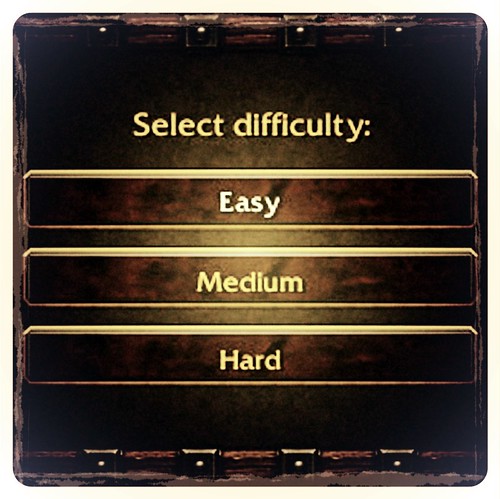
Levels of Difficult

You Can’t Choose This Difficulty Level!

I think I received my first comeuppance regarding white privilege around 1973. I was not quite 26 years old and had been a very active member in the anti-Vietnam War movement in Los Angeles. I had attended, organized, publicized, and provided security for a number of demonstrations and events.

Now I was preparing to spend a couple of months in Cuba as a guest of the Cuban government. I was a member of the Sixth Contingent (Sexto Contingente) of La Brigada Venceremos. I was excited. However, nobody was allowed to travel without first undergoing some rigorous training in how to not be an ugly American.

We Americans (even the term American is somewhat arrogant, as the U.S. is only one country in an entire hemisphere referred to as America), especially us straight males, have got it way better than we like to think. Unfortunately, due to the concept of American Exceptionalism, we really do like to think our shit doesn’t stink and we are in a class by ourselves.

Well, actually, we are in a class by ourselves – but it’s really not something to be all that proud of, in my less than humble opinion. But I digress.

Part of my ongoing training (which lasted several months) was learning about white privilege, i.e. the numerous and subtle ways in which being white gives those who sport the color (or lack thereof) a leg up on everyone else. The training was excellent. I was not made to feel guilty; merely shown how it works, the evidence of which was impossible for me to deny.

As a Knowledge Management professional, one of the things that’s important to me is the avoidance of re-inventing the wheel. That means, among other things, using the work of others to build on, where appropriate. I think this is an appropriate place to do that with a blog written by John Scalzi who, frankly, I don’t know much about. Nevertheless, this blog he wrote is absolutely brilliant and draws an analogy I think useful in understanding the concept I’m talking about. I want to share it with my small group of readers.

Here’s the link to his post – http://whatever.scalzi.com/2012/05/15/straight-white-male-the-lowest-difficulty-setting-there-is/

I also want to share a video that’s a nice supplement to it. Enjoy!


Social Business and Social Intercourse

Hand Axe and Computer Mouse

The Axe (made by one person) vs. The Mouse (made by millions)

While working on a presentation, which I’ll be giving to the American Oil Chemists’ Society’s Annual Meeting in Long Beach, CA at the end of this month, I’ve been looking for material I can use to highlight my excitement at the prospect of social business applications. I long ago came to the conclusion that what then was the nascent capabilities of Web 2.0 would someday revolutionize how we go about creating value in our economy and, necessarily, in our enterprises and organizations. Nothing has diminished this excitement and, in fact, I become more excited as I follow the changes that are taking place today.

In doing this bit of research I was reminded of a wonderful TED talk I watched some time ago and thought to check it out and see if it would jog my memory and, perhaps, give me some greater insight into how I can communicate my excitement and the vision I have to those to whom I will be presenting. The talk is by Matt Ridley and is entitled “When Ideas Have Sex”. I’ve embedded it below. In addition to the points he makes about the interchange of ideas (sex), it is also a wonderful example of the systemic nature of existence and human interaction.

Matt also refers to an interesting essay I believe gave him the overall idea for his talk. It was written by Leonard E. Read and is entitled, “I, Pencil: My Family Tree as told to Leonard E. Read.” Although I’m reasonably certain it was written with somewhat of a political agenda, which is the defense of free-market capitalism, I believe it also demonstrates the systemic nature of human economy and interaction . . . trade, if you will. I will leave the arguments for and against government intervention, whether through planning or through regulation, for other posts in future.

In the meantime, I really think you should read Read’s essay and watch this highly-engaging TED talk by Matt Ridley. You may find yourself wanting to repeat the process on occasion. I think this was the third time I’ve watched. Hope you like them.


The Many Uses of Facebook

Speak Up?

Thinking Back

A while back I wrote about the dilemma I faced when I first realized my Facebook “friends” consisted of numerous constituencies, and my concern that speaking frankly to one may unwittingly offend or alienate some from another. I also mentioned that, despite this initial fear, I quickly resolved it in favor of just being myself and not worrying too much about it.

Lately I’ve noticed another phenomena that’s been slowly creeping into my activity on Facebook. While it’s related to my interest in economics and politics, it does seem to be driven considerably by the Occupy movement (I use only Occupy advisedly, as there exist not merely an Occupy Wall Street group – which started this whole thing – but also other groups, most evident on Facebook as Occupy Together, Occupy Marines, etc.)

As part of my decision to just “let it all hang loose” and be myself, I have increasingly shared articles, pictures, etc. from some of the political sites I either frequent or that like-minded friends have shared with me. As it happens, I generally characterize my political leaning as so far to the left I’m almost a Libertarian (mind you, emphatically not one). I have also responded to some posts from people with whom I don’t exactly agree, telling them politely of my problems with their positions. Most of these conversations have been quite pleasant; spirited debates over policy and principle. Several times someone has actually commented on how they were pleased with the civility of the thread and its participants.

Is Useful Political Discourse Possible?

So, what I’m beginning to wonder is if this is, indeed, a new phenomena that may turn out to be useful and healthy for political discourse. If you have a fair amount of friends there’s a substantial chance they will represent numerous viewpoints and positions on the important issues facing us. Might not we be able to understand each other better and, consequently, move away from the precipice of irreconcilable differences we seem to be teetering on lately?

I have to admit there is a bit of a dark side to this as well. Two things have happened to me that I find a bit chilling. The first was a friendly “suggestion” I received that I might want to tone it down a bit when discussing the Occupy movement and the politics and economics behind it. The impact this might have on my standing in the business community was the implication, and its seriousness did not go unnoticed by me. The second is related, but needs a bit of background.

UC Davis Pepper Spray Incident

Not Exactly a Meeting of Minds

Maybe We Can’t All “Just Get Along”

I live in a relatively insular city – Simi Valley, CA – home of the Ronald Reagan Presidential Library and Museum. The City leaders are, for the most part, far more conservative than I am (who isn’t?) and I have become Facebook friends with a lot of them, including the Mayor, members of the local Chamber of Commerce, and at least one City Council member. Being a strong proponent of the right of free speech, I have spoken my mind rather openly; at least on Facebook. I don’t get into too many political discussions when doing business and I am a big supporter of local small business and wish to actively contribute to making our local economy strong and vibrant.

Last night I realized the City Council member had “unfriended” me, presumably due to a conversation I had with a couple of his friends. As I recall, it was one that received a post of praise for its tenor and the level of intellect involved. I do recall, though, I was very adamant in pointing out what I saw as fallacious arguments based on incomplete or incorrect knowledge. Frankly, I’d like to hear of anyone having a really fruitful discussion about the merits of Dialectical Materialism with a rabid anti-Communist. In my experience, the philosophy behind Marxism is little known here in these enlightened United States, and it’s very hard to receive any respect from someone who is certain of the correctness of their knowledge and the evilness of yours.

A Profound Dilemma

So I’m also wondering . . . despite my essentially being out of the job market and, therefore, not having to worry about alienating a potential employer, do I now have to censor myself politically lest I “upset” a city leader and risk throwing a roadblock in my meager, but important, efforts at making Simi Valley a better place to live? I don’t ask that people agree with me; merely that they respect my position and – especially – my desire to do what’s right for the community as I see it . . . just as I respect their beliefs and integrity. I really don’t care for revisiting this whole dilemma around what’s appropriate when it involves the core issues of our lives and livelihoods.

As well, I’m very disappointed this person decided to unfriend me. I believe we have more in common than we differ on. I also wanted to keep up with what he was doing as a Councilperson, as he uses Facebook to post from various events he is involved with. It seems I’ve been cut off from a useful, viable channel to the goings on of one of my city’s leaders and I’m still not sure how I feel about it. How do you feel about this?

Mouth/Flag Image from reading. writing. revolution


Hey! Long Time, No See.

Putting The Pieces Together

These Trying Times

So . . . I haven’t written much lately. I had been writing about things I believe will be helpful to the people and organizations I’m beginning to work with to build their businesses in these trying times. This has been, however, a period of transition for me and sometimes I feel the need to concentrate on what I’m doing, as well as on my current clients and others who have expressed an interest in using my services. One of those services is not yet writing a blog; at least not this one.

The last few weeks have been quite interesting for me. I’ve been working in earnest with two larger clients, both of whom require a lot of attention and even more learning on my part. They are helping me continue my journey from the corporate world to the world of small business. The differences are stark and, sometimes, very challenging to deal with competently. Frightening is a word that comes to mind some times as well.

I live in a comparatively small town. Simi Valley has a population – according to the last census – of nearly 125,000 people. Not tiny by a long shot, but pretty small compared to its neighbor, Los Angeles. Everybody doesn’t know everybody, but it can seem that way at times. It took a while, but I finally settled on a business model I though made sense and, slowly but surely, it seems to be working out. The model is simple. Provide social media marketing coaching for small businesses.

The model may be simple, but I’m discovering the execution of that model is fraught with difficulty. I think there are two things that make selling my services so hard. The first has to do with the lack of understanding – and misunderstanding – of the role social media plays in marketing one’s products or services; the second is tied to the economics of very small businesses and the current state of the economy. I am addressing the former in several different ways, but the latter is something I have little control over.

What’s both interesting and frustrating is that various surveys are showing greater and greater acceptance of social media within large organizations, but it doesn’t seem to be translating into the same interest and use by small businesses. For instance, I am working with a small development company/landlord that has approximately 30 retail tenants. All of these businesses could benefit from the use of social media to market themselves.

They are a combination of restaurants, retail shops, service organizations, and professionals – each with slightly different but closely related needs when it comes to marketing. The landlord is very supportive of the tenants, always looking for ways to increase traffic and visibility of their businesses. They’ve even offered to underwrite some of my services, and I’ve endeavored to offer a package that would be both useful and quite affordable.

Regardless, it feels like pulling teeth to get most of these businesses to take advantage of either the services available to them or the coaching and analysis I can offer in their proper use. This is an ongoing battle I’m not willing to forsake at this time, as I am committed to seeing my little town weather this economic storm and, if at all possible, even thrive. I’m working on different methods to help and am hopeful that some combination of offers will allow me to be both useful and modestly profitable. In addition, I hope to share more and more of what I’m discovering as I travel this new road. Stay tuned.

Photo Credit:

Winston-Salem-SEO.com


Why Would We Wish to Waste So Much Talent & Investment?

Atlantis ascending - STS-27

Atlantis Powers to Orbit

As long as I worked at what is now called Pratt & Whitney Rocketdyne we referred to NASA and the Air Force as our “customers”. For nearly twenty years I worked on the Space Shuttle Main Engine program and we always called NASA our “customer”. In the last few years of my employment there, when my awareness of – and interest in – social media brought me to learn as much as I could about what was available and how it might be of benefit to my company, I began arguing for a different approach. I believed, still do, that the real customers of companies involved in space exploration are the American people, those who pay the taxes that were used to pay our salaries. I still believe this is the case, and I still await the evidence of an enlightened approach to engaging them.

In the meantime, I just received an email request to take action and I want to pass it on in the hope some of you who read this will consider taking action; very simple, virtual action. I believe it is imperative for the human race to establish not merely a technological presence in space, but a strong cultural presence as well. I don’t believe it has to be dominated by the United States. In fact, I would prefer it be an international, world-wide effort to ensure the long-term survival of our species. Nevertheless, what is currently happening here is the gradual wasting away of our talent and our industrial base to continue leading the effort. I will no doubt write more about this as it is near and dear to my heart.

What follows is the text of the email, which comes from the website I’m asking you to visit and consider using to send a letter of support to the President, your U.S. Senators, and your Congressional Representative. I’m also including the link below the text so you might take action if you’re so inclined.

I’m concerned about the future of the United States’ role in space. Investments in our nation’s space programs will have a direct impact on our future economic strength and ability to remain a space-faring nation on the cutting edge of technology. I urge you to make a strong commitment to maintaining the U.S. as the unsurpassed leader in space.

For decades, U.S. leadership in space has been recognized across the globe. However, that position is perishable, and continued national leadership will be vital for our future. Therefore:

  • It is important to establish a long-term national space strategy that factors in civil, national security and commercial interests in space. Our national strategy must also cut across all agencies that have a stake in space. Without a national strategy, America risks a future where the workforce and industrial capacity needed to maintain U.S. leadership and competitiveness in space is seriously – and in some cases irreversibly – degraded.
  • It is important for our future global competitiveness, leadership and innovation in space that budgets and funding remain stable and robust. Appropriate funding must accompany strategic goals to meet established objectives and sustain a strong and progressive space industry.
  • It is important to support policies that maintain a healthy and vibrant space industrial base that employs technically-skilled American workers. Modernizing our nation’s export control policies – so that U.S. industry can compete on a level playing field – is one step in the right direction.
  • It is important to recognize that the space industrial base drives technological development important to our economy and national security. Our national strategy must identify and seek to preserve the space capabilities critical to meeting our national goals.

The United States stands at a critical juncture between past accomplishments and future ambitions in space. The rest of the world is not waiting. Yet there is uncertainty about the future of U.S. leadership in space; our workforce is facing upheaval and layoffs and the U.S. space industrial base is at the brink of losing our competitive and innovative edge.It is absolutely critical that our nation’s decision-makers work together to show the leadership needed to keep our space efforts robust. I urge you to make addressing these issues a national priority.

Here is the link to send this letter. Thanks for considering it – http://www.spaceleadership.org/


Enterprise 2.0 Through The Eyes of a Friend

I have been a KM practitioner for over a decade, and one of the principal reasons we have given for using KM principles is the need to keep from reinventing the wheel. So, in that spirit, rather than write my impressions of the Enterprise 2.0 Black Belt Workshop here at the Enterprise 2.0 Conference in Boston, I’m merely going to point to the blog of my friend @VMaryAbraham, since she has taken copious notes and already put them online.

This will make up for the fact that I accidentally set my alarm for 6:51 pm (most of my timepieces are set to 24 hr time) and got about an hour later than I had planned, coupled with a public transport nightmare, that had me over two hours late to today’s inaugural session.

So without further ado, here’s the link to Mary’s (award-winning, I might add) blog – Above and Beyond KM – http://aboveandbeyondkm.com/2010/06/learn-from-the-e2-0-vanguard-part-3.html

P.S. – unfortunately, WordPress does not fully support the iPad yet, and publishing a blog is a bit problematic. One problem; I can’t make the URL to Mary’s blog an actual hyperlink. I’ll have to fix that as soon as I have access to a regular computer. In the meantime, if you want to read Mary’s notes you’ll have to copy and paste the URL into your browser. Sorry about that.


Where’s the Anger?

Listening to only minor excerpts (and some exceptional analysis on KPFK Pacifica Radio) I find myself absolutely incensed at the arrogance of the people who caused the financial meltdown and who gladly took our tax dollars, ostensibly to keep the economy afloat, and are now proceeding to pay themselves handsomely for their indiscretions.

Listen . . . I’m doing OK. I didn’t get caught up – at least not directly – in the mortgage fiasco and I’m lucky enough to have a job that probably isn’t going anywhere, but what about all the people who’ve lost so much? Even if they were a bit greedy (or where they just reacting logically to a society that preaches the ethos of looking out for oneself and the hell with everyone else?), I don’t think they deserve this kind of disrespect and the uncertainty that so many face right now . . . with no end in sight.

But I have to ask, where’s the anger? Why aren’t people really paying attention to how we’re being played. Though I think Phil Angelides probably has the best of intentions, I think his commission is going to end up toothless and, once again, the high-rollers of Wall Street are going to scoop their ill-gained winnings off the table and we’re going to be left wondering what happened? Where are the pitchforks? Why aren’t more people demanding accountability? Where’s the call for bringing back the guillotine?


Once More Unto The Breach, Dear Friends

Blogging is an interesting occupation or, in my case, avocation. For me it has allowed mostly venting, though I started with a blog about my family that was anything but. I finally gave up on that, believing it really wasn’t my place to put out our personal details for everyone to see. I am considering doing just that in a book, which requires some personal investment and input (like moolah) from the reader; something to salve my family’s wounds for having made our foibles public. That, however, is another venue I will explore. For now we are about blogging.

I propose, for this blog, to explore the symmetries, similarities, and synergies of the philosophy of the Dialectic and the teachings of Systems Theory. I propose to explore the writings of people like Karl Marx, W. Edwards Demming, and Russell Ackoff, as well as others who have studied and written on either of the subjects. As far as I can tell, this is a novel approach; some may say strange or even dangerous. Nonetheless, I find it interesting and quite valid, i.e. the juxtaposition of the two seemingly disparate concepts.

I say disparate because the philosophy of the Dialectic (actually Dialectical Materialism) espoused by Karl Marx, Fredrich Engels, and (yes, even) V.I. Lenin is irrevocably and inextricably entertwined with the Soviet Revolution and State no longer extant in Eastern Europe, while the teachings of Systems Thinking took root in post-war Japan and have flourished in the deeply entrenched Capitalism of the United States and elsewhere.

I don’t expect my analysis to proceed quickly, nor do I expect to be able to post all that frequently. The exigencies of my real job, coupled with my attendance in an online Masters program at CSUN – not to mention the fact I have two quite young daughters who demand a lot of my attention – will make it difficult to attend to this blog. Regardless, I think it a worthy objective and, God willing and the creek don’t rise, I’m hopeful it will be the precursor to either a Doctoral Thesis, or – at the least – a serviceable essay on the subject. Who knows? I guess that’s one of the beauties of blogging. I can put forth ideas and, if I’m lucky, I’ll even get some feedback. At the very least I get the opportunity to blather on about something that interests at least one person in this world.