
There’s a little sort of game going on in Facebook lately. Someone is challenged to list three things they’re thankful for for seven days, at the same time tagging a friend each day (or something like that) to do the same. I haven’t been asked to do it, and I have no plans of doing it either, as it just seems too spread out and broad to do justice to the recognition of those things we might be thankful for. Nevertheless, it does give me pause and I have been thinking about what I would say should I choose one or two specific things for which I’m thankful. There is one seemingly mundane thing that keeps popping into my head. My ability to type.
I can’t imagine how different my world would be if I had to use what an old girlfriend of mine called the “search and destroy” method of typing. Most people use the more pastoral term “hunt and peck”, but she spent several tours with the USO in Vietnam and her life was colored by her exposure to that war, the military, and her involvement in the movement to end it. If I were hampered by that inability, my social presence and my ability to communicate would be virtually non-existent.
I was fortunate. In Junior High School I took a typing class; instead of what I haven’t the faintest, but I recall it seeming to be the most useful option at the time. As a result, I learned to touch type. Later on, when I was in Law School, I secured a position as a legal secretary for a sole practitioner who did a lot of contract and property damage work for several of the largest car rental agencies in the country. We were very busy and my workload was challenging enough that my speed increased. I’ve never been as prolific as the best, but I was up to a little over 80 wpm, with few if any errors. That’s not quite as fast as the average person can speak, but it’s a respectable clip.
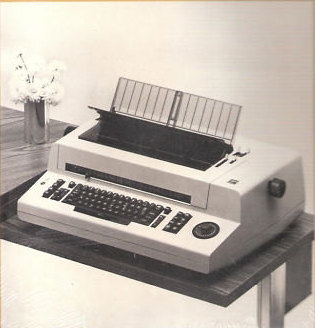
The IBM Memory Typewriter
The job turned out to be a major turning point in my life, as I was introduced to the early stages of office computing and word processing. We ended up getting an IBM Memory Typewriter, the one built on the correcting Selectric, but with a dial providing memory for 50 separate pages. We moved up shortly to an Artec Display 2000, which used two 8″ floppies and had a scrolling display of approximately 30 characters. I don’t remember if it was LED or LCD, but the characters were red. We used it for pleadings, and wills and trusts.
Back to typing speed and how critical it is to communication in today’s world. I don’t really have to imagine what it would be like, because I had an experience with a colleague that pointed it out rather clearly, though it took months for me to recognize what was happening. I was working with the Director of our newly formed Program Management Office at what was then the Rocketdyne Power & Propulsion business unit of The Boeing Company. We were at almost opposite ends of the main office building in Canoga Park and I was upstairs in what was called The Annex. The distance between his office and my cubesickle was around 400 yards; not a huge distance, but it took time to walk back and forth. Plus it meant passing through the Executive Office area and there were always distractions.
I can’t recall the exact dates, but it was very early in our use of Instant Messenger; so early that I had to point out its value, as most of the older staff (which meant all of the Executives) perceived it as only a toy their kids used to communicate with each other. I kept sending IMs to this Director, but he never answered them, nor did he respond in anything resembling a timely manner to emails, so I was forced to walk to his office repeatedly during the day.
It wasn’t until a couple of months had passed that I happened to be sitting with him in his office and he was answering an email. Watching him type . . . ever so slowly and painfully . . . made it clear why he never responded to me. He had to hunt anew for each letter and, with his two index fingers, peck them out in a long, excruciatingly difficult session. He clearly hated it. I know I was cringing as I watched. I never sent him an IM after that day.
I’m thinking the ability to type is one of those essential tools we seldom think about — perhaps take for granted — without which our world would be far less rich and fulfilling. I can type this post, tweet, post to Facebook, engage in lengthy, spirited debates with dozens of widely dispersed people, and participate in a plethora of other forms of communication or collaboration relatively easily, all because of my ability to type quickly and accurately. I imagine this is true for almost all, if not all, of my friends and acquaintances.
For this I am deeply thankful.



 Systems Savvy
Tweaking Facebook
Use the Like, Luke.
I am — at least, I was — a Knowledge Management professional. It’s what I did for over a decade at Rocketdyne, starting when it was a business unit of The Boeing Company, up through my retirement from Pratt & Whitney Rocketdyne, a division of United Technologies. Pratt & Whitney paid for me to earn a Masters Degree in KM online from CSUN’s Tseng College. It’s such an exclusive degree they don’t offer it anymore. 🙂
I mention this because it affects how I share information, especially here on my blog. One of the tenets we tried to drill into people’s heads, and follow ourselves, was to avoid reinventing the wheel. That is, make it a habit to reuse information and knowledge that’s already been won at some cost to one or more individuals and the organization in which it was produced. This means, among other things, I am not interested in rewriting what others have written, while adding my own twist to it. This doesn’t apply when how I perceive an issue is substantially different than others, but it does when I’m sharing things I mostly agree with.
Yesterday and today brought me two great, and related, examples of things that need sharing and for which there’s little for me to do than announce them. The first I will actually place second, below, as it’s the subject of the second, which is a post by Dennis Howlett, which he published today in diginomica. What Dennis discusses is a Google Hangout Robert Scoble conducted, wherein he described what he has learned in thousands of hours of tweaking Facebook’s algorithms — primarily through his educated use of lists, likes, shares, etc.
Both Dennis and Robert are still far more embedded in the business world than I am and, rather than attempt an explanation through my eyes, I want to leave it to both of them to help you out. If you are using Facebook for your business or profession, or even if you just want to have a much better experience when using Facebook personally, I suggest reading the post and watching the video, which I am also including here. As Dennis points out, Robert is very generous with sharing his knowledge, something this KM pro really admires. You really should take advantage of it.
If you care to share:
Leave a comment | tags: algorithm, Business, comment, diginomica, Facebook, Google, Google Hangout, Howlett, KM, Knowledge Management, Like, lists, Personal, Scobleizer, share, sharing | posted in Business, Info Tech, Knowledge Management, Marketing/Branding, Professional, Social Media, Technology