I have, in the past, asked when it would be time to consider acting out against polluters, climate change deniers and, especially, so-called governmental leaders as acts of self-defense. After all, increasingly severe weather events are killing large groups of people who currently have no say in how we deal with the climate crisis, which I believe is very real and abundantly documented.
So I’ve wondered just how long we’re going to sit back and allow our leaders and businesses to ignore what is patently obvious, ensuring more and more of us will be sickened, impoverished, and killed because of their greed and intransigence.
You might want to take 10 minutes of your time and listen to what Chris has to say here. It seems to me we have only about three paths to implement the changes that are necessary. Massive participation in the electoral process to fundamentally change our leadership, massive civil disobedience to disrupt the status quo, or massive violence to overthrow the government and install new leadership. I would prefer one of the first two (and, like Chris, I’m fairly convinced the second of the two has the best chance of making real, fundamental, transformative change) but I’m not opposed to the latter on ethical grounds. I do, however, think violence will end up hurting those who are the most susceptible to oppression and suppression and, therefore, am not terribly sanguine about such a direction.
I’m thinking this is something that will deeply impact all of use far sooner than we’ve been led to believe, and action is imperative. What do you think?
I came across this graphic on Facebook today. It struck me, as the concept has struck me for decades, that this should be part of any truly progressive agenda. I have been an “ordained minister” since the late sixties. I have performed approximately 50 weddings, which was the main reason I became “ordained.” It wasn’t to lead a congregation or even to claim tax breaks, and I claim no special relationship with the universe. In fact, I am an atheist.
One thing I learned early on, though, is the State considers a church a business, an organization, with the lone exception (that I can think of) of taxation. By not taxing religious organizations the State is giving them an unfair advantage over any other type of business and is, in my less-than-humble opinion, violating the 1st Amendment to the Constitution byโin factโmaking a law respecting an establishment of religion.
Even more egregious is the situation depicted here. Mega churches are nothing more than income sources for their “leaders.” I believe this is Joel Osteen’s “flock,” as well as his home. Why does a follower of Jesus, a poor itinerant, and one who purports to be a spiritual leader, need a house that could probably accommodate the entire village of ancient Bethlehem? If nothing else, these huge and “Osteen”tacious abominations should pay their fair share of taxes on the revenue they get from their “flock.”
As if there weren’t enough problems with the absolutely crazy proliferation of guns in the United States, some people are so caught up in the perceived value of everyone owning and constantly carrying guns, we’re beginning to see what I would consider crazier and crazier legislation to exalt the use of firearms. This article from American Military News is a bit disheartening. Isn’t this a mission the National Guard is designed to fulfill?
If you ask me (I know, you haven’t. Consider it a figure of speech on my behalf) this is nothing more than fear mongering; a cowardly bend of the knee to racism and xenophobia. We already have Police forces, Sheriff’s departments, and various types of Marshals, in addition to the aforementioned National Guard. Who are these “minutemen” going to protect us from? White supremacists. For some reason, I suspect this would actually prove to be a natural way for white supremacists to move closer to realize some of their darkest fantasies.
I’ll reiterate. Bad idea! Bad, bad fucking idea. Here’s an excerpt and you can read more at the link appearing below.
Lawmakers in Missouri are considering legislation that would make it legal to create a Missouri Minutemen, a group of legal gun owners who could be called to action by the governor. On Tuesday, state senators discussed S.B. 258, which would establish โthat there shall be the minutemen of the state which shall be called into service by the governor for use in defense during a state of emergency with consent of two-thirds of the General Assembly.โ According to the legislation, any legal Missouri resident who is legally able to own a firearm will be allowed to voluntarily join the minutemen
While doing a bit of research on the original sin of racism in the United States, I came across this quote by Benjamin Franklin. I find it a powerful argument for why the Constitution of the United States needs to be either completely re-written or deeply studied and amended. I say this because it was written entirely by white men. At the time, this made “sense” as nobody else was allowed to own property or to vote; not women, indigenous Americans, or black people, all (or, certainly, the vast majority) of whom were slaves at the time.
โI doubt too whether any other Convention we can obtain, may be able to make a better Constitution. For when you assemble a number of men to have the advantage of their joint wisdom, you inevitably assemble with those men, all their prejudices, their passions, their errors of opinion, their local interests, and their selfish views. From such an assembly can a perfect production be expected?โ he asked.
Benjamin franklin – September 17, 1787
Things have changed considerably in the ensuing nearly 234 years and I believe our guiding documents should be updated to reflect the profound changes that have occurred in our nation during that time. From the ending of slavery, through women’s suffrage, to the Civil Rights Movement, and to the first Native American to be appointed to a Presidential Cabinet position, nearly everyone has been “emancipated” politically, yet our founding document still rests on the “prejudices, passions, errors of opinion, local interests, and selfish views” of the Founders. I believe we can … nay, must … do better.
I am a lover of coleslaw, especially the creamy deli coleslaw I grew up eating in small Jewish delis in the San Fernando Valley, as well as the Fairfax area (I’m looking at you, Canter’s) and, later, Langer’s. However, I discovered a different way to prepare coleslaw when I first had the opportunity (at least 15 years ago, maybe more) to eat at Wood Ranch BBQ, near my current home in Simi Valley, CA. Instead of creamy and sweet, it’s oily, vinegary, and savory … and it’s delicious.
Since I’ve been cooking a lot more lately, and have spent some time searching out and gathering recipes, I had found a recipe for Wood Ranch BBQ’s peanut cole slaw and wanted to try it out. I had no choice but to make a few adjustments, as I didn’t have any red cabbage and only had a 14 oz bag of shredded cabbage and carrots. I had no intention of going shopping. I made some adjustments in ingredient amounts to compensate, and left out the salt, since the only peanuts I had were salted. I had two small bowls and am looking forward to dinner, when I will eat it again. My wife is thrilled as well. It tastes very much like I remember, and my memory tells me it wasโand ISโdeliciously wunderbar! I’m sharing the recipe, just in case you’d like to try it yourself. As the saying goes, “Try it. You’ll like it.”
Based on the activities of these six senators (at least these ones) I worked this up a while ago, then forgot about it. Just want to put it out there. These six are, in my estimation, particularly egregious in their subservience and sycophancy, though we all know it’s based on naked ambition. If there is a better argument against allowing these kinds of people to run for any office of public trust, I don’t know where it’s to be found.
I was raised in the San Fernando Valley. Sputnik 1 was launched exactly four months after my 10th birthday. I remember lying outside on our front lawn, watching it go over. It was exciting and mysterious at the same time. I have a vague memory of seeing the United States’ first satellite, Exlorer, go over and I have a real vivid memory of seeing Echo as it orbited our planet. Echo was a giant aluminum balloon that, when inflated in orbit, was 100 feet in diameter and reflected the Sun, making it the brightest object in the sky except for the Moon.
I also have vivid memories of rocket engine tests in the Santa Susana mountains, just slight northwest of where I lived. Many of the tests were conducted at night, and I could see the sky light up over those mountains. As I grew up, I had friends whose parents worked at Rocketdyne, the company that built just about every liquid-fueled rocket engine used to power America’s space program, including Mercury, Gemini, and Apollo, not to mention the Space Shuttle.
Little did I know that many years later I would, quite serendipitously, get sent on a temporary assignment to work at Rocketdyne. I had been working at a company that manufactured what were, at the time, high density hard drives. This was in 1986 – 1987, and high density meant something like 5 Gigabytes! It was, for some reason I still can’t quite fathom, a seasonal business and when demand dropped all the temporary employees got laid off. That was me. I lost my job on a Friday. Later that evening I got a call from Apple One, the organization I was temping through, telling me to show up at Rocketdyne’s Canoga Park facility the following Monday.
To make an exceedingly long story short, I started work on the FMEA-CIL (Failure Mode & Effects Analysis-Critical Items List) the document that would prove Rocketdyne’s RS-25, SSME (Space Shuttle Main Engine) was safe for the Shuttle’s return to flight almost a year to the day after Challenger exploded during the ascent of STS-51-L. (For clarity, I think it important to note those engines were not responsible for the loss of Challenger; they had worked just fine.) I had long been a space cadet (in far more ways than one) but I never imagined I could end up working there, as I wasn’t an engineer. Silly me. I just hadn’t realized it takes a lot more than engineers to run a business that large and complex.
I was hired in after a year as what they referred to as a “job shopper.” I was forty years old. I retired 23 years later and it was the best, most fulfilling job I ever had, though dealing with a huge corporation (and “the Rock,” as we called it, was part of Rockwell International, the Boeing Company, United Technologies’ Pratt & Whitney Division, and Aerojet) was why I left early. The Shuttle program was winding down and P&W offered everyone over 60 a severance package I just couldn’t refuse, even though it wasn’t terribly generous.
Nevertheless, I’ve remained deeply interested in space exploration. I have long believed it’s important to the survival of humanity we get off the surface of this planet. I believe we need to establish not merely a scientific, but also a cultural presence off-planet in case of an extinction-level event. Frankly, it’s my opinion if we don’t do something about climate change and our contribution to it, we may be the ones causing such an event.
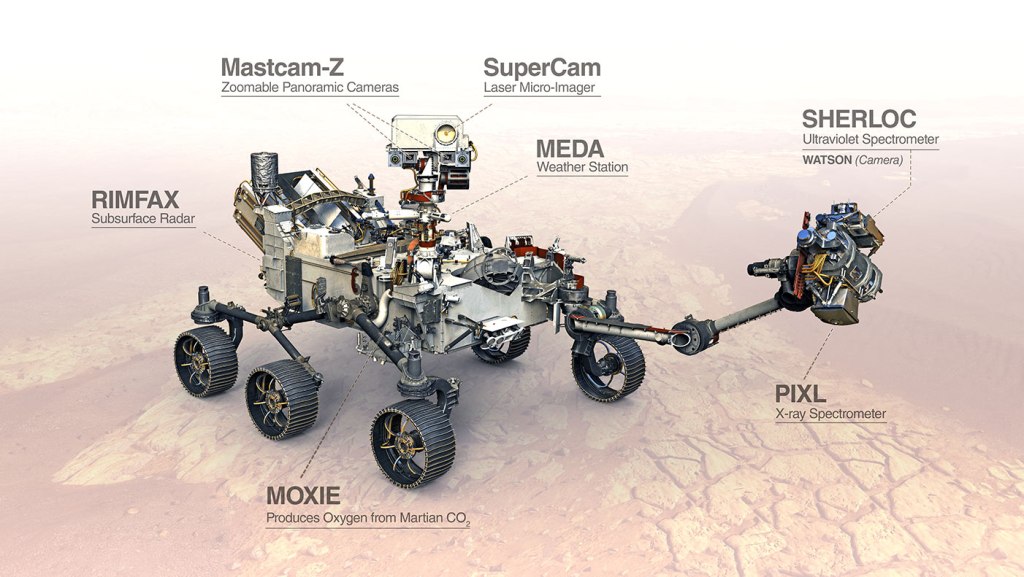
At any rate, all this is to say I am happy Perseverance landed safely on Mars this afternoon (PST) and appears to be functioning as designed. I’m looking forward to learning more about the Red Planet. I’m especially keen on learning how well the Moxie instrument (see graphic, below) accomplishes its mission of producing oxygen from Martian CO2. Congratulations to JPL and the Perseverance team. Job well done!
PS – I’ve also posted a graphic depicting one of Perseverance’s scientific missions, the Ingenuity helicopter which, if successful, should dramatically improve our ability to send rovers to the most fruitful (scientifically) locations, after they’ve been scouted out by Ingenuity and its successors.
I was born just after the end of World War II. The nation was heady with promise and I was raised immersed in what I later came to realize was propaganda; the belief that the United States of America was the greatest, most progressive country in the world. I’ve known for a long time that’s not true, but I find myself wondering how a country that speaks and thinks of itself as “exceptional,” can defend so many people coming this close to financial and, perhaps, physical ruin (see WaPo article in Tweet, below.)
Never in my wildest dreams did I think I would ever feel guilty about being on Social Security. I don’t get a lot (nobody does) but along with my wife’s social security and the income from our meager retirement savings, at least we’re not food insecure or in danger of being homeless. It doesn’t feel right, though.
Yet, I’m helpless to do much to assist other than support economic transformation that would alleviate these problems. If there are millions of families in this horrible situation, how can any of us do much about it, especially when doing so would bring us closer to the same kind of ruin. Losing one’s home, especially if you “own” it, is devastating and very difficult to come back from. Nobody deserves this kind of reckless abandonment, yet that’s exactly what Donald Trump is doing. I can’t think of much that would be a worse dereliction of duty than this.
I don’t know what’s going to happen in these next 28 days … and beyond. The fact that Trump vetoed the legislation and has left for Mar-a-Lago, the government closes down next Tuesday, and much of the help that had been made available for people who’ve lost their jobs to COVID-19 is drying up this week is not helpful. Maybe it’s time for:
Thirty-four years ago next month I showed up for work at Rockwell International’s Rocketdyne Division. Having grown up in the San Fernando Valley in Southern California, I was familiar with Rocketdyne, as during the Mercury, Gemini, and Apollo programs the rocket engines they made, which powered the vehicles used to launch our astronauts into space, were all designed and manufactured not far from where I lived.
The factory was in Canoga Park, but the engines were tested at the Santa Susana Field Laboratory, which was in the hills to the west of my home. I have vivid memories of seeing the night sky light up and hearing the roar of those engines as they were being tested. I also remember going out at night and lying down on our front lawn to watch Sputnik 1, the world’s first artificial satellite (launched by the Soviet Union on October 4, 1957) go by overhead. I was ten years old at the time.
While these experiences didn’t cause me to pursue a career in engineering, they did serve to pique my interest in astronomy and space exploration. They also had absolutely nothing to do with my ending up working at Rocketdyne. My beginning there was entirely serendipitous. I was working for the temp agency, Apple One, where I had been temping at a hard drive manufacturer called Micropolis. Their business model, perhaps the industry itself, was somewhat seasonal and work for temps was boom and bust there. As had happened many times before (we’d heard about it and weren’t surprised when it happened) business slowed down and they decided to lay off the temps, who comprised the majority of the workforce.
That was on a Friday. That evening, my contact at Apple One called me and asked if I could show up at Rocketdyne the following Monday. I don’t remember the exact date, but it was in the middle of January, 1987, almost exactly a year after OV-099, Space Shuttle Orbiter Vehicle Challenger, exploded as it was ascending to orbit, killing all seven crew members.
I was to turn 40 years old later that year and of course I would show up. I needed to work. However, that it was Rocketdyne I was to show up at was something of a bonus, as far as I was concerned. I had known people who worked at Rocketdyne over the years, and it never occurred to me I could work there. I wasn’t an Engineer or a Scientist. I didn’t even have a college education, though I did have a Juris Doctorate, which I had earned eleven years before. I was the only person in my law school without a baccalaureate. None of that mattered as a temp (or what they called a “job shopper”.) They didn’t ask anything about my background or my capabilities. They just needed a warm body who could perform data input.
So, that following Monday I showed up to work at the plant on Canoga Ave. in Canoga Park. I had never worked at a really large organization before. In fact, with the exception of the temp job I had previously been working at, I had never worked anywhere that had more than a dozen or so people. Most places I’d worked only had five or six, at the most. Rocketdyne had armed guards at the gates. There were at least four entrances guarded by men with guns. It was actually a bit heady.
I ended up hiring in a year later and worked there until May of 2010, when I accepted an early severance package offered to everyone over the age of 60. I turned 63 the next month, June. I’m writing several memoirs, and my time at Rocketdyne will play a big role in at least one of them. However, my purpose here is merely to introduce one of the “awards” I received when I worked there.
I was not a big fan of individual performance awards, believing they tended to pit people against each other when, in fact, we needed to find ways to improve our collaborative and collective abilities. This particular award was given to each of the members of the Space Shuttle Main Engine High Pressure Fuel Turbo-pump team, who labored mightily to manufacture, test, and deliver 10 additional pumps for the program when Pratt & Whitney was unable to certify their alternate design. As our contract ran out, and we knew there would be no new business, the team had to wind down and members had to find other places to hang their hats.
You should note that everyone on the team received one of these shadow boxes, with a flag, a turbine blade, several mission buttons, and these inscriptions (see below.) I’m including the back, because our managers took the time to personally thank each person on the team; there were well over fifty, if memory serves. This “award” hangs in my home office. This coming May it will have been 20 years since I received it, and I’m every bit as proud of it now as I was back then. Plus … how often do you get to have a piece of rocket engine hardware and other space memorabilia?
PS – In case you don’t get to it (it’s on the back of the shadow box) that turbine blade traveled a total of 27,600,000 miles, mostly doing nothing after MECO (Main Engine Cut Off) on each flight.
PPS – Just to be clear, in these two photos (below) I’ve superimposed the award (from the front) on a picture of a shuttle night launch. It has a glass door, which I opened because it’s reflective and I didn’t want that in the photo, and digitally removed with Photoshop. I’ve separately added the two pieces of text from the back, without including the box, and superimposed them on that same night launch photo.
One of the ways I’ve been working on upping my writing game is by paying attention to what people are reading here on my blog so I might get an idea of what moves my readers. I have now posted well over six hundred times and about 90% of these posts are essentially essays regarding my thoughts about various things, e.g. politics, religion, life, the universe, and everything. The other 10% are tests and sharing things I’ve come across but have little to say about. I also occasionally have reason to look back myself, even if no one has recently read a particular post of mine I find interesting.
To Open Up And Believe
Because there have been many highly emotional news stories lately, and emotions are high to begin with, I’ve been giving a lot of thought to the role of emotions and, especially, how they relate to empathy. Turns out I had written about empathy over eight years ago, long before Donald Trump’s presidency. Since the reality has hit us that he is entirely without empathy, I would like to share a concatenation of the two posts I wrote in late September of 2012. It’s my hope these two are as pertinent today as they were when I wrote them; perhaps more so because I was only writing then about my feelings and now what I wrote seems so pertinent to what we’re all experiencing in the waning days of this disastrous presidency.
The willing suspension of disbelief. What a powerful, magical, and exceedingly frightening thing it can be โ at least for me. Not always, though. Itโs been quite a while since my last venture into the genre but, a long time ago โ in a galaxy far, far away โ I read a lot of Science Fiction. Reading it canโt possibly be enjoyable if you arenโt able to suspend your ability to think critically. Nevertheless, I enjoyed the hell out of what many an author hated being called Sci-Fi.
Iโm normally somewhat cynical and am a fairly skeptical person, so Iโm continuously surprised at how easily I can get sucked into a compelling story, especially if the characters are even moderately complex. I think it actually frightens me to realize how deeply I have disappeared into many a television drama.
This tendency has no doubt been exacerbated by my becoming a father at the ripe old age of 55, when my wife and I culminated a decision we had made a couple of years earlier and traveled to the Peopleโs Republic of China to adopt our first child. We repeated the process four years later and, at the tender age of 59, I once again became a new father.
I now find myself immersed in shows where children are involved (it happens far more often than one might think) and I canโt help but identify with the parents, which sometimes brings me to tears โ occasionally racking sobs of grief.
It has always been this way. Iโve been told the men in my family โ many of them โ were blubberers. Though I couldnโt have been older than five or six at the time, I recall the first time I saw my father cry. He had just received news that my Bubbie Jennie, his mother, had died. He hadnโt seen much of her since moving to Southern California. She had remained in Chicago, where both my parents were born. It was eerie, and not a little unsettling to see my father, a young boyโs tower of strength and resolve, break down like that.
It was made more difficult because I had only met her once, when she came to visit for a week, and she was unfamiliar to me. On the other hand, my maternal grandparents lived with us and I felt a strong emotional tie to them I could not summon up for her. She was by Bubbie, though. My motherโs mother was just Grandma.
I frequently ask myself, however, why I am so deeply and painfully drawn into these stories. Iโm not entirely certain I have the answer, but Iโm pretty sure itโs not so much the story itself as it is the relationship those stories bear to my own life.
Dictionary.com defines empathy as follows: the intellectual identification with or vicarious experiencing of the feelings, thoughts, or attitudes of another. That seems pretty straight-forward, yes? I am a fairly empathetic person and I tend toward the second part of that definition, i.e. I feel the pain of others vicariously. However, I donโt think this captures the essence of what is happening when I am fully immersed in a story.
Perhaps itโs too fine a point and the distinction isnโt all that great, but it seems to me whatโs really happening is Iโm overlaying the experience in the story onto my own life. Iโm not so much experiencing the feelings of another as Iโm experiencing the feelings I would have were I to be in that situation. I donโt think theyโre the same. Then again, maybe thatโs the mechanism that actually facilitates empathy.
This is a minor conundrum that comes to me most every time it happens and, usually, I forget about it within a minute or two. Lately I decided to try and get a descriptive handle on it and this is my first attempt.
Empathy is a valuable and deeply human trait. It is one of the five traits listed as characteristic of emotional intelligence which, in turn, is seen by many as a valuable business and leadership skill. Itโs important to understand and to cultivate in order that we may better understand the people in our lives, whether at work, play, or home.
I want to understand what is moving me when this happens. On some levels it seems patently ridiculous to get so emotionally involved in a fiction story. On the other hand, perhaps it is really what makes us human. Iโm wondering if someone with a more classical education than I have knows more of the thinking humans have brought to the subject. Iโm sure some in the Arts (especially the Theater Arts) have tackled it. Iโll have to do more research. In the meantime, Iโm glad thereโs plenty of tissue in the house.
As it turns out, thanks to a friend I discovered an interesting answer through a wonderful TED talk by VS Ramachandran, a Neuroscientist who has studied the functions of mirror neurons. It would seem there is overwhelming evidence we humans are more closely connected than I was hinting at.
In his talk he says, โThere is no real independent self, aloof from other human beings, inspecting the world, inspecting other people. You are, in fact, connected not just via Facebook and Internet, youโre actually quite literally connected by your neurons.โ I find this resonates in many ways with my understanding of Systems Dynamics, Quantum Theory, and Zen and goes a long way toward answering my question. Frankly I find it a meaningful addition to my understanding, but still find myself wondering why it manifests itself so powerfully in some . . . and not at all in others. After all, the world is filled with people who are anti-social in varying degrees of severity from mild conduct disorders to outright sociopathy or APSD.
Regardless, there is much value in this talk. He speaks of the wonders of the human brain and, with respect to the issues I raised yesterday, uses words like imitation and emulation, ultimately winding his way to empathy. Rather than repeat any of his talk, I urge you to listen to it. Thereโs at least one very cool surprise a little more than halfway through. At less than eight minutes, itโs really engaging. Hereโs the video. Iโd love to hear what others think of this: