A Career Change at 70

When I was in High School (1962 – 1966) it took me three and a half years to escape) there were no computer classes. Although there seems to be some disagreement on when the first personal computer was invented, even the earliest claim puts the date six years after I graduated. There was no such thing as a computer, let alone a programming or coding, class. Also, I did not attend university and, to my recollection, nobody I knew at the time was interested in computers or information technology. Actually, I was a terrible student and wasn’t interested in much of anything by the time I finished High School.

IBM Memory 50

The IBM Memory 50 Typewriter

Fast forward to 1974. Despite having no undergraduate education, I was able to secure admission to an accredited Law School, located not far from my home in the San Fernando Valley. I began in the fall of 1973 and the following year I managed to get a job in the law office of a sole practitioner in Beverly Hills as a legal secretary/law clerk. Shortly after I began, the lawyer I worked for purchased an IBM Memory 50 Typewriter. I attended a one-day class where I learned how to use it. This was my first introduction to anything resembling “computing.”

The office later upgraded to an Artec Display 2000, which had an LED readout of approximately 30 characters. There was no CRT display. It used two 8″ floppy disks and had a document/data merge capability that made it perfect for boilerplate documents, e.g. Pleadings, Interrogatories, Summonses, etc. It was a great leap forward in word processing.

Edward Ladd & Sons

The Family’s Wholesale Food Business

Shortly after graduating from law school I had, for numerous reasons, decided spending the rest of my work life around the judicial system was not something I really had my heart in and, after much gnashing of teeth and going over my alternatives, I decided to join my family’s wholesale food distribution business. One large factor in making this determination was my father suffering his second major heart attack. The business was supporting my mother and my sister, who was only 10 years old at the time. I felt the need to help the business grow, ensuring they would be taken care of if my father were to die . . . which he did eight years later.

Edward Ladd & Sons Jacket

Our company jackets. Logo design by me, jackets created by Cat’s Pyjamas.

After a couple of years, the business had grown substantially and, given my desire for another type of challenge, I once again struck off on my own. I dabbled in a few things, then joined forces with a couple of CPAs and formed a royalty auditing business, serving some very high-end artists. The company first purchased an Apple computer (I can’t recall if it was a II or a IIe but, based on the release dates of the two, I’m inclined to think it was a II). We later purchased a Northstar Advantage, which used the CP/M OS and two 160 KB, 5.25″ floppy disks. We also purchased a dot matrix printer and, in anticipation of taking the system out on the road, we had Anvil make a hardened case for the two, with room for cabling, paper, and instructions to be packed inside.

At that point our audits required us to visit the artists’ recording companies, and my first visit was to RCA records in the Meadowlands of New Jersey. Standard procedure for the record company was to stick us somewhere that was relatively uncomfortable, then bring us stacks of paper, which we then transferred to ledger pages. Upon returning to our office in Playa del Rey, we would then have to transfer all the data to a spreadsheet; we were using SuperCalc on the Northstar Advantage, though we had started with VisiCalc on the Apple.

I suggested taking the computer with us when we performed audits, so the people who went out on the road could enter the numbers they received directly into an electronic spreadsheet, thereby saving a huge amount of time and stress. We were also using WordStar at the time for writing the narratives that would accompany our audit analysis.

My first experience with programming came when we were contemplating taking the system out on a European tour with Neil Young. I sat with my friend and partner, who had performed many a box office reconciliation, and we sketched out the different scenarios that were used to close out the night’s receipts. Doing so required the use of nested “if” statements, which determined the precise equation to use for each venue. Unfortunately, that same friend who had worked so diligently with me to create the formulae that would power the spreadsheet never felt comfortable with using it by himself and it never went out on the road.

Sinclair ZX81

My Very First Computer, the Sinclair ZX81

It was also around this time I purchased a Sinclair ZX81, which was a small computer that had a membrane keyboard and used a cassette recorder to save programs on. It also had its own OS, as well as its own version of Basic, which I endeavored to learn. The first program I wrote, which took me all night to complete, counted down from 10 to 0, in the center of the screen. It then plotted a single pixel (resolution was 64 x 48) at a time, starting from the bottom and, after reaching a height of six pixels, began plotting another pixel above the previous six and erasing a pixel from the bottom of the stack, until it left the screen at the top. This required me to learn how to use either (I don’t recall the exact commands; it’s only been a little over thirty-five years) nested “if” statements or “do while” commands.

Fast forward to 1984, the year my father died. Shortly afterward, I returned to help my brother keep the business going. We purchased a more advanced Northstar Advantage, which had a huge hard disk that could store 5MB of data! At the time, we also purchased a copy of dBase II, which was one of the first database systems written for microcomputers. I taught myself how to write systems using their programming language, which I wrote using WordStar. I wrote an entire accounting system for the business. My favorite component was the preparation of a deposit ticket, where I laboriously emulated the workings of a calculator in allowing for numerous methods of inputting dollars and cents (whether or not a decimal point was included) was the real differentiator and sticking point for me but, after much trial and error, I figured it out.

Unfortunately, my brother and I didn’t see eye-to-eye on the direction the business should go in and, after a while I left again, this time taking temporary jobs to keep me afloat. It was during this time I worked for a while at a litigation support firm that used a DEC minicomputer and several of the earliest versions of the Macintosh. All of my work with computers was novel for me, as I never took any classes — with the exception of that class I took to learn how to use the IBM Memory 50 typewriter. I taught myself how to program through reading and doing, sometimes taking dozens of iterations to get a bit of code correct.

In 1987, I had been working for a company that made hard drives (Micropolis). Their business was highly seasonal and, on one particular Friday, all the temps got summarily laid off. I was using Apple One at the time to send me out on engagements and, thanks to my willingness to show up wherever, and whenever, they would offer me a job, I got a call from them on that very Friday, telling me to report to Rocketdyne the following Monday.

By this time I had been shifting my focus from working under the hood, to figuring out how to best use the systems and tools that were rapidly evolving as business tools. I was beginning to focus more on business results with whatever was available. My first responsibility at Rocketdyne was to enter text I received from Engineers into a document called a Failure Modes and Effects Analysis / Critical Items List (FMEA/CIL). It was in direct support of recertifying the Space Shuttle Main Engine (SSME) for eventual return to flight after the Challenger disaster.

SSME

SSME Hotfire Test

It was a strange task, as the document was clearly text-based, yet we were using a spreadsheet to create it. I suppose it made some sort of sense, as the company was an engineering company and that’s kind of how engineers see the world; in numbers, rather than words.

I also worked with a stress engineer on creating an app (we didn’t use the term back then, but that’s what it was) that could be used to predict crack propagation and its effects. I was unfamiliar with the equations behind the program, but my job was to use dBase II to create an interface that allowed for data input and crunched the numbers. It was fun and was successfully used for some time after that.

One year after joining as a temp (referred to as a “job shopper”) I hired in full-time and began working with the Flight Ops team. It was exciting and I spent much of my time massaging telemetry data from hot fire tests of the SSME. I received flat files from a Perkin-Elmer mainframe and eventually ported the data to Microsoft Access, which allowed for further massaging and reporting.

In October of 1988, a little over eight months after hiring in, the U.S. Space Program returned to flight with the successful launch of Discovery. At a celebratory event that evening I met one of the managers of the Program Office. As we talked and he discovered my background, he offered me a job. I did some research and talked to my current managers, who advised me to take it, which I did. As time went on, I moved further away from anything resembling coding and, eventually, wound up concentrating on the use of software and computing tools to increase the effectiveness of me and my colleagues.

Not quite 22 years later, I took an early severance package (which was offered to everyone over 60) and retired. I would turn 63 less than a month after leaving the company. In 2015, I returned as a contractor doing something I had done nearly 20 years previously. I spent the next two years (until February 17 of 2017, to be exact) providing program scheduling for two small rocket engine programs.

Last month I turned 70. I recently signed a referral partnership agreement with an organization I worked with a few years ago. They specialize in machine learning (ML) though I was unaware of that back then. My primary responsibility will be selling their services and, when possible, any product they may create. In order to be effective, I am now studying statistics and ML, partly to better understand what it is I’m selling and partly because I’m fascinated by the algorithms that power these efforts.

I do worry that my comprehension is somewhat hampered by, if not the years, the considerable mileage I’ve managed to accumulate. There’s also a minor problem with my “just don’t give a shit” attitude about a lot of things. Nevertheless, I will persist. I intend to share what I’m learning but, as with most things these days, it may be sporadic and somewhat unfocused.

I do believe machine learning is going to drastically change just about everything humans do and I’m well aware of the disruption it might entail. I don’t however, believe that to be a show stopper. We’ve opened Pandora’s box and there is no closing it. Let’s roll!

Romeo & Juliet: My Very Own Personal Experience

The balcony scene

Romeo courts Juliet prior to their mutual display of stupidity.

I was going through some of my old files and came across this paper I wrote nearly sixteen and a half years ago. I was in a program at California Lutheran University called ADEP (Adult Degree Evening Program) where I was attempting to earn a Bachelor’s degree in . . . I don’t remember, but it was something like “Information Technology”. Unfortunately for me, the lower division classes were designed for eighteen to twenty year olds, and I was nearly 54 years old at the time. Much of it was boring and I was a bit miffed at having to slog my way through material, much of which I was quite familiar with.

At any rate, one of my classes was a performing arts class, which I really did enjoy, especially because it gave me the opportunity to spend some time on stage. Being somewhat of a ham, it was great fun. This review of Romeo & Juliet, which was the first (and, I believe, only) Shakespearean play I’ve attended, is the result of an assignment. Here, then, is that review in all its stupendously innocent glory.


Having never seen a performance of this play, and neither having previously read it, I was uncertain as to how I would pick a favorite character amongst the many. This was made even more difficult by my rusty Elizabethan English. Nevertheless, at curtain time (figuratively speaking, for there was no curtain) I sat attentively and pricked that portion of my brain devoted to my ears, straining to find meaning and direction in the activity taking place before me.

Romeo and Juliet were too easy. Besides, the actor doing Romeo played him with a type of boyishness which bordered on, shall we say, dweebiness . . . or perhaps a certain goofiness reminiscent of Jim Carrey as either dumb or dumber (I forget which role he played). Juliet was, of course, sweet and petite, but singularly uninteresting from my point of view.

Mercutio, however, was a character I liked immediately, even though most of the time I couldn’t be entirely certain I understood what he was saying. I do believe early on I caught a glimpse of at least one of his objectives. He spoke of “fine foot, straight leg and quivering thigh, and [especially, I assumed] the demesnes that there adjacent lie”[1]. Certainly, this is what I was most interested in when I was a young, impetuous man. This, then, I felt was one of Mercutio’s primary objectives; to get laid.

This isn’t to say he had no other objectives. Certainly, he wished to demonstrate his loyalty to Romeo and the Montague household, but my overwhelming feeling during the play was that, above all else, Mercutio wished to tear off a piece, if you will. All other objectives were subordinated to this overarching quest.

I can think of at least two major obstacles which stood in his way. The first was Romeo; this was, after all, his show. His obsession with Juliet dominated the play (how strange), and greatly cut into Mercutio’s stage time. The other obstacle, as I saw it, was Tybalt who (rather pointedly) ended Mercutio’s quest to achieve any of his objectives.

Mercutio’s tactic then was one of challenge and bravado. Perhaps, if Romeo hadn’t been such an insufferable dolt, Tybalt would not have gotten in the cheap shot which ended Mercutio’s presence in the play, rendering his tactic moot. Who’s to say? This has been happening for many hundreds of years now, and the result is always the same is it not?

Except for the fact that the seating was not designed for the comfort of a man temporarily crippled with a palsied foot, I enjoyed the play immensely. As I said, I had never seen this nor, in fact, any Shakespeare and it was quite enjoyable.

My two favorite characters where Mercutio and the Nurse. I thought the Nurse was played brilliantly, and I watched her closely. Her facial expressions and body language were superb. I also thought Mercutio played well. I wish that I had been a little closer so I could have seen both their faces more clearly.

As I, er, intimated above, I thought the actor who played Romeo made him out to be rather foolish. Since I have never seen this play performed by others, I don’t know how he has been interpreted previously. The impetuousness with which both Romeo and Juliet pursue their relationship and, ultimately, end it is reminiscent of today’s teenagers and reminded me of teen love affairs and the high rate of teen suicide. Perhaps, then, Romeo was played as he should have been. A bumbling numbskull marginally responsible for the death of one of his best friends, not to mention himself and his putative love. Call me callous, but I found him singularly unsympathetic. I might have killed him myself, if Will hadn’t saved me the trouble.

Thanks for the tickets. I could go on. I find flowery language grows on me and, given time, could no doubt tell you of my experience in rhyme, perhaps even in heroic couplet. However, this is ADEP and I’m injured, a mere shadow of my former self. I end, anon.


[1] I looked this up on the Internet. Hey! Like I said, my Elizabethan English is rather rusty, so I thought I’d check and see if the lines jibed with what his actions said to me. Indeed.


The Consequences of NOT Seeing Systems

Senge on Seeing Systems

Want to understand Systems better? Check out Peter Senge, Russell Ackoff, W. Edwards Deming, or just search Google for some info

When I first started this blog, one of my goals was to bring a systems perspective to my posts. Circumstance made that goal a bit difficult at times, and my interests are a bit too eclectic for me to stay in a single lane, but it is a perspective I feel most comfortable with and believe is useful in understanding the world and human society and relationships.

It’s long been clear to me that many people haven’t the faintest idea how systems work and how not understanding the interplay of their aggregate parts makes it virtually impossible to make quality, informed decisions.

In order for democracy to be spread and actually implemented in ways that are meaningful to ordinary people (who are often really afterthoughts to our institutions and those who lead them) I am convinced we need to become not merely critical thinkers, but also “systems thinkers”, i.e. we need to learn how to “see” systems. We, meaning “the people”, need to recognize how all things are parts of systems and that smaller systems are parts of other, more encompassing systems. Whether closely or remotely, we need to recognize how things are related to each other, such that we can appreciate the ways in which they affect and sometimes transform each other.

When this happens without our fully (or even partially) understanding these effects, we call them “unintended consequences.” However, these generally come about not because we failed to appreciate their possibility, but because we didn’t even see how they were related. It is our ignorance — in the non-pejorative sense — that’s causing us harm, because we just don’t see the subtle interplay of forces or the way they interact with each other. I plan on continuing to touch on this subject, as well as the other things that interest me. Stay tuned!


Another Father’s Day In The Books

I spend a lot of time on Facebook and, once in awhile, I write posts that are a bit longer than a paragraph or two. I seldom cross post here, but it’s a habit I’d like to get into. This was originally posted Sunday morning, June 18, 2017 and I’m memorializing it the following day. Better late than never, eh?


My father died nearly 33 years ago; my maternal grandfather passed earlier that same year. I never knew my paternal grandfather. For nearly two decades, Father’s Day meant precious little to me.

Nearly 15 years ago, despite my having concluded for over a decade fatherhood would not be something I would ever experience, 14.5 month-old Aimee Lian (Cen Fuxing) was placed in my willing arms, and I became an adoptive father. I repeated the exercise when 33 month-old Alyssa Bai Yuan (Guang Bai Yuan) joined our family a few months after my 59th birthday.

At times I still marvel at the reality I am a father, and have been one for quite some time now. Today, I give thanks for the tremendous responsibility this has placed on me, which I have happily embraced and thoroughly enjoy. I have no idea how I’m doing or, more precisely, how I’ve done so far. Both my girls are now teenagers, who are notoriously difficult to read beyond the rolled eyeballs, the “I know”s, and the wholesale dismissal of virtually anything I say or do.

Yet, I take comfort in knowing I have done all I am capable of. Being a father at my age has been the most challenging and, definitely, the most satisfying thing I have done in my life. Today I am grateful for my wife’s desire to have a family and for our two girls, all three of whom have caused me to become the man, the father, I am. That thought, on this day, gives me the chills and fills me with gratitude and humility.

Happy Father’s Day . . . Today and every day, to all the men who struggle to be the fathers they believe their families deserve.


I Think I’m Going to Keep on Truckin’

Bday Cake

It’s my 70th soon. Call the Fire Dept.

I knew it was coming, but I just spaced the fact that two days ago was exactly when I hit being ten years older than my father was when he died. He was approximately two months shy of his 60th birthday and I’m a little less than two months shy of my 70th.

Shortly after his death, I was certain 59 would be my end as well, because I’d heard all my life how I was exactly like him and, from all appearances – including my personality – that seemed true. Fortunately for me, as time went by I came to see ways in which I was far more like my maternal grandfather.

Now . . . ten years after I passed that admittedly self-imposed, and somewhat neurotic, deadline, I have yet to have one heart attack, let alone three like my father. I’m lighter and in better shape than I’ve been in probably 40 years (certainly 30, as my metabolism made a noticeable change when I turned 40). I feel great . . . for the most part. I am, after all, almost 70 years old and there are some inevitable consequences of all that mileage, but I’m looking forward to the next decade or two. Maybe three if I’m lucky and I continue taking care of myself. My greatest fear, I guess, is that I’ll reach a point where I just won’t give a shit any longer. Although it does cross my mind occasionally, I’m not too worried about it. Life is good.


Restarting A Knowledge Management Program

Tseng College at CSUN Logo

My Alma Mater

I received my Master’s degree in Knowledge Management from the Tseng College of Extended Learning at California State University Northridge (CSUN) in 2009. Shortly afterward, the University decided to cancel the program. Recently, I received a request to participate in a survey being used to determine if it was time to reinstate it.

 
As a result, I not only took the survey, but also shared some of my thoughts about the program and its importance. Today I am meeting with the person at CSUN who is leading the effort to make the determination of whether it’s worthwhile to start up again. I also expressed my interest in teaching a class or two.
 
I’m still quite convinced (at least my interpretation of) Knowledge Management is an important part of how organizations can make the most of what they know and how they use it to further their efforts. It may need to be re-branded, as KM seems to be a term too loaded with baggage, especially the concept of “managing” knowledge. Frankly, I’m not sure, but I’d like to be part of the conversation.
 
I’m not expecting much, but it would be nice if they brought the program back and, even better, if I can play a role in making it truly meaningful and relevant. Far too many think of it as something like library science on steroids . . . and I think that characterization misses the point. I’m of the opinion connecting people day-to-day is far more important than developing a repository of lessons learned and better practices. Not that they aren’t necessary; I just believe facilitating continuous conversation aimed toward more useful collaboration and greater innovation (especially wrt internal processes) holds more promise for most organizations.

What Ever Happened to all the Old Racist Whites from those Civil Rights Photos?

I don’t do this very often, but I want to reblog this post. I think it’s important, especially for white people.

Johnny Silvercloud's avatarAfroSapiophile

What ever happened to those white folks from those old photos?

A few months ago from this day of publishing, I had an interesting discussion with a white guy at work.  The subject of riots came up.  Pretty much, he attempted to place a mass association of “riots” to Black Lives Matter protesters.  Fascinated with his thoughts (which severely lacked critical thinking), I throw him a critical thinking question:

“Do you think that Black Live Matter protesters, command riots?”

I had to repeat the question because he was in total shock, as if he walked from a train wreck, because he didn’t expect to engage in critical thinking.

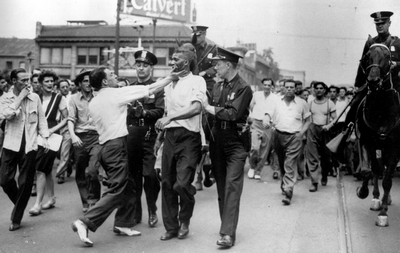
detroit_race_riots Do you think MLK changed this white man’s bigoted social ideology?  Any of them?

He answered no, which was smart; they do not command riots to occur.  It’s a bit stupid to suggest such.  While he did concede the point that BLM…

View original post 1,164 more words


How Seniors can Cope with Financial Stress

A little while back I received an email from a woman who had come across this blog and, specifically, had perused posts tagged with the word “retirement.” She wrote me that “a combination of my father being downsized in his 60s and my mother falling ill have combined to seriously affect their financial planning for retirement and has exacerbated their health problems. They have inspired me to write a guide for seniors and their families about the most common causes of financial stress, how it affects the person, and provide some coping strategies.” She provided a link to the guide she wrote and asked if I would consider posting it, along with an intro she wrote for it.

I said I would be glad to consider it and she wrote back with the following introduction, which I’m just pasting in, below. I’ve gone over the Guide she wrote and am providing her info here as a service to anyone considering or preparing for retirement, or for anyone who just might be interested in what to expect and, perhaps, how best to plan for one’s eventual exit from the workforce. What follows come from Ms. Jenny Holt.

PS – I will offer one observation. The site her link points to is called “Reverse Mortgage Alert”, which I have to admit raised a red flag for me. I’m not a fan of the concept, at least not as I’ve learned it is frequently practiced. However, after reading some of the info provided there, I do believe what they have to offer is useful information. They are not “pushing” reverse mortgages. Rather, they seem to be intent on providing useful information that anyone seeking to make a major investment move, especially with the home they’re living in, should take into account. If you have info that proves this wrong, I’d really appreciate hearing from you. Thanks.


With more limited access to financial services and often post-retirement, a money problem for seniors can be magnified more than for other age groups. While many have saved or invested in property and pensions, there are common causes of financial issues for the over 55s. These include:

  1. Job Loss/Reduction – 51%

  2. Healthcare – 29.5%

  3. Other – 21.6%

  4. Unpaid Taxes – 12.7%

  5. Divorce/separation – 8.2%

  6. Bankruptcy – 6.7%

  7. Foreclosure notices – 5.7%

The onset of stress can cause a range of emotional and physical problems which may exacerbate any health-related financial issues. These include insomnia, headaches, chest pains, anxiety, and depression.

However, it is more than possible to mitigate these issues. Of course, finding a solution to the financial problem in the first place is preferable. That being said, clearer and more focused decisions can be made with the right approach. Many seniors find stressful situations easier to cope with by combining a better diet with more exercise and meditation.

There is more to learn about this issue and more information can be found in the full Senior Financial Stress Coping Guide.


How I Became A Vampire

Nine years ago I had a nice chunk of flesh removed from my left lower back to remove a Melanoma. They also took a couple of lymph nodes from under my left arm and the left side of my groin. Tests all proved negative and, save for becoming a vampire, I’d put it mostly behind me.

This morning I went for my yearly dermatological exam and had to have another small chunk taken out of the middle of my back and sent for biopsy. So . . . I’ll know in a week or two if I have to undergo another surgery.

Compared to many people, including a number I know, my experience was a walk in the park. No chemo, no radiation, just scoop that shit right out of my body. I’d rather not have to do anything other than eat healthy and exercise, but if I have to go through this again, I’ll take heart from my past experience. Given what others have gone through, I refuse to call myself a cancer survivor. I was never sick and the entire episode took less than three months from discovery to excision.


The Regimental Repp and the POTUS

I seldom wear a tie any longer, but I used to wear them frequently and I have dozens still hanging in my closet. I learned a long time ago that the regimental repp stripe tie originated in England and there is a significant difference between English and American ties of this type.

Very briefly, the history of the designs harks back to when the British realized bright red uniforms were not the best way to engage on a battlefield and they changed to olive drab in order for their soldiers to be a wee tad less conspicuous. In order for the different regiments to distinguish themselves when in dress uniform, they each transferred their regimental colors to their ties.

There is a fundamental difference between ties from England and ties from America. In England, the stripe goes from the left shoulder, over the heart, and toward the right hip. In America they’re the exact opposite. There is a difference in meaning with the use of color as well, in that here in the U.S. the colors don’t mean anything. In England the colors signify either an element of the armed forces or a boarding/prep school.

Over the years I’ve been struck by the fact that our Presidents – at least the last three of them – most frequently wear English ties. This is also true of our PEEOTUS as well. Notably, the two Presidents prior to these four seldom wore regimental repp ties from England. I put the attached graphic together after looking through hundreds of photos of all six of them to illustrate this “discrepancy.”

Last Six Presidents

The Last Six (including the illegitimate one) Presidents

I have no idea why the change and I also have no idea why this is so. Perhaps American manufacturers are now making ties with the stripes going from the left shoulder, but I’ve seen nothing to convince me that’s the case.

I know this is trivial, but it’s been floating in the back of my mind for some time. I’ve found it a taste ironic these men go to great pains to wear American flag pins on their lapels, and I often wonder why they’re wearing ties the symbolism of which evokes merry old England. Where’s their patriotism?

More about these ties at http://bit.ly/2iuQ6nu