Corporations, conglomerates, and industrial organizations aren’t the enemy, ipso facto. In fact, they make socialism not only possible, but necessary, IMO.
What is the enemy is unbridled greed, rampant cronyism, nepotism and, especially, the codification of deep income inequality. It is not good for a society when individuals can amass fortunes they can’t possibly spend. That they then turn some of that fortune into philanthropy and charitable organizations doesn’t change the fact that it should be criminal for one individual to take that much surplus value from the workforce that made their fortune possible. It’s estimated Jeff Bezos makes (not earns) around $2,500/second. Dafuque does he do, other than own Amazon stock?
I’m not saying inventors, creators, entrepreneurs, etc. aren’t entitled to profit from their efforts, but they shouldn’t be able to continue siphoning profit off an organization that has reached a point where it could easily survive without them. By the same token, intellectual property law has expanded patent and copyright protections way beyond their original intent, creating other avenues of indecent profit-making.
And getting back to what I said about making socialism possible and necessary, without large profitable organizations, we’d all be living off mom & pop’s and craft-making. Many of the products we enjoy, and that provide the grease that skids civilization as we know it, would not be possible without large factories, laboratories, and other institutions. By their very nature, though, they transcend the control and direction of any one individual, and I believe our pay/profit structure needs to take that much more into consideration, providing a larger share to the workers who have helped make the org successful.
Recently, I came across an article on Axios.com with the title “America is losing its religion.” In the article, the author (Bryan Walsh) opens by saying, “New surveys show Americans’ membership in communities of worship has declined sharply in recent years, with less than 50% of the country belonging to a church, synagogue or mosque.” He goes on to list the Gallup poll results he rests his premise on and concludes with the following thought: “But conventional religion’s power is on the wane, and it might take a miracle for that to change.”
I can’t say I’m bothered in the slightest about this trend. Being an atheist, I have a somewhat dim view of organized religion, especially when it’s used to deny rights to others based on some cockamamie interpretation of words that were uttered thousands of years ago, when life, economics, and society in general were much different than they are now.
On the other hand, I understand, and empathize with, the desire for community that religious observance brings to those who practice, but belief in a supreme intelligence/being that literally created us and watches over us is, IMO, patently absurd. I find acknowledging and appreciating how physics, chemistry, and cosmology (in other words, science) explain where we came from far more compelling and beautiful than anything to be found in any religious text I’ve read. And to be clear, my general attitude toward religion is, “what you believe is none of my business … until you start telling me or others we are required to believe as you do or we’re damned.”
So … here’s the deal. If attending services at a “house of worship” is your cup of tea, and you attend with others who share your beliefs or your faith (however you define those) I say “zei gezunt,” which is Yiddish for “be well” or, as I tend to think of it, and somewhat more ironically “more power to you.” Just keep it to yourself. Don’t bring it to the commons. Enjoy it for you and those who you consider part of your fellowship, but don’t for one minute suppose you can tell others this is the ONLY way. Do that and you will richly deserve to be shunned by others who don’t feel as you do.
PS – You can read the article, which contains a bit more detail than I’m including, here.
There are two books that have had an inordinately large effect on my life. One of them I can remember large parts of and can offer reasonably intelligent analyses of what the author was trying to say. The other one I can hardly recall one thing about, save for the overall message the author was trying to convey. The reason these two come to mind—and have affected me so greatly—is that they’re closely related conceptually and their messages resonate and overlap, at least as I see them and I’m pretty sure that’s about all that counts.
The first of these two books is “The Wisdom of Insecurity,” by Alan Watts. The second of these books is “Passages,” by Gail Sheehy. Without going into any detail, I’ll merely note that each of them speaks to the inexorable rhythms of life and the inevitability of change. They also offer a philosophical approach to dealing with those rhythms and changes that offers one a chance to navigate them with as little friction and pain as possible. I read the book by Watts in my early twenties. At the time I was head-over-heels in love with a young woman, but the relationship wasn’t to be and she broke up with me. I was young, impetuous, and prone to bouts of manic happiness and deep, dark depression.
I somehow found the book; how is lost in the mists of my slowly calcifying synapses. Perhaps it found me. It wasn’t the first book by Watts I had read. That was “The Book: On the Taboo Against Knowing Who You Are,” which I found quite helpful in navigating the changes I was going through shortly after high school, a short stint in the U.S. Navy, a slightly longer stint as a businessman, a somewhat shorter flirtation with Haight-Ashbury in the Summer of ’67, and a steadily growing antipathy toward the nation’s conduct of the war in Vietnam.
Another thing I thought interesting, and somewhat serendipitous, was the juxtaposition of the release of two Beatles records that coincided with my reading of these two books by Watts. When I read “The Book: …” the Beatles had just released “Everybody’s Got Something to Hide Except Me and My Monkey.” The book was kind of my introduction to Zen Buddhist philosophy and the concept of the dialectic as represented by the Yin-Yang symbol. I was beginning to understand the duality of nature and the essence of all forms of evolution. Some of the lyrics in the song point out that same kind of duality, e.g. “Your inside is out when your outside is in. Your outside is in when your inside is out,” and the title of the song seemed to resonate with Watts’s message that we needed to get in touch with our actual selves (our “inner monkey”) if we were to understand our place in the world and not color it with the expectations of others.
The second song, which coincided with my reading of “The Wisdom of Insecurity,” was “Let It Be” which, as I understood it was the message Watts was conveying about the reality there is no such thing as security, that all things are in a constant state of flux, and the only way to (paradoxically, a very Zen concept) achieve any semblance of security—no matter how ephemeral and transient it may be—was to stop seeking it.
Sheehy’s book, as I recall it (and I only read it once, whereas I’ve read The Wisdom of Insecurity three times) had a similar message, but it was less on a spiritual and philosophical level and more on a practical, everyday “here’s what to expect” kind of approach. She wrote of what she referred to as the “passages” we all go through as we age and gain experience, while everything around us is changing and moving forward.
The reason I’m bringing this up is because I have reached a point (a passage, if you will) in my life where I find far too many reasons to prepare myself for the end. I’ll be 74 years old three months from today. Next month I will be fourteen years older than my father was when he died. I realize I’ve reached an age where I could, conceivably, live another decade or more, but I could also drop dead tomorrow. There sure are a lot of people doing it who are younger than me.
Throw in the reality that I still have two daughters at home, one of whom is a Junior in High School, the other a Freshman in College, and it’s producing a bit of a tension arc that I’m struggling to put behind me.
I’m not trying to be morose, or overly glum. I am, however, attempting to approach what is definitely the autumn (more likely winter) of my life with as much spring in my step and lightness in my heart as I can muster. I need to understand what this passage I’m experiencing is all about (Sheehy did not write about septuagenarians) and position myself to take advantage of all it might offer. If there’s one thing I have learned over the years, it’s that there’s always benefit to be found in nearly every situation, at least until there isn’t (if that makes sense.) I am an optimist, so even when I get deeply (perhaps depressingly) introspective, I usually snap out of it within a few hours or now more than a day or two.
I’m looking forward to what the next stage of my life is going to offer. Both of my girls will be on their own in a few years, God (or whoever’s in charge of these things) willing and the creek don’t rise, and Linda and I will be on our own again. The difference for us, is we won’t be in our early to late fifties, like most people who have their families when they’re no older than their thirties. As long as I know my girls are doing well and taking care of themselves (which is an entirely different story) I’ll be OK with whatever happens. I will say this. Not having to help with high school homework will be deeply enjoyable!
I am a southpaw, a left-hander. Big time! So much so that when my father tried to get me to golf right-handed (he said golf courses were built to favor righties) I just wasn’t able to do it. I played a little—he even bought me a beginner’s set of left-handed clubs—when I was 15, but came to the conclusion surfing was more my speed and gave up golf.
I actually have no plan to become a right-handed golfer, assuming I can ever golf again (that’s another story.)
When I took it up again at the tender age of 46, I still played left-handed, though I realized it would be helpful to my game if I spent a little time strengthening my right side, as well as improving my right-handed coordination. I set about doing some exercises and using my right hand more frequently. It was a bit haphazard, but I managed to become a bit more comfortable with it as time went by.
Last night I believe I came to the conclusion I need to change my handedness from left to right. The reason for this has nothing to do with golf, however. Sometime around a decade ago, I began to experience the effects of what is known as essential tremors. Also called familial tremors, the malady is genetic and generally affects one or more of three areas: the neck muscles, the hands and fingers, and vocal chords. My mother had them in her neck; she was, in her last years, a bobble-head.
My tremors show up in my hands and, ironically, they are worst in my left (dominant) hand. I am almost certain sometime in the next few years, I will experience them in my neck muscles as well. I can feel it coming on when I’m drinking any liquid I don’t sip. Not all the time; my hands don’t shake all the time either. When they do, though, it can be pretty had to do certain things. For instance, typing becomes next to impossible when they’re shaking, as is eating with a fork or a spoon.
Ironically, eating with hashi (chopsticks, in Japanese; my wife is Sansei) is much easier than eating with a fork. It might present a bit of a problem if grabbing whatever it is I wish to lift to my lips, but once I’ve got it grasped I can hang onto it because they shake in the same amount and same direction, and the food is securely pinched between the two pieces. This does not work with a fork or a spoon unless whatever it is I’m eating can be stabbed with the fork. Spoons are even worse because one eats things that are liquid and can spray all over the place when shaken as thoroughly as my left hand is capable of when it gets going.
For example, when I was in the midst of my battle with Covid-19, at the beginning of the year, I didn’t eat for a couple of days. Even though I could neither smell nor taste, I finally got hungry and my wife brought me a bowl of homemade chicken soup. She served it with one of the large, Chinese soup spoons we have, which are reasonably deep. As I raised a spoonful to my mouth, my hand began to shake violently and I sprayed hot soup all over myself and the bed. It was frustrating.
Last night I was eating some canned pears and cottage cheese; one of my favorite comfort foods (actually pineapple is my real fave, mixed with cottage cheese) and I was having a difficult time getting the spoon to my mouth without dropping or flinging the food hither and yon. Having done it once or twice before, I decided to try eating right-handed. It went much better than I had hoped for. So now, difficult as it may be at 73 years old, I’m going to start re-training myself to be right-handed. It won’t help with my typing, but I’m pretty sure it will improve my dining satisfaction … and that’s important. I may even begin eating with hashi right-handed as well. I’ve done it before and I know I can.
PS – Did you know that all the synonyms for “southpaw” are negative? According to thesaurus.com, these words are: ambilevous; awkward; clumsy; dubious; gauche; insincere; maladroit; sinister; and sinistral.
One of the ways I’ve been working on upping my writing game is by paying attention to what people are reading here on my blog so I might get an idea of what moves my readers. I have now posted well over six hundred times and about 90% of these posts are essentially essays regarding my thoughts about various things, e.g. politics, religion, life, the universe, and everything. The other 10% are tests and sharing things I’ve come across but have little to say about. I also occasionally have reason to look back myself, even if no one has recently read a particular post of mine I find interesting.
To Open Up And Believe
Because there have been many highly emotional news stories lately, and emotions are high to begin with, I’ve been giving a lot of thought to the role of emotions and, especially, how they relate to empathy. Turns out I had written about empathy over eight years ago, long before Donald Trump’s presidency. Since the reality has hit us that he is entirely without empathy, I would like to share a concatenation of the two posts I wrote in late September of 2012. It’s my hope these two are as pertinent today as they were when I wrote them; perhaps more so because I was only writing then about my feelings and now what I wrote seems so pertinent to what we’re all experiencing in the waning days of this disastrous presidency.
The willing suspension of disbelief. What a powerful, magical, and exceedingly frightening thing it can be – at least for me. Not always, though. It’s been quite a while since my last venture into the genre but, a long time ago – in a galaxy far, far away – I read a lot of Science Fiction. Reading it can’t possibly be enjoyable if you aren’t able to suspend your ability to think critically. Nevertheless, I enjoyed the hell out of what many an author hated being called Sci-Fi.
I’m normally somewhat cynical and am a fairly skeptical person, so I’m continuously surprised at how easily I can get sucked into a compelling story, especially if the characters are even moderately complex. I think it actually frightens me to realize how deeply I have disappeared into many a television drama.
This tendency has no doubt been exacerbated by my becoming a father at the ripe old age of 55, when my wife and I culminated a decision we had made a couple of years earlier and traveled to the People’s Republic of China to adopt our first child. We repeated the process four years later and, at the tender age of 59, I once again became a new father.
I now find myself immersed in shows where children are involved (it happens far more often than one might think) and I can’t help but identify with the parents, which sometimes brings me to tears – occasionally racking sobs of grief.
It has always been this way. I’ve been told the men in my family – many of them – were blubberers. Though I couldn’t have been older than five or six at the time, I recall the first time I saw my father cry. He had just received news that my Bubbie Jennie, his mother, had died. He hadn’t seen much of her since moving to Southern California. She had remained in Chicago, where both my parents were born. It was eerie, and not a little unsettling to see my father, a young boy’s tower of strength and resolve, break down like that.
It was made more difficult because I had only met her once, when she came to visit for a week, and she was unfamiliar to me. On the other hand, my maternal grandparents lived with us and I felt a strong emotional tie to them I could not summon up for her. She was by Bubbie, though. My mother’s mother was just Grandma.
I frequently ask myself, however, why I am so deeply and painfully drawn into these stories. I’m not entirely certain I have the answer, but I’m pretty sure it’s not so much the story itself as it is the relationship those stories bear to my own life.
Dictionary.com defines empathy as follows: the intellectual identification with or vicarious experiencing of the feelings, thoughts, or attitudes of another. That seems pretty straight-forward, yes? I am a fairly empathetic person and I tend toward the second part of that definition, i.e. I feel the pain of others vicariously. However, I don’t think this captures the essence of what is happening when I am fully immersed in a story.
Perhaps it’s too fine a point and the distinction isn’t all that great, but it seems to me what’s really happening is I’m overlaying the experience in the story onto my own life. I’m not so much experiencing the feelings of another as I’m experiencing the feelings I would have were I to be in that situation. I don’t think they’re the same. Then again, maybe that’s the mechanism that actually facilitates empathy.
This is a minor conundrum that comes to me most every time it happens and, usually, I forget about it within a minute or two. Lately I decided to try and get a descriptive handle on it and this is my first attempt.
Empathy is a valuable and deeply human trait. It is one of the five traits listed as characteristic of emotional intelligence which, in turn, is seen by many as a valuable business and leadership skill. It’s important to understand and to cultivate in order that we may better understand the people in our lives, whether at work, play, or home.
I want to understand what is moving me when this happens. On some levels it seems patently ridiculous to get so emotionally involved in a fiction story. On the other hand, perhaps it is really what makes us human. I’m wondering if someone with a more classical education than I have knows more of the thinking humans have brought to the subject. I’m sure some in the Arts (especially the Theater Arts) have tackled it. I’ll have to do more research. In the meantime, I’m glad there’s plenty of tissue in the house.
As it turns out, thanks to a friend I discovered an interesting answer through a wonderful TED talk by VS Ramachandran, a Neuroscientist who has studied the functions of mirror neurons. It would seem there is overwhelming evidence we humans are more closely connected than I was hinting at.
In his talk he says, “There is no real independent self, aloof from other human beings, inspecting the world, inspecting other people. You are, in fact, connected not just via Facebook and Internet, you’re actually quite literally connected by your neurons.” I find this resonates in many ways with my understanding of Systems Dynamics, Quantum Theory, and Zen and goes a long way toward answering my question. Frankly I find it a meaningful addition to my understanding, but still find myself wondering why it manifests itself so powerfully in some . . . and not at all in others. After all, the world is filled with people who are anti-social in varying degrees of severity from mild conduct disorders to outright sociopathy or APSD.
Regardless, there is much value in this talk. He speaks of the wonders of the human brain and, with respect to the issues I raised yesterday, uses words like imitation and emulation, ultimately winding his way to empathy. Rather than repeat any of his talk, I urge you to listen to it. There’s at least one very cool surprise a little more than halfway through. At less than eight minutes, it’s really engaging. Here’s the video. I’d love to hear what others think of this:
My wife would say I’m overly gregarious and too willing to share things about my life and experiences, and from all appearances, I seem to have spent much of that life being outgoing and transparent, yet I think I just realized that in actuality, I have always hidden much of who I am from others. Specific others, not everyone . . . and not about everything. Most of the things I’ve kept to myself over the years aren’t deeds I’m ashamed of or thoughts I’ve believed in and now think are wrong. It’s just that it wasn’t important for certain people to know about them.
For instance, I never shared my experiences in the late sixties with the “Free Love” movement with my mother. Somehow, I felt she wouldn’t have appreciated learning why I refer to myself as a “battle-scarred veteran” of the Sexual Revolution. Similarly, when I first hired in at Rockwell International’s Rocketdyne division, to work on the Space Shuttle Main Engine team, I didn’t think they needed to know I had spent two months in Cuba in 1973 as a guest of the Cuban government. The list goes on.
When I became a first-time, adoptive father at the age of 55, I considered writing about the experience of adopting, but decided against it because I thought it stood too much of a chance of violating my children’s privacy. I’m still a bit conflicted over how much I can share about my experience for fear of sharing too much of their lives, and those things don’t belong to me alone.
Now that I’m less than a year and a half from my 75th birthday, I’m thinking it’s time to stop being so concerned about embarrassing anyone who knows or is related to me . . . and just write my truth and put it out there for everyone to judge for themselves. That is what I’m doing, but I’m also just realizing how seriously I have been hobbled by my unwillingness to risk bringing shame to my family . . . even though I’m hardly ashamed about anything I’ve done over the years. Sorry for some things, yes – because they hurt me or others I loved and cared about – but shame does not emanate from this boy.
Having recognized this serious impediment to telling my story, it’s now my job to overcome what it’s done to me over the years (it hasn’t perzackly helped me overcome “imposter syndrome.”) I can no longer embarrass my parents or grandparents; they’ve been gone for quite some time, and I need to get these stories out, regardless. Even if I live to be ninety, I won’t have to regret anything (which I likely won’t anyway) for very long.
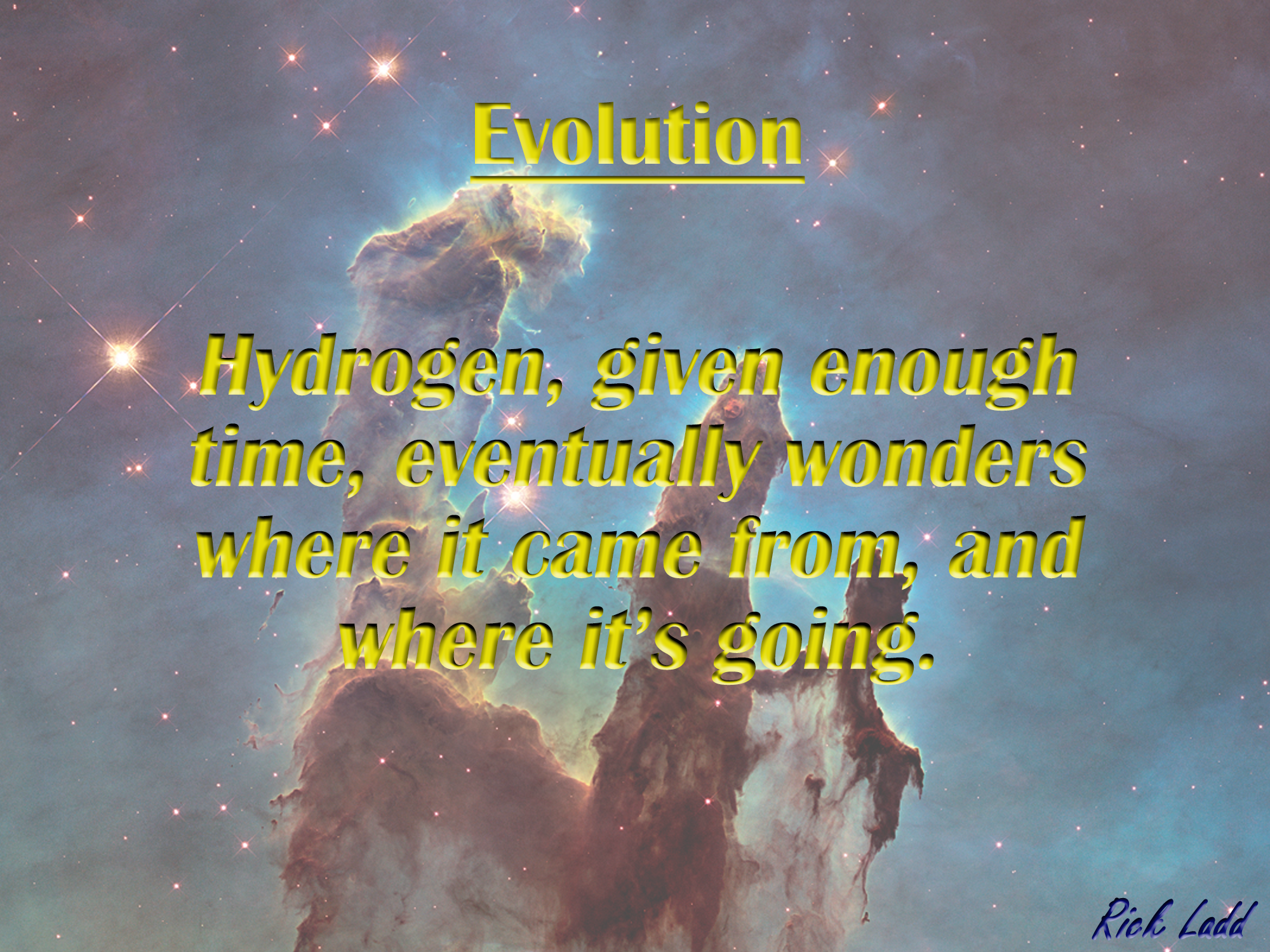
Another quite simple Photoshop effort, though all this is is a compilation of a quote I’m fond of and a photo of what is referred to as the pillars of creation, located in M16, the Eagle Nebula, over thataway.
The Pillars of Creation
If you study cosmology, and you’re not blinded by any particular religious dogma, it becomes clear that our evolution as a species (the human one) draws a gravity-assisted line from the first hydrogen atoms to who we are now. That we have reached a point in our evolution where we have been able to understand how we and our universe came about and developed over billions of years, I find every bit as awesome as the thought of some bearded white dude thinking us up out of nothing. Actually, I find it more awesome.
Understanding cosmological (read, primarily, stellar) as well as biological evolution is, to me, far more beautiful and compelling than anything I’ve learned from all of the world’s religions, including the one I was raised in (Judaism) and the one I was surrounded by (Christianity). I find it far more compelling and reasonable and, again for me, all the proof I need that we don’t need a “God” or “Gods” to explain how we came to be and where we’re headed.
There’s a “tripwire” somewhere Out there, downstream Where . . . I’m not sure
Some discover its presence early For some the revelation is a surprise Everyone’s waiting for it Our entire lives Some wait with dread and trepidation Some with simple resignation Many in anticipation Of what lies on the other side
Are there any who give it no thought? Like our animal brethren Who live their lives on a daily basis, Not as an ongoing saga
Many of us prepare In numerous ways Some useful Some not I know I’ve been waiting For as long as I can remember Now, however, I’m beginning to Sense its presence more acutely I feel its approach Though it’s still amorphous and indistinct
And each time someone younger than me passes I swear I can feel its hot breath on the back of my neck
We Americans (in the United States, that is) are, in my opinion, a little too fond of bad-mouthing people who don’t speak English, don’t speak it well, or speak it but don’t pronounce it like we do . . . the latter of which, given the number of regional accents in the U.S., seems a bit ridiculous. Furthermore, have you ever listened to most English-speaking Americans try to pronounce any other language? It would be humorous were it not pathetic.
I’ve always felt that pronouncing another language correctly is both a sign of respect, and an exercise in emulation. I don’t understand people who can’t learn to pronounce words from a language other than their native tongue. After all, the people who speak that language have no trouble with the pronunciation, and they’re human beings too. We share the same physiology, so what’s the problem?
It seems to me it’s cultural and, with many, culturally chauvinistic. I know, when I was younger I felt a little odd pronouncing Spanish words correctly, as they didn’t quite sound like they were coming from me. I have to admit it took a while before I was able to really pay attention and learn how to properly pronounce words that weren’t native to me. Especially important, and somewhat difficult, was learning how to roll my “Rs” when speaking Spanish.
I taught myself Spanish before I traveled to Cuba with the 6th contingent of the Venceremos Brigade, in the Spring of 1973. I purchased a Spanish/English dictionary and a book called “501 Spanish Verbs Fully Conjugated” and I spent hours every day reading and practicing. I also had a book of short stories written in Spanish with side-by-side English translations.
The rules of grammar were not terribly difficult; they’re def easier than those for the proper use of English. My first discovery was that of patterns in infinitive verbs and their conjugation in the three basic tenses: Past; present; and future. It really made the use of verbs fairly easy once I knew the infinitive. There were some irregularities, but nowhere near the quantity found in my native tongue.
Pronunciation, however, was another story entirely. I came to the conclusion—and believe it to this day—that native speakers will forgive grammatical errors more easily than they forgive errors in pronunciation. Think about it the next time you’re listening to someone speaking English with a foreign accent.
With that in mind, I spent a great deal of time learning how Spanish is pronounced. I practiced continuously. In fact, I distinctly recall sitting on the bus in which we were traveling around the country during the last week of our two-month stay, heading for the western province of Pinar del Rio. The name presents a pronunciation challenge, as the “r” in “Pinar” is pronounced with what is called an “alveolar tap,” where you touch the tip of your tongue to the roof of your mouth. The letter generally ends up sounding like the letter “t” or “d” in English pronunciation.
The “R” in “Rio,” however, is rolled (also referred to as “trilled”) as are all “Rs” at the beginning of a word. Double “Rs” are always rolled, regardless of where they occur in a word. I would sit in the bus, staring out at the Cuban countryside, repeating “Pinar del Rio” over and over and over, until I could effortlessly shift from the alveolar tap to the trill without screwing it up.
One problem this created for me was that people for whom Spanish was their native language, upon hearing me speak Spanish, assumed from my meticulous pronunciation that I could speak fluently. I could not. I could carry on a decent conversation, though deep philosophy was not in my repertoire. I can probably still carry on a conversation all these years later, and am quite certain I could blend in to a Spanish speaking area within a couple of weeks.
Bottom line . . . speaking, and pronouncing, another language correctly is both an intelligent thing to do and a sign of respect for those who speak that language as their primary tongue. The human mouth, tongue, and throat are designed to make the sounds that humans make, regardless of where they’re from or how strange their pronunciations may seem to you. It just takes practice and, maybe, a little courage.
Nearly 50 years ago I was preparing for a revolution. It was premature, but I was young and brash. Now I’m an old man and, although I’m in reasonably good shape, old bodies don’t lend themselves readily to battle.
Nevertheless, it’s looking more likely to me a revolution will be necessary to defeat Trump and his bootlickers, toadies, and sycophants. They are all inexorably locked into white supremacy and patriarchy and I don’t see logic doing anything to disabuse them of their hatreds and prejudices.
I think there’s a better than even chance Trump and his minions will find a way to steal the presidency. Should we flip the Senate (hardly guaranteed) and retain the House (all but guaranteed) it’s quite possible Trump can be impeached again—a first for the country—and found guilty this time.
I remain hopeful we can keep from descending into a Balkanized mess of a country but, should the populace rise up, I will do everything in my power to support them for as long as I’m able.
At the same time, should Trump manage to pull off an electoral coup, I’m more than ready to support an effort for California and other states to secede. The country I was born and raised in is already becoming completely unrecognizable to me.