Just thought I should mention today (Thursday, 14 May 2020) is the 10th anniversary of my retirement from Pratt & Whitney Rocketdyne. I’m still not entirely sure it was the right thing to do (accept the early severance package they offered everyone over 60) but her I yam!
Well . . . this came at an auspicious time. This article was just shared by a friend on FB, in a local Indivisible group. It’s very short, but contains a TED Talk that’s a little over six minutes long. It’s really worth watching; game me the chills. Also, think about what we’re doing right now by staying home and practicing social distancing. I am certain it’s making a difference, thought it may be another couple of weeks before the numbers will make it clear. And, since I’m one of the people who’s theoretically inside the bullseye (age and comorbidities) I’m thankful to everyone who’s taking this seriously. I certainly am.
This moment that we are living through right now, is really rather extraordinary. Tens of millions of us are sitting at home. We don’t have our military patrolling the streets, threatening to…
With respect to the subject of the video, there was a group of us at Rocketdyne who used to constantly say, “lead from where you are,” meaning “don’t wait for others to tell you what to do or how to do it; step up and step out. You know what to do. Now do it!” So, in addition to the speaker’s assertion that we need to accept ourselves as leaders, I would add we need to recognize the opportunities presented to us to do so. Enjoy the talk.
When I was at Rocketdyne, my last job was to research, test, and (if warranted and reasonable) deploy social media and collaboration technologies. Part of the reason I took the early severance package they offered back in 2010 was because I didn’t believe the company was really commmitted to supporting what I was doing.
Now it looks like I’m going to have to resurrect my knowledge of those tools and platforms just so I can interact with my friends and family. For instance, anyone who sees a lot of my posts on Facebook knows I usually go to the gym on Fridays, then out to dinner and for a couple of craft beers with two of my former colleagues from Rocketdyne.
We can no longer do that for the next month or so, and we’ve already talked (texted) about how to get together virtually. Not sure how, but there are lots of options. I’ve been using Slack with Quantellia, but I’m really interested in something free. I’ve used Google Hangouts before and I’ve been reading some good reviews from Zoom users. I don’t think Zoom existed back then, but I’m going to find out about it.
The saying is “necessity is the mother of invention,” and I have no doubt the next few months are going to drive our innovative capabilities and our need to collaborate and work together. While I’m not looking forward to being essentially cooped up in my house with my wife and two teenagers (plus a dog and two cats) I am a little excited about discovering the positive things we can extract from the disruption. I expect there will be far more than most of us can contemplate. Hang in there everyone. Let’s expand that silver lining.
During my last eight years at Rocketdyne (which traversed ownership by The Boeing Company and United Technologies’ Pratt & Whitney Division) I was the Project Manager for an internal tool called AskMe. It’s original intent was to provide a method whereby people could find both experts and expertise, i.e. people with knowledge they needed or papers and other publications that expressed useful knowledge. I later came to realize what we were doing was using a social media tool.
During the entire eight years I worked on that system, it was a constant struggle to get people to use it. People clearly believed that sharing was not in their best interests. Either that, or they were too intimidated by the thought of putting their knowledge to the test of time, as the whole idea was to foster conversations that would be saved and could later be searched when that kind of knowledge was needed again.
At any rate, I tried lots of different ways of promoting the tool. This one, below, came about after I received an email (at home) for a penis enlargement product. I thought to borrow the concept and see if it flew. I have taken the liberty of blurring out my colleague’s face, as I’m not sure where he is and, frankly, I don’t even remember who he is!
BTW – Within a couple of years of my departure, much to the chagrin of many who had worked on it, the tool was gone. I’ll share later why I think this was so.
The
amorphous collection of knowledge residing within the minds and computers of
any organization is now being referred to as “Intellectual Capital”. The
question we face is how to preserve and invest that capital wisely. In order to
understand and solve this problem it is important first to understand how we go
about acquiring and sharing our collective knowledge.
The
processing of knowledge can be seen as occurring in one of four interrelated
steps. These steps may be characterized as sensing, organizing, socializing,
and internalizing. Each of these steps may be further characterized by specific
activities that people engage in to develop their understanding of, and ability
to use, the information they receive.
Sensing
Sensing
consists of two basic dimensions, discovering and capturing. Every day we are
experiencing the world around us, whether at work, play, or rest. Regardless of
where we are, be it work or home, the world impinges on us. It is the degree to
which we pay attention to our world that determines how much we will discover,
and how much of it we will manage to capture (remember).
In
order for information to be shared, or even utilized by an individual, it must
be captured. Capture in the context of this analysis consists of placing
information or knowledge in a form which is accessible by others. One of the
most obvious manifestations of information capture is a report, written and/or
posted on an intranet site, This aspect of Knowledge Management can also be
characterized as turning tacit knowledge into explicit knowledge. It prepares
the way for the next step in the acquisition and sharing of knowledge.
At
Rocketdyne, this is done through reports such as Monthly Progress, Inspection
Discrepancy and Correction, Periodic Schedule updates, Budget Variance, and
others. These items memorialize the analysis, by various individuals, of
information gleaned from sources as varied as the mainframe computer systems,
their own experience, and anecdotal knowledge learned from others.
Organizing
Once
information is acquired, it must be categorized and fit into each of our
personal set of experiences. People who have been at a particular function for
a long time generally know more about that function than those who have just
started performing it. This is so because “veterans” have had time to make
mistakes, to learn from those mistakes, and to adjust their behavior
accordingly.
They
understand almost intuitively how best to approach particular problems and how
best to solve them. This is the area in which we develop our tacit knowledge,
our knowledge which we find difficult to put into words, but know deep down.
Organizing
also has an external dimension and involves such activities as: The writing of
reports and presentations; the compilation of data, specs, or rules, and; the
maintenance of databases, spreadsheets, drawings, and other documents.
Socializing or Sharing
No
matter what our intelligence and experience, we still need to work with other
people. Although not true of all, most of us do our best, and learn the most,
when we collaborate and work with others. By working together, and sharing our
thoughts and feelings, we are capable of looking at problems and situations
from many different perspectives.
This
is where the whole becomes greater than the sum of its parts. When people
collaborate, they are generally capable of getting more done than when they
work separately. This is obviously true of producing a complex product, and it
is also true of understanding
Socialization
consists of all the informal ways in which workers interact with each other and
share knowledge. It is the tacit to tacit aspect of knowledge transfer.
Informal email, conferencing tools, even meetings over lunch and before and
after presentations and briefings fit into this category.
At
Rocketdyne this activity take many forms and, in some ways, continues on
throughout the day. In addition to the ways in which people share information
informally listed above, there are numerous conversations which take place at
peoples’ desks, over a cup of coffee, or during a cigarette break outside the
building.
Internalization
Once
information or knowledge is captured and set forth in explicit form, it is then
possible for others to benefit from it. This is done, for the most part,
through the reading of reports (however published) and the studying of graphs,
charts, etc. This phase may be characterized as explicit to tacit and leads to
summarizing, orienting, and personalizing of tasks and content.
At
Rocketdyne, this is done in numerous ways. There are briefings taking place on
a daily basis. There are Corrective Action Boards, Preventive Action Boards,
Material Review Boards, Flight Readiness Reviews, etc. Numerous schedules and
reports are placed on the intranet and each product team has its own intranet
presence. Additionally, every process has an intranet presence.
Regardless
of how we process knowledge, there remains the question of how we actually
relate to it and its pursuit. Too often, in our zeal to get through the day,
get things done, finish what we started, we fail to take the time to process
what’s happening in our lives or on our jobs. By failing to do so, we rob
ourselves of the sense of wonder and awe which precedes discovery and
invention. A complete approach to Knowledge Management must include an
understanding of the importance reflection and relaxation can play in the role
of innovation. To do so may require entirely new methods of presenting
information to knowledge workers, methods we can only begin to comprehend.
We
do know this. These methods will undoubtedly spring from the World Wide Web and
the Internet. Already, most large companies are using their intranet more and
more to gather and present the collective knowledge of their organization. Both
Boeing and Rocketdyne have an extensive intranet presence which includes Vision
statements, Mission statements, and items ranging from “Lessons Learned” to
benefits information to product part numbers and the Manufacturing Engineers
responsible for them. There are pages and pages of content devoted to
education, organization, and even Knowledge Management.
There
is one further dimension of knowledge which needs to be discussed, and that is
the concept of tacit knowledge. Tacit knowledge is knowledge which cannot be
put into words. Despite the numerous definitions, and the apparent disagreement
of what exactly Knowledge Management is, there appears to be a great deal of
agreement on the type of knowledge which presents the greatest amount of
potential benefit to a business.
IBM states the issue thus, “. . .lots of valuable
knowledge ‘falls through the cracks’ within business organizations, never
finding its way into databases, process diagrams, or corporate libraries. As a
consequence, much of what the firm ‘knows’ remains unknown or inaccessible to
those who need it. Such knowledge is present within the organization, but it
remains hidden, unspoken, tacit. In business organizations, this hidden or tacit knowledge takes one of two forms:
1) knowledge embodied in people and social networks, 2) knowledge embedded in
the processes and products that people create.”[1]
Tacit knowledge, therefore, represents at once both the
most important type of knowledge and the least accessible form of knowledge. It
is invaluable in efficiently carrying on the activities of an organization, yet
is exceedingly difficult to harness in any meaningful fashion. Even when an
organization is able to somehow chronicle the experience of its employees, it
does not follow that it will be capable of passing that knowledge on in a
manner that is both easily accessible and effortlessly assimilable. Two
examples which come to mind from the organization of which I am a part are
welding and scheduling.
Welding
of exotic metals, especially for components which will be used in manned space
flight and are, therefore, subject to the most stringent specifications, is
composed of both explicit elements and tacit elements. While the former (the
explicit elements) may be capable of precise, scientific expression, the latter
of these are similar to art. It is not uncommon to find that a welder has
retired and, suddenly, the company is without a person who can reliably perform
a critical weld. Immediately, the company finds itself in a position where it
must either allot a far greater amount of time to accomplishing the weld, or
attempt to lure the retired welder back to perform the weld or to teach a
younger welder how to do so.
The
second example involves the scheduling of complex, time-phased activities which
include the procurement, manufacture, inspection, and testing of literally
thousands of items used in the manufacture of rocket engines. This task was
performed for years by groups of individuals using hand-drawn Gantt charts. It
is now being performed by individuals using a combination of mainframe software
(e.g. MRPII, OPT21) and PC-based, standalone software (e.g. Microsoft
Project98, Advanced Management Solutions’ RealTime Projects). Experience is
showing that the earlier, more labor-intensive methods were, against all logic,
accomplished with greater accuracy and reliability.
These
two problems point to the necessity of Rocketdyne’s utilizing one of the basic
elements of Knowledge Management, that of acquiring, retaining, and
disseminating the tacit knowledge, gained through years of experience, of its
workforce. This is not the same as simply cataloguing items such as tools used,
temperatures achieved, lead time per component, and supplier on-time
reliability, nor even placing all this information within easy reach through
the company intranet.
Inherent
in the definition of tacit knowledge is its ephemeral nature, the difficulty of
conveying things which are understood, at times, only subconsciously or of
which people are only vaguely aware. This, then, is probably one of the most difficult
tasks faced by any organization, given our current state of development in the
field of Knowledge Management.
[1]Working With Tacit Knowledge.
Horvath, Joseph A., Ph.D. IBM
Although
the current move toward gathering, cataloguing, storing, and disseminating
information and data for widespread organizational use is a fairly recent
development, the basic concepts of Knowledge Management have been with us for
as long as humans have gathered in communities. Humans have always struggled
with the need to pass on information gathered through hard experience and
disastrous failure.
In
his new book, to be published this fall, Steven Denning sets forth a brief
synopsis of the human activities which have preceded our current drive toward
Knowledge Management. In it he states, “The pursuit of any significant
human activity typically leads to the acquisition by those involved of know-how
and expertise as to how the activity may be successfully conducted. Insofar as
what is learned in the process can be captured, and communicated and shared
with others, it can enable subsequent practitioners – or even generations – to
build on earlier experience and obviate the need of costly rework or of
learning by making the same repetitive mistakes.
“In the village, from time immemorial,
the elder, the traditional healer and the midwife have been the living
repositories of distilled experience in the life of the community.
“…
”
Interactive knowledge-sharing mechanisms
have always been used – from palavers under the baobab, village square debates,
and town meetings, to conclaves, professional consultations, meetings,
workshops, and conferences – all functioning to enable individuals to share
what they know with others in the relevant area of knowledge. “[1]
(emphasis the author’s)
In
1988, as the pace of change was accelerating with the rapid development and
deployment of large-scale information systems, Peter F. Drucker observed,
“Information responsibility to others is increasingly understood, especially in
middle-sized companies. But information responsibility to oneself is still
largely neglected. That is, everyone in an organization should constantly be
thinking through what information he or she needs to do the job and to make a
contribution”.[2]
Drucker
understood then the pivotal dilemma with respect to data and information now
being faced by many organizations, that of understanding its power and devising
the methodologies whereby it can be harnessed and used to the benefit of the
people who need it to perform their jobs properly.
In
referring to information specialists as toolmakers, Drucker said, “They can
tell us what tool to use to hammer upholstery nails into a chair. We need to
decide whether we should be upholstering a chair at all.
“Executives
and professional specialists need to think through what information is for
them, what data they need: first, to know what they are doing; then, to be able
to decide what they should be doing; and finally, to appraise how well they are
doing. Until this happens MIS departments are likely to remain cost centers
rather than become the result center they could be.”[3]
Today,
MIS departments are still struggling with the notion of becoming “result
centers”. Too frequently, they concern themselves with the infrastructure of
the organization’s data processing capabilities, and completely ignore the role
Knowledge Management (in its broadest sense) can play. Instead of leading the
way through the morass of competing needs, whether perceived or real, they find
themselves being led around by various departments seeking to have their agenda
legitimized, often to the detriment of the MIS department’s ability to serve the
company as a whole.
At
Rocketdyne, which employs a large percentage of well-educated, highly computer
literate individuals, there exists a great deal of enmity between the users and
the Information Systems (IS) department. There are many who feel the department
should fulfill the role only of providing the infrastructure, i.e. the
telecommunications backbone and the hardware, and maintaining its reliability.
These people believe IS has abdicated its responsibility of providing guidance
for software development and acquisition, through an historic ineptness in
performing this function.
Whether
this view is accurate or not, it demonstrates a division which has long been
developing and will not soon go away, especially without visionary leadership
schooled in the concept of Knowledge Management. Many knowledgeable workers at
Rocketdyne believe they must have the freedom to purchase software which will
support their needs, or to develop that software without interference and
second-guessing by the IS department.
The
question which looms now for most organizations, and certainly for Rocketdyne,
is how can the data which is both created and collected be harnessed for the
purpose of continuing a company’s pursuit of its goals.
What
we are experiencing, I believe, is a time of challenge and opportunity.
Historically, humans have always valued the hard-earned wisdom of our
forebears. We rightly believe in the inappropriateness of “reinventing the
wheel”, and we have continuously improved on our methodologies for categorizing
and memorializing the lessons we have been taught or have learned through
experience.
Knowledge
Management is merely the application of this historical pursuit of know-how and
expertise to the comparatively new tools we have developed. The concept itself
is nothing new, The question then becomes one of how do we go about harnessing
these tools to our advantage; how do we make that quantum leap into an entirely
new way of viewing an old problem.
In
the next section we will look at a little bit of the background of the present
day approaches to Knowledge Management, and see how companies are beginning to
recognize the necessity of understanding and utilizing this approach to
conducting business and running an organization successfully.
[2]
Peter F. Drucker, “The Coming of the New
Organization”, Harvard Business Review on Knowledge Management (Boston:
Harvard Business School, 1998) p. 11
I’ve begun work on something I have wanted to do for a long time but, for numerous reasons (some of which actually make sense in retrospect) have not been able to accomplish. I’m speaking of writing a book. Actually, I’ve had three books in mind for a few years: One sharing my blog posts; one about the years I spent in the Peace & Justice movement, with special emphasis on the movement against the war in Vietnam; and, my memoirs. I can say with reasonable objectivity, I have had a rather unconventional and interesting life.
Since the beginning of March of 2018, I have been working part-time as the business manager for a small AI software development firm. In doing so, I transitioned from my Mac to a PC laptop in order to comply with the company standards. Today I moved my Mac out into a place in our living room where I can sit quietly and write. Since this is the first time I’ve actually spent a while at the Mac, I have been going through my files and am somewhat pleased to discover there are a lot things I’ve written over the years that should prove helpful in writing (at least) my memoirs. Some of the things I’ve written are only a couple of sentences or a paragraph or two, but they convey the essence of a thought I can expand upon. On the other hand, some of them are completely unintelligible.
What I’m going to do here, however, is use this blog to publish a term paper I submitted 19 years ago, when I was attending classes at California Lutheran University, in their Center for Lifelong Learning offering, ADEP (Adult Degree Evening Program.) It’s 22 pages long, so I’m going to post it in sections, as I wrote it. Today I’m sharing the intro. As I’ve re-read parts of it, I’m reasonably certain some will end up in at least my memoirs, as they are part of my unusual education.
Introduction
Although
this paper is being written as part of the requirements for a grade in
Organizational Management, its impetus and content are driven by a real life
situation at the company I work for, Rocketdyne Propulsion and Power, a
business unit of the Space and Communications Division of the Boeing Company.
As suggested in the course syllabus, I selected a subject which I felt had some
relevance to my company’s activities and my position within it.
As
with many organizations throughout the world, mine is struggling with
understanding and implementing the concepts of Knowledge Management. These
concepts, and the issues surrounding them, are numerous and complex. As an
example, one question which must be asked is how does an organization determine
the importance of the information it uses and how does it weight that
importance? How does it determine who needs it, who wants it, who might benefit
from knowing of its existence, or whether or not it should be available to
everyone who might wish to make those determinations for themselves?
Furthermore,
there are numerous software developers who are touting their particular method
of capturing data and making it available to a company’s workforce. Each of
these developers will attempt to convince you their method is best for your
application. Of course, this situation is hardly different from that faced by
anyone who has to determine what method they will use, or what software they
will purchase, for any task. Nevertheless, at this early stage of the game it
doesn’t make the task any easier.
I
propose, in the following pages, to set forth some of the history of Knowledge
Management, from tribal times to today, and the perceived need for Knowledge
Management, both in general, and with particular emphasis for my company,
Rocketdyne. I will look at what knowledge management means, and briefly mention
some of the tools which are being used to develop its use. The definition of
tacit knowledge, and the importance of understanding it when implementing
Knowledge Management will be discussed, along with a brief look at how we
acquire and share knowledge. I will close with a glance at what is probably the
most daunting task facing a company which desires to utilize Knowledge
Management to its advantage, the need for dramatic cultural change.
Before
beginning, however, I would like to quickly explain the nature of this paper’s
subtitle, “Breaking the Information Bottleneck”. Here, the word
bottleneck has the same meaning we use when speaking of a traffic jam. Most of
us have experienced being caught on the freeway when suddenly we come to a
crawl or dead stop. Usually there is an explanation for the delay. Sometimes,
however, there is no apparent reason.
In
the same way that freeways experience bottlenecks, so too does any system which
requires the smooth flow of some activity or commodity. On the shop floor, it
is generally components, though it can also be tooling, raw material, or usage
hardware. In the office it is generally data or information, and when its flow
is restricted the organization suffers.
I
believe, with the advent of computers, and their widespread use through Local
Area Networks and intranets, and with our increasing dependence on technology
to solve our problems, we have forgotten how sharing knowledge actually works
and, in the process, created huge information bottlenecks which will not go
away until we learn once again how to manage knowledge.
Unfortunately,
the scope of this paper is woefully inadequate to fully treat all the issues
involved in this major change now occurring. It is my hope that I will be able
to expand upon and use it to help melt the glacier of resistance which
surrounds my organization at present and makes change painful and tedious.
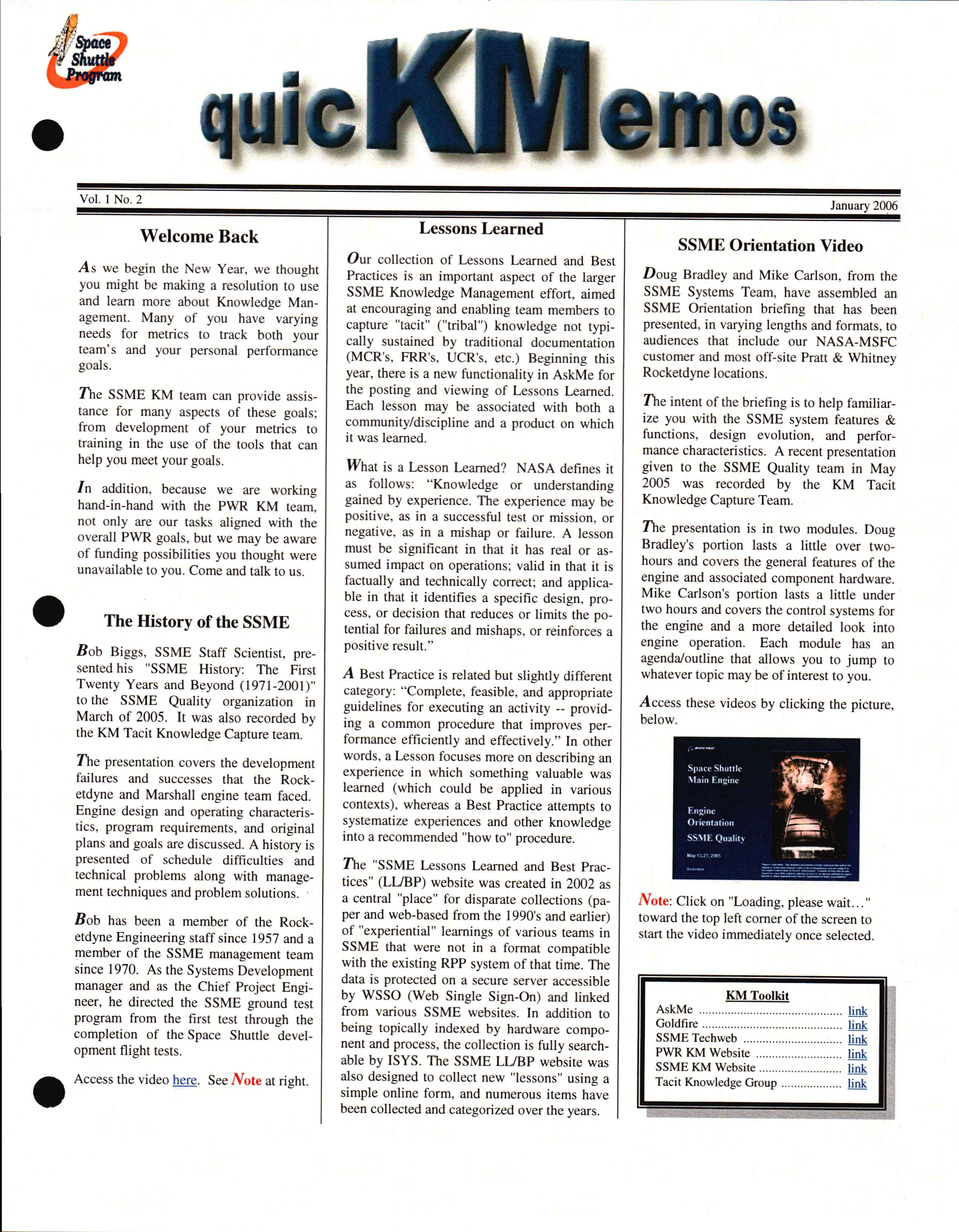
Here’s the second issue of the KM newsletter I wrote and published for the SSME KM team. This one was for January of 2006. The middle column has a couple of decent descriptions of “Lessons Learned” and “Best Practices.” What it doesn’t address, which is something many of us came to understand later, is that we don’t actually want “Best” Practices; which implies there won’t be any room for improvement, as “best” is a superlative adjective, which means it just doesn’t get any better than best. We, therefore, preferred to talk about “Better” Practices, which also fits rather nicely into the philosophy of continuous improvement. My apologies if this is boring.
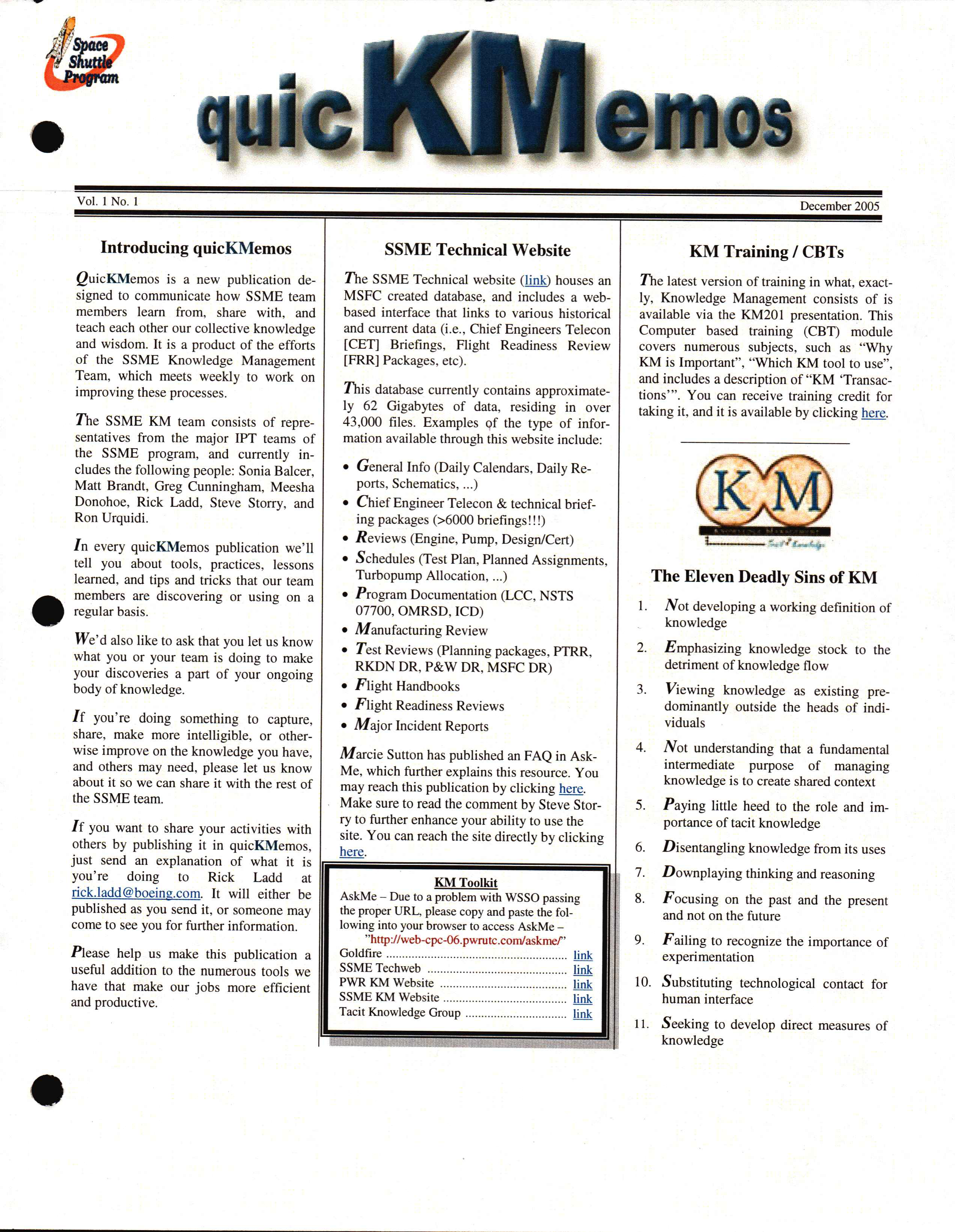
At the end of 2005, I was still five years away from accepting an early severance package from Pratt & Whitney Rocketdyne and then retiring a couple years early. I don’t think the Shuttle program had yet been cancelled, so everything appeared to be full steam ahead. I had been deeply involved in developing the concept of Knowledge Management (KM), primarily to the Space Shuttle Main Engine (SSME) team—for which I was the lead—as well as for the entire organization, from its ownership by Boeing to a subsequent purchase and merger with United Technologies’ Pratt & Whitney Division.
So, there were two teams I was involved with: the corporate, enterprise-wide team, and the SSME team. I had convinced my management to start the SSME team before I knew there was a corporate team, and it was my primary focus of attention at the time. Starting in December of 2005, I published a newsletter for the team; a KM newsletter, ostensibly by the SSME KM team for the entire SSME program team.
When I returned to work for a couple of years at Rocketdyne in 2015, I was able to find pdf files of every issue of that newsletter, which we called “quicKMemos.” I’m am converting these pdf files into png files so I can upload them here. I’ll post them somewhat sporadically, no doubt, as I have several duties and obligations that are always tugging at my sleeve and demanding my attention. So . . . here’s the first one; Vol. 1 No. 1, December 2005.
NB – Check out the Eleven Deadly Sins of KM. They still seem relevant to me, though it’s hard for me to tell as it’s been nearly 10 years since I’ve been in a large enterprise environment.







 Systems Savvy