Category Archives: History

Manzanar & Toyo Miyatake

In the Spring of 2018, my wife’s niece arranged for a few members of the family to take some portrait photos. She chose the studio of Toyo Miyatake, a photographer who was imprisoned in the Manzanar concentration camp, during World War II. My wife is Sansei (3rd generation Japanese-American) and grew up on Monterey Park, CA, where most of her family continues to reside. The studio is currently being run by his son, Archie, who took some wonderful pictures of my wife, our daughters, and her mother, sister, and niece.
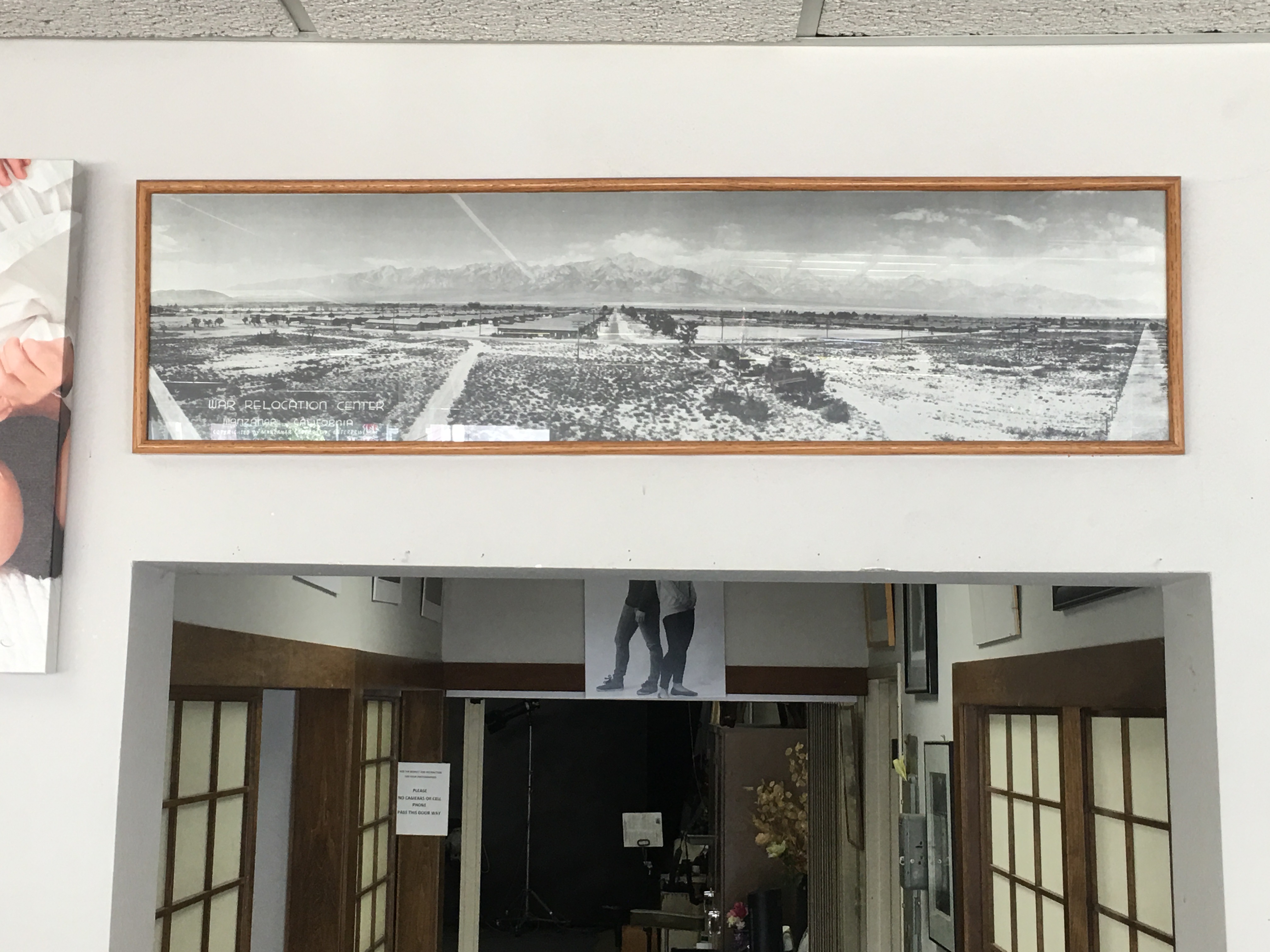
Caption on photo reads “War Relocation Center – Manzanar, California”

The studio is in San Gabriel and it’s filled with lots of photos taken by Toyo and Archie and I snapped some pics with my phone to share. I didn’t get around to doing anything until now, for reasons I’m incapable of reciting. Nevertheless, here they are. In looking for information on Toyo and Manzanar, I came across the Densho Encyclopedia, which has this to say about their work:

From the Densho Encyclopedia’s website:

The Densho Encyclopedia is a free and publicly accessible website that provides concise, accurate, and balanced information on many aspects of the Japanese American story during World War II. It is designed and written for a non-specialist audience that includes high school and college students and instructors, multiple generations of Nikkei community members, confinement sites preservation groups, amateur and professional historians, librarians, journalists, documentarians, and the general public.

The Encyclopedia is thoroughly cross indexed and articles are linked to relevant primary and secondary materials from the Densho archive and from other websites that include still and moving images, documents, databases, and oral history interview excerpts as well as standard bibliographical sources.

https://encyclopedia.densho.org/about/
Caption on left reads, “Manzanar Spring 1944”

The history of America’s treatment of Japanese-American citizens during WWII is a stain on everything this country is “supposed” to stand for, yet rarely seems to be able to provide. It was the result of racism and chauvinism, of nationalism and white supremacy. It set the Japanese-American community back years, if not decades, especially for those families whose property was stolen by white citizens who remained behind. Some were able to reclaim their homes and farms, but many didn’t. Toyo Miyatake was imprisoned here in California, at Manzanar. Here is what the Densho Encyclopedia has to say about his time there.

From the Densho Encyclopedia’s website:

The exclusion order forced Miyatake, his wife and four children, to the concentration camp at Manzanar. He was able to store his photographic equipment but managed to smuggle a camera lens and film plate holder into the camp against government orders. Miyatake told his son Archie that he felt it was his duty to document camp life. An Issei carpenter in camp constructed a box to house the lens, and Miyatake was able to get film into camp by way of a hardware salesman and former client. The photographer eventually asked camp director Ralph Merritt if he could set up a photo studio, and Merritt, who learned about Miyatake from Edward Weston, consented with the provision that Miyatake only load and set the camera, and a Caucasian assistant snap the shutter. Eventually, that restriction was lifted, and Miyatake was designated official camp photographer, and granted the freedom to take photos of everyday life at Manzanar. While there, Miyatake met and began a longtime collaboration with Ansel Adams, who wanted to capture candid photos of people there; the two men later published their work together in the book Two Views of Manzanar. Miyatake’s groundbreaking Manzanar photographs have also been featured in a 2012 exhibition at the Eastern California Museum called “Personal Responsibility: The Camp Photos of Toyo Miyatake.”

https://encyclopedia.densho.org/Toyo_Miyatake/

The collage I’m sharing, below, is of Archie recreating one of his father’s more iconic photos. He was able to find the now grown men who were originally pictured in Manzanar and bring them to the site for the shoot. I think the photos are pretty self explanatory, but the second row has the money shots, IMO.

Manzanar then and now!

I’ll share three more photos I took while we were there. The photo on the left is of a portion of the front of the studio, where much of Archie’s work is displayed. It was there I saw large photos of people like Condoleezza Rice and Vin Scully, in addition to many others. The center photo is of Archie shooting photos of my family, which consisted of my wife, my MIL and SIL, along with My SIL’s daughter (our niece), her grand daughter by her other daughter (deceased) and our two daughters. The photo on the right is a collage of photos Archie took at the wedding of “Uncle” George Takei and Brad Altman. Click on any of the pics to see a larger version.

Aaaand . . . since I’ve mentioned George and Brad, I have one more photo to share, below these three. On September 19, 2019, Linda and I attended a talk at The Ricardo Montalbรกn Theatre, in Hollywood, where George was discussing his newest book, “They Called Us Enemy.” We purchased a copy and, while waiting in line to get it autographed, Brad walked through the line greeting everybody. We got a nice photo with him. Here’s how George’s book has been described:

George Takei has captured hearts and minds worldwide with his captivating stage presence and outspoken commitment to equal rights. But long before he braved new frontiers in Star Trek, he woke up as a four-year-old boy to find his own birth country at war with his father’s-and their entire family forced from their home into an uncertain future. In a stunning graphic memoir, Takei revisits his haunting childhood in American concentration camps, as one of over 100,000 Japanese Americans imprisoned by the U.S. government during World War II. Experience the forces that shaped an American icon-and America itself-in this gripping tale of courage, country, loyalty, and love.

https://www.hoopladigital.com/title/12579768

Linda, Brad, & Moi

TJ’s 5-Tab Browser

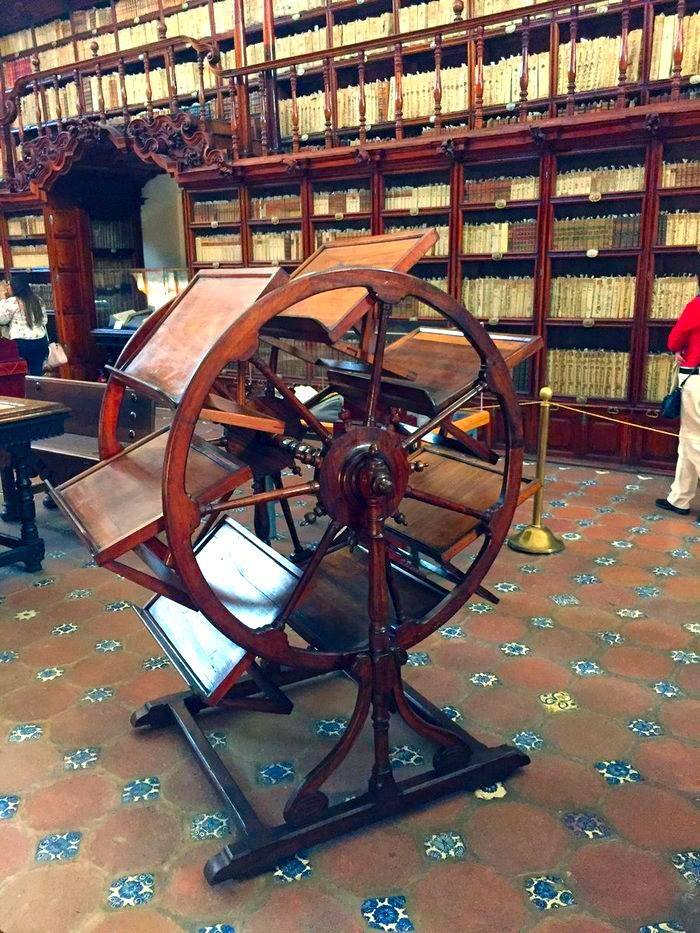
A friend of mine posted an interesting picture the other day. She’s a librarian and often posts items of interest regarding libraries, books, reading, and education in general. It was of a 300-year-old library tool that enabled a researcher to have seven books open at once. She also commented, “Now they’re all just browser tabs,” referring to how we do research nowadays using multiple tabs on whatever browser we happen to be using, whether it’s Chrome, Firefox, Edge, Opera, etc. Below is the photo from her post.

Old-Fashioned Browser

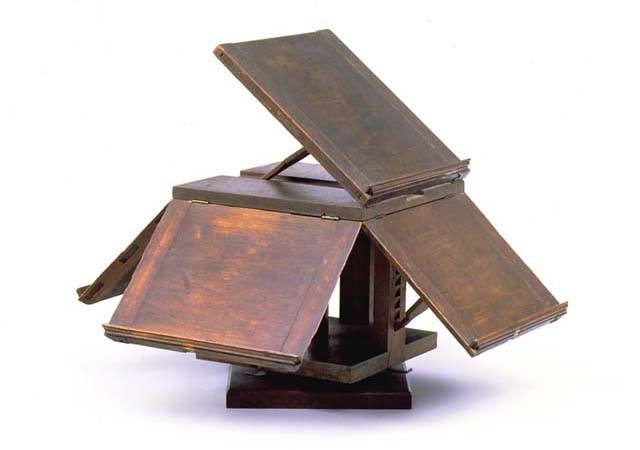
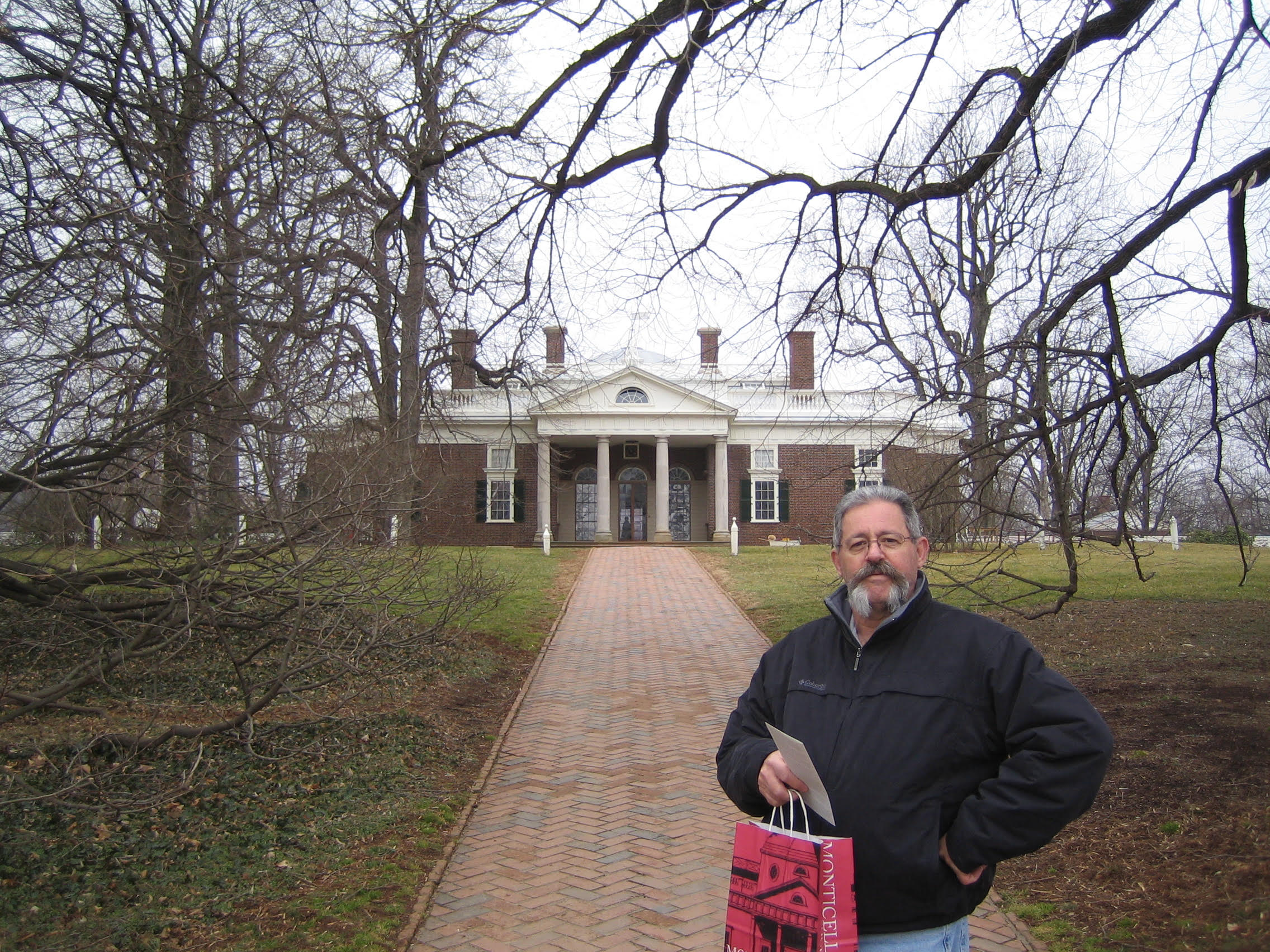
Seeing it instantly reminded me of a tool I had seen over a decade earlier when I had the opportunity to visit a vendor in Charlottesville, Virginia, the owners of which I had become friends with. I was on my way back home from a conference in Maryland and stopped to visit with them for a couple of days. Inasmuch as Thomas Jefferson’s mansion and slave plantation, Monticello, was nearby, I felt obliged to check it out. It was in Jefferson’s library that I saw the item this tool had reminded me of. It was another type of research tool (depicted below) that served the same purpose. Also, I remembered it specifically because, at the time, I thought the same thing my friend did; this was the 18th/19th century equivalent of having five (Jefferson’s wasn’t quite as lavish as the one above) browser tabs open simultaneously.

TJ’s Monticello Five-Tab Browser

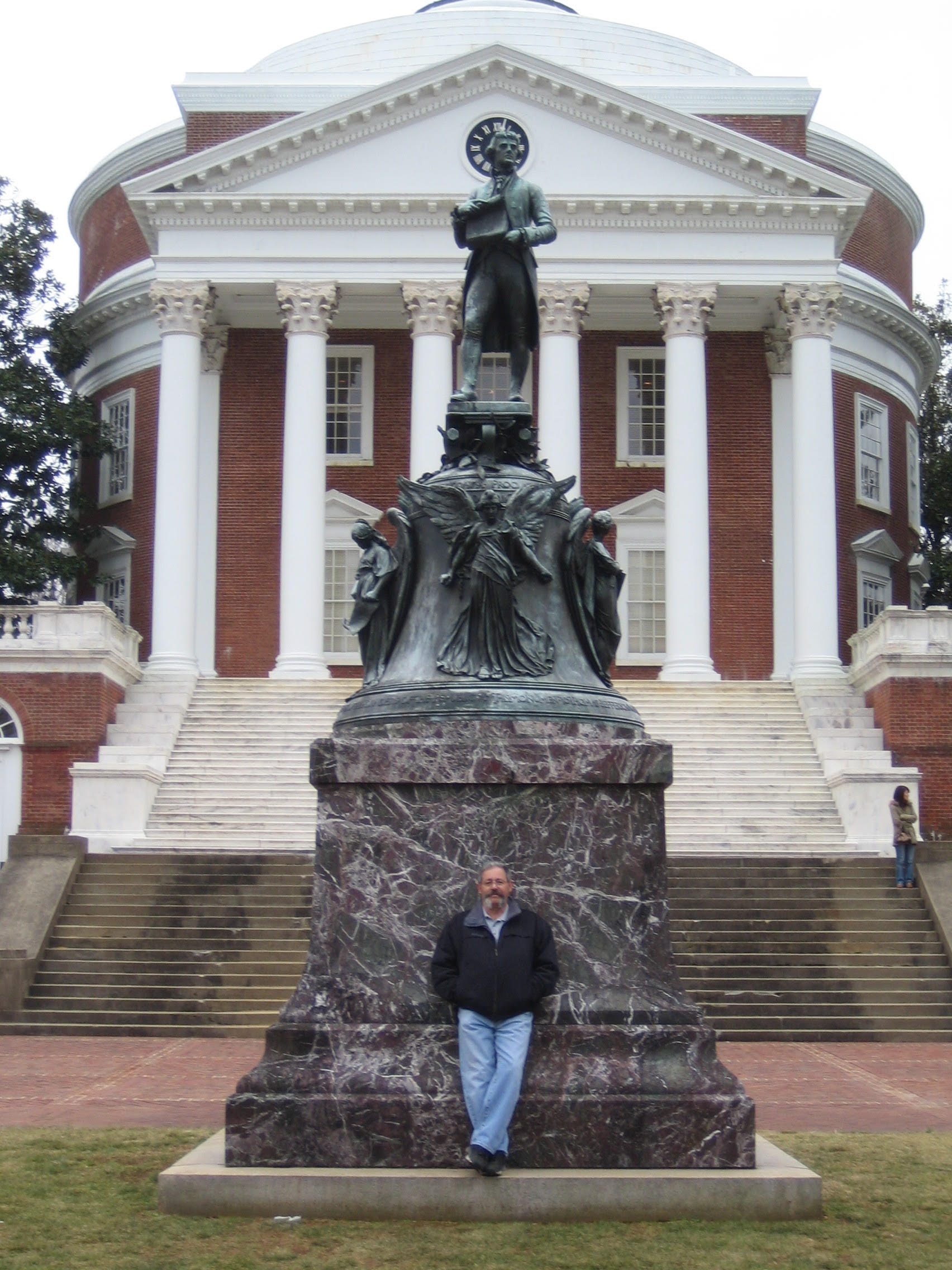
I also had the pleasure of visiting the University of Virginia, which had been founded in 1819 by Jefferson. Seven years later, Edgar Allan Poe attended the University where, apparently, he had to raise money for tuition by gambling because his father hadn’t sent him to school with enough money to get my. Below are a few more pictures from my visits in Charlottesville.

Fully-Mustachioed Rick Apres-Visit
Jefferson’s Burial Plot Marker
I Think This Is The Entrance To The University Of Virginia
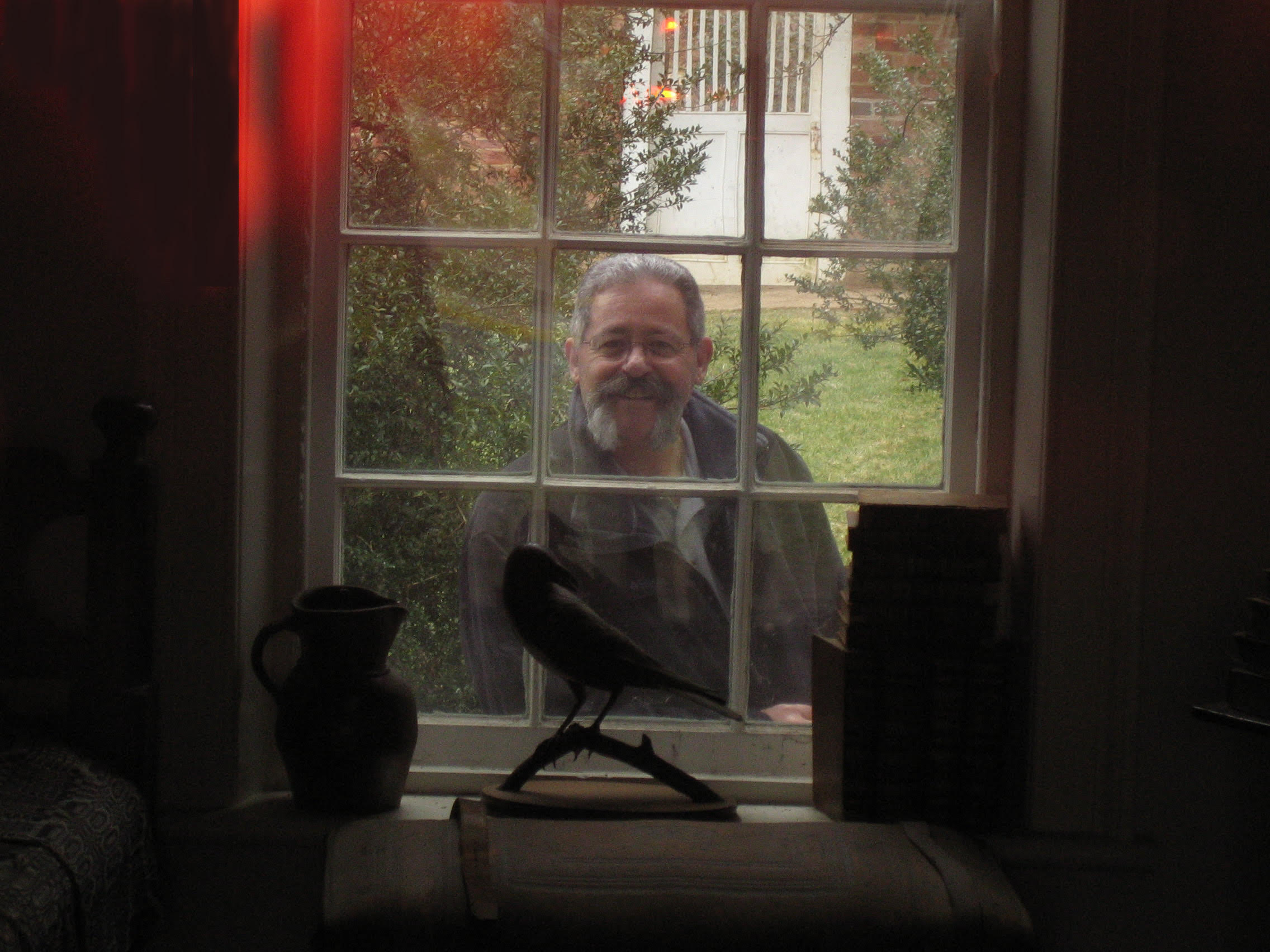
Edgar Allan Poe’s Dorm Room, Which Is Sealed. This Photo Was Taken Through A Window On The Other Side Of The Room. Can You Say, “Nevermore“?

Perseverance Arrives!

A Blue Martian Sunset

I was raised in the San Fernando Valley. Sputnik 1 was launched exactly four months after my 10th birthday. I remember lying outside on our front lawn, watching it go over. It was exciting and mysterious at the same time. I have a vague memory of seeing the United States’ first satellite, Exlorer, go over and I have a real vivid memory of seeing Echo as it orbited our planet. Echo was a giant aluminum balloon that, when inflated in orbit, was 100 feet in diameter and reflected the Sun, making it the brightest object in the sky except for the Moon.

I also have vivid memories of rocket engine tests in the Santa Susana mountains, just slight northwest of where I lived. Many of the tests were conducted at night, and I could see the sky light up over those mountains. As I grew up, I had friends whose parents worked at Rocketdyne, the company that built just about every liquid-fueled rocket engine used to power America’s space program, including Mercury, Gemini, and Apollo, not to mention the Space Shuttle.

Little did I know that many years later I would, quite serendipitously, get sent on a temporary assignment to work at Rocketdyne. I had been working at a company that manufactured what were, at the time, high density hard drives. This was in 1986 – 1987, and high density meant something like 5 Gigabytes! It was, for some reason I still can’t quite fathom, a seasonal business and when demand dropped all the temporary employees got laid off. That was me. I lost my job on a Friday. Later that evening I got a call from Apple One, the organization I was temping through, telling me to show up at Rocketdyne’s Canoga Park facility the following Monday.

To make an exceedingly long story short, I started work on the FMEA-CIL (Failure Mode & Effects Analysis-Critical Items List) the document that would prove Rocketdyne’s RS-25, SSME (Space Shuttle Main Engine) was safe for the Shuttle’s return to flight almost a year to the day after Challenger exploded during the ascent of STS-51-L. (For clarity, I think it important to note those engines were not responsible for the loss of Challenger; they had worked just fine.) I had long been a space cadet (in far more ways than one) but I never imagined I could end up working there, as I wasn’t an engineer. Silly me. I just hadn’t realized it takes a lot more than engineers to run a business that large and complex.

I was hired in after a year as what they referred to as a “job shopper.” I was forty years old. I retired 23 years later and it was the best, most fulfilling job I ever had, though dealing with a huge corporation (and “the Rock,” as we called it, was part of Rockwell International, the Boeing Company, United Technologies’ Pratt & Whitney Division, and Aerojet) was why I left early. The Shuttle program was winding down and P&W offered everyone over 60 a severance package I just couldn’t refuse, even though it wasn’t terribly generous.

Nevertheless, I’ve remained deeply interested in space exploration. I have long believed it’s important to the survival of humanity we get off the surface of this planet. I believe we need to establish not merely a scientific, but also a cultural presence off-planet in case of an extinction-level event. Frankly, it’s my opinion if we don’t do something about climate change and our contribution to it, we may be the ones causing such an event.

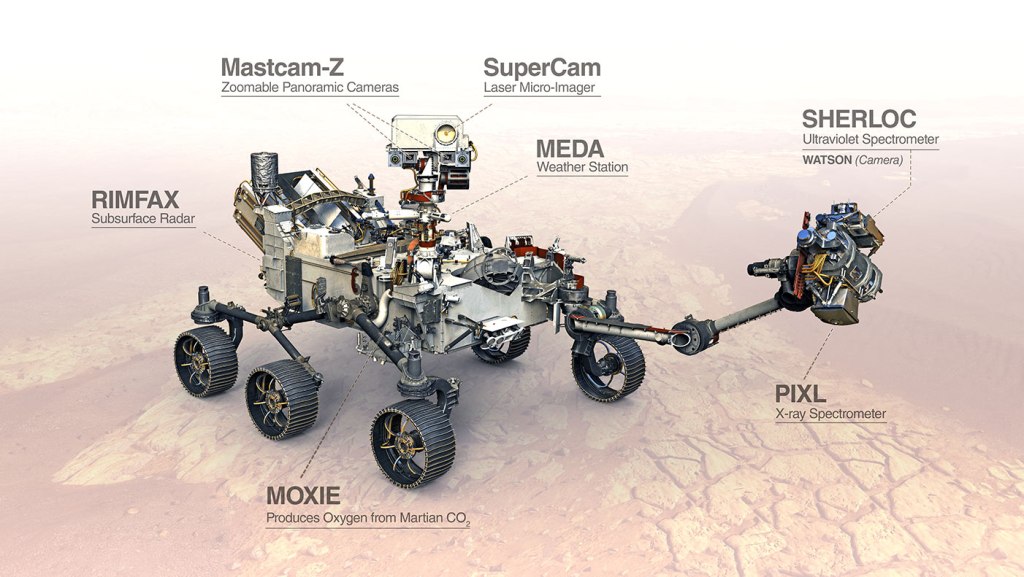
At any rate, all this is to say I am happy Perseverance landed safely on Mars this afternoon (PST) and appears to be functioning as designed. I’m looking forward to learning more about the Red Planet. I’m especially keen on learning how well the Moxie instrument (see graphic, below) accomplishes its mission of producing oxygen from Martian CO2. Congratulations to JPL and the Perseverance team. Job well done!

PS – I’ve also posted a graphic depicting one of Perseverance’s scientific missions, the Ingenuity helicopter which, if successful, should dramatically improve our ability to send rovers to the most fruitful (scientifically) locations, after they’ve been scouted out by Ingenuity and its successors.


Why I’m Not a Journalist

In January of 1971 I was living in Berkeley (aka Berzerkeley), California. I was “working” at an underground radio station run out of the living room of one of the guys who lived in my building. The address of our building was serendipitously easy to remember; it was 1776 Leroy, just north of the UC campus. I had a one-room, no-water flat though, during that winter there were times when moisture dripped from the walls. I had to go down the hallway to get water, relieve myself, or take a shower. I had a hotplate in my room and, truth to tell, I don’t recall if I had a small refrigerator or we shared one in a common area.

Our studio put out 500 watts of power, but we only had a 1/10 watt transmitter our engineer had managed to sneak up and secure at the top of the Engineering Building on campus. We had dual turntables, a reel-to-reel tape recorder, and various other recording devices, microphones, etc. With that little of a transmitter we only reached about 5 blocks square, which was a substantial portion of the north campus community.

In addition to playing music, I thought it was important for us to report on local news, as well as national political news if it happened nearby. On January 5 of that year, the trial of Angela Davis began in the Marin County Courthouse, a little over 20 miles away. One of the devices we had was a boom box that had a cassette tape recorder and I decided to haul my ass over to the courthouse and cover the trial.

I later provided armed security for the McAfee family, whose farm was used for Angela’s bail, when they appeared at this concert.

When Angela Davis’s attorneys came out to speak to the crowd, they were inundated by reporters, journalists, and photographers. There were so many of them (in case you aren’t familiar with this case, it drew international attention) her supporters could not hear a word that was being said. I knew that my boom box could be used as a megaphone, and I knew how to make it happen. I offered her attorneys the use of what I had turned into a way to amplify their voices and reach her supporters. They gladly accepted.

So … everyone got to hear the update Angela’s attorneys provided. Unfortunately, it meant I didn’t get to record anything. I returned to Berkeley empty-handed, save for the memory I had of the event. I had nothing to report other than that. No audio at all. Though I later published the Los Angeles version of The War Bulletin, which was produced in Berkeley, and I’ve written and published several newsletter over the years, that was really the end of whatever career I might have had as a journalist. I wasn’t capable of detaching myself from the story (at least not THAT story) and recognized I didn’t have what it takes to “get” the story.

PS – Today is Angela’s birthday. Happy Birthday, Comrade. Wishing you many more.


I Do NOT Like These Feelz

I was born just after the end of World War II. The nation was heady with promise and I was raised immersed in what I later came to realize was propaganda; the belief that the United States of America was the greatest, most progressive country in the world. I’ve known for a long time that’s not true, but I find myself wondering how a country that speaks and thinks of itself as “exceptional,” can defend so many people coming this close to financial and, perhaps, physical ruin (see WaPo article in Tweet, below.)

Never in my wildest dreams did I think I would ever feel guilty about being on Social Security. I don’t get a lot (nobody does) but along with my wife’s social security and the income from our meager retirement savings, at least we’re not food insecure or in danger of being homeless. It doesn’t feel right, though.

Yet, I’m helpless to do much to assist other than support economic transformation that would alleviate these problems. If there are millions of families in this horrible situation, how can any of us do much about it, especially when doing so would bring us closer to the same kind of ruin. Losing one’s home, especially if you “own” it, is devastating and very difficult to come back from. Nobody deserves this kind of reckless abandonment, yet that’s exactly what Donald Trump is doing. I can’t think of much that would be a worse dereliction of duty than this.

I don’t know what’s going to happen in these next 28 days … and beyond. The fact that Trump vetoed the legislation and has left for Mar-a-Lago, the government closes down next Tuesday, and much of the help that had been made available for people who’ve lost their jobs to COVID-19 is drying up this week is not helpful. Maybe it’s time for:


Some Personal Space Shuttle History

Thirty-four years ago next month I showed up for work at Rockwell International’s Rocketdyne Division. Having grown up in the San Fernando Valley in Southern California, I was familiar with Rocketdyne, as during the Mercury, Gemini, and Apollo programs the rocket engines they made, which powered the vehicles used to launch our astronauts into space, were all designed and manufactured not far from where I lived.

The factory was in Canoga Park, but the engines were tested at the Santa Susana Field Laboratory, which was in the hills to the west of my home. I have vivid memories of seeing the night sky light up and hearing the roar of those engines as they were being tested. I also remember going out at night and lying down on our front lawn to watch Sputnik 1, the world’s first artificial satellite (launched by the Soviet Union on October 4, 1957) go by overhead. I was ten years old at the time.

While these experiences didn’t cause me to pursue a career in engineering, they did serve to pique my interest in astronomy and space exploration. They also had absolutely nothing to do with my ending up working at Rocketdyne. My beginning there was entirely serendipitous. I was working for the temp agency, Apple One, where I had been temping at a hard drive manufacturer called Micropolis. Their business model, perhaps the industry itself, was somewhat seasonal and work for temps was boom and bust there. As had happened many times before (we’d heard about it and weren’t surprised when it happened) business slowed down and they decided to lay off the temps, who comprised the majority of the workforce.

That was on a Friday. That evening, my contact at Apple One called me and asked if I could show up at Rocketdyne the following Monday. I don’t remember the exact date, but it was in the middle of January, 1987, almost exactly a year after OV-099, Space Shuttle Orbiter Vehicle Challenger, exploded as it was ascending to orbit, killing all seven crew members.

I was to turn 40 years old later that year and of course I would show up. I needed to work. However, that it was Rocketdyne I was to show up at was something of a bonus, as far as I was concerned. I had known people who worked at Rocketdyne over the years, and it never occurred to me I could work there. I wasn’t an Engineer or a Scientist. I didn’t even have a college education, though I did have a Juris Doctorate, which I had earned eleven years before. I was the only person in my law school without a baccalaureate. None of that mattered as a temp (or what they called a “job shopper”.) They didn’t ask anything about my background or my capabilities. They just needed a warm body who could perform data input.

So, that following Monday I showed up to work at the plant on Canoga Ave. in Canoga Park. I had never worked at a really large organization before. In fact, with the exception of the temp job I had previously been working at, I had never worked anywhere that had more than a dozen or so people. Most places I’d worked only had five or six, at the most. Rocketdyne had armed guards at the gates. There were at least four entrances guarded by men with guns. It was actually a bit heady.

I ended up hiring in a year later and worked there until May of 2010, when I accepted an early severance package offered to everyone over the age of 60. I turned 63 the next month, June. I’m writing several memoirs, and my time at Rocketdyne will play a big role in at least one of them. However, my purpose here is merely to introduce one of the “awards” I received when I worked there.

I was not a big fan of individual performance awards, believing they tended to pit people against each other when, in fact, we needed to find ways to improve our collaborative and collective abilities. This particular award was given to each of the members of the Space Shuttle Main Engine High Pressure Fuel Turbo-pump team, who labored mightily to manufacture, test, and deliver 10 additional pumps for the program when Pratt & Whitney was unable to certify their alternate design. As our contract ran out, and we knew there would be no new business, the team had to wind down and members had to find other places to hang their hats.

You should note that everyone on the team received one of these shadow boxes, with a flag, a turbine blade, several mission buttons, and these inscriptions (see below.) I’m including the back, because our managers took the time to personally thank each person on the team; there were well over fifty, if memory serves. This “award” hangs in my home office. This coming May it will have been 20 years since I received it, and I’m every bit as proud of it now as I was back then. Plus … how often do you get to have a piece of rocket engine hardware and other space memorabilia?

PS – In case you don’t get to it (it’s on the back of the shadow box) that turbine blade traveled a total of 27,600,000 miles, mostly doing nothing after MECO (Main Engine Cut Off) on each flight.

PPS – Just to be clear, in these two photos (below) I’ve superimposed the award (from the front) on a picture of a shuttle night launch. It has a glass door, which I opened because it’s reflective and I didn’t want that in the photo, and digitally removed with Photoshop. I’ve separately added the two pieces of text from the back, without including the box, and superimposed them on that same night launch photo.

Obverse of My Turbo Team Award
Reverse of My Turbo Team Award

A Well-Deserved BuhBye

I think we all can agree this year (2020) has been a real pain in the ass. So many things that dismayed, disappointed, and disgusted the majority of us. I just came across this short video with a Holiday Message for the past year. It conveys my sentiments exactly. Quite likely yours too.


History Repeats Itself

As I have mentioned in other posts, I have been working at understanding Photoshop well enough to create my own memes, to touch up photos new and old, and to generally be able to utilize most of the power it provides to those patient enough to work on the skills. This is my latest, though the overlay of Trump’s fugliness on what is likely a painting of Marie Antoinette I stole from the Intertubes. I actually had a piece I did with Donald’s face on Marie, but I would have had to pull off some kind of mighty effort to have a plate and raised hand available to showcase to CORONA virus.

This story is disturbing. President Trump and nearly every one of the Republicans in Congress have failed to protect the American public from both this virus and from the economic effects of efforts to mitigate its destructiveness. That they will rush to vaccinate themselves before essential workers disgusts and appalls me. It doesn’t, however, surprise me. The Republican party is stuffed to the gills with pompous preeners who care little for the people they purport to represent. I suspect quite a few Democrats, especially the old guard, have similar propensities. We need to elect people who care about their constituents.


Is There A Doctor In The House?

Photo by Andrea Piacquadio on Pexels.com

I suspect just about everyone is aware of the flap over an opinion piece in the Wall Street Journal regarding our soon-to-be First Lady’s credentials. Written by Joseph Epstein, it’s entitled “Is There a Doctor in the White House? Not if You Need an M.D.” and subtitled “Jill Biden should think about dropping the honorific, which feels fraudulent, even comic.”

My most recent job was as the Business Manager for a Machine Learning (AI) Software Development firm, the co-founder of which had a PhD in computer science. When last I spoke with her, which was at least a year ago, she was not using her title, which she feared was seen as somewhat presumptuous. I’m not sure how she feels about it now, and I’m inclined to agree with those who see this op/ed piece as misogynistic and hollow. Frankly, I have often wondered if I could use the honorific “Dr.” in front of my name because I have earned a Juris Doctorate (JD) when I graduated Law School in 1976. However, I’ve never done so because the amount of schooling, and the quality of work, required for the degree don’t match up to that of a PhD or EdD. Actually, I tend to agree with those who suggest calling oneself “Dr.” when in possession of a law degree is ridiculous and pedantic.

It’s been discussed at great length by now, torn apart and analyzed by people far better at it than I, but I’d like to bring up what I think is an ancillary issue to that of the rank sexism and hypocrisy that exists wrt men and their seeming inability to accept women as their equals. What I’m referring to, which affects both men and women, regardless of race, creed, or color (though there are differences in degree and approach) is the depth of anti-intellectualism that has come to seemingly dominate our public life.

Just look at how many people are not only comfortable with, but are absolutely adamant about, ignoring science, facts, and reality-based analysis/synthesis. The number of people who believe most scientists are only doing what they do for the money is astounding. It’s likely one of, if not the, main reasons we’re doing so poorly in handling the pandemic here in the States.

This isn’t a new phenomenon. Hardly! I recall deciding in the third grade (that would have been around 1955) I didn’t want to be seen by everybody as an egghead, which changed the trajectory of my life . . . and probably not in the best way it could have. I remember feeling at the time that I wouldn’t have any friends if I continued on the path of academic excellence I had been on. Part of me wishes I hadn’t made that choice, though my life turned out pretty well regardless. It’s just that, in retrospect, the decision was made because of the negative view most people I knew seemed to have about being too intelligent; or, at least, being willing to use that intelligence in a positive way.

I believe this is one of the reasons the United States is in the bind it’s in right now. We’re just coming off of a four-year bender with the sleaziest and dumbest President in our nation’s history. He came to power as the result of years of anti-intellectual posturing and reality TV-informed ignorance. I am thankful I have never watched one reality TV show, especially not The Apprentice or Celebrity Apprentice. It’s clear Donald Chrump managed to suck a large portion of the nation into believing he was a highly successful businessman when, in fact, he’s a serial fuck-up who managed to burn through tens, if not hundreds, of millions of dollars given to him by his father.

These past four years of the worst “leadership” of my lifetime has been brought to us by our nation’s well-developed sense of anti-intellectualism. This does not bode well for maintaining our position as a preeminent nation of entrepreneurs and innovators. Our quality of life in the United States is what it is in large part because of our scientific accomplishments. It amazes me so many people don’t recognize the value that science has added to our lives, be it at work, home, or play. Virtually every aspect of our lives is enhanced by science and the products and enhancements it brings to us on a heretofore regular basis. I fear we’re going to lose that edge. Perhaps we already have. More the pity.


Fear of Sharing

My wife would say I’m overly gregarious and too willing to share things about my life and experiences, and from all appearances, I seem to have spent much of that life being outgoing and transparent, yet I think I just realized that in actuality, I have always hidden much of who I am from others. Specific others, not everyone . . . and not about everything. Most of the things I’ve kept to myself over the years aren’t deeds I’m ashamed of or thoughts I’ve believed in and now think are wrong. It’s just that it wasn’t important for certain people to know about them.

Photo by Andrea Piacquadio on Pexels.com

For instance, I never shared my experiences in the late sixties with the “Free Love” movement with my mother. Somehow, I felt she wouldn’t have appreciated learning why I refer to myself as a “battle-scarred veteran” of the Sexual Revolution. Similarly, when I first hired in at Rockwell International’s Rocketdyne division, to work on the Space Shuttle Main Engine team, I didn’t think they needed to know I had spent two months in Cuba in 1973 as a guest of the Cuban government. The list goes on.

When I became a first-time, adoptive father at the age of 55, I considered writing about the experience of adopting, but decided against it because I thought it stood too much of a chance of violating my children’s privacy. I’m still a bit conflicted over how much I can share about my experience for fear of sharing too much of their lives, and those things don’t belong to me alone.

Now that I’m less than a year and a half from my 75th birthday, I’m thinking it’s time to stop being so concerned about embarrassing anyone who knows or is related to me . . . and just write my truth and put it out there for everyone to judge for themselves. That is what I’m doing, but I’m also just realizing how seriously I have been hobbled by my unwillingness to risk bringing shame to my family . . . even though I’m hardly ashamed about anything I’ve done over the years. Sorry for some things, yes – because they hurt me or others I loved and cared about – but shame does not emanate from this boy.

Having recognized this serious impediment to telling my story, it’s now my job to overcome what it’s done to me over the years (it hasn’t perzackly helped me overcome “imposter syndrome.”) I can no longer embarrass my parents or grandparents; they’ve been gone for quite some time, and I need to get these stories out, regardless. Even if I live to be ninety, I won’t have to regret anything (which I likely won’t anyway) for very long.