Category Archives: Collaboration

The Secret to Innovation Isn’t Learning More—It’s Forgetting Less

In today’s hyper-connected, information-overloaded world, companies spend billions on training programs, knowledge-sharing platforms, and professional development. The conventional wisdom is simple: the more you learn, the better you’ll perform. But what if the key to innovation isn’t about learning more, but rather about forgetting less?

It might sound counterintuitive, but this subtle shift in perspective can transform how you think about knowledge management and creativity in your organization.


The Forgetting Curve: Your Biggest Knowledge Leak

The problem starts with how our brains work. Research by German psychologist Hermann Ebbinghaus introduced the concept of the “forgetting curve.” Essentially, we forget up to 50% of newly learned information within an hour and as much as 90% within a week—unless we take deliberate action to reinforce it.

This isn’t just an individual issue. Consider the collective implications for organizations where employees undergo training, attend meetings, or share insights. If 90% of that knowledge is forgotten or left unutilized, what’s the point of investing in learning initiatives?

Forgetting is natural, but it’s also a huge leak in your company’s knowledge pipeline. And while many organizations focus on teaching employees new skills or introducing the latest tools, they often overlook the need to help employees retain and apply what they’ve already learned.


The Innovation Gap: How Forgetting Limits Creativity

Innovation thrives at the intersection of knowledge and application. It’s not about the sheer volume of information you have but how effectively you can connect the dots between what you know and what you do.

When knowledge is forgotten, those dots disappear, making it harder to generate fresh ideas, solve problems, or build on past successes. Employees waste time reinventing the wheel, repeating mistakes, or duplicating effort because critical lessons learned have been buried in the sands of time.

The result? A company that feels stuck, constantly chasing the next big thing while failing to capitalize on the wealth of knowledge it already has.


Flipping the Script: How to Forget Less

So, how do you ensure your organization forgets less—and builds a culture of continuous innovation? Here are three actionable strategies:

1. Reinforce Learning Through Spaced Repetition

Spaced repetition is a proven technique for combating the forgetting curve. Instead of a single training session, reinforce critical knowledge over time. For example, follow up on workshops with microlearning modules, quizzes, or discussion groups that revisit key concepts. This repetition strengthens memory retention and ensures that knowledge sticks.

2. Capture Knowledge in Accessible Systems

Don’t let valuable insights evaporate into thin air after a meeting or brainstorming session. Use knowledge management tools to document and organize critical information. Platforms like Notion, Confluence, or SharePoint make it easy to store and retrieve knowledge so that your team can access it when they need it most.

3. Foster a Culture of Knowledge Sharing

Encourage employees to share their learnings and experiences with their peers. This could be through informal lunch-and-learns, internal blogs, or mentorship programs. When knowledge is shared, it’s reinforced—not just for the sharer but for the audience as well.


The Competitive Edge: Retention Over Acquisition

The companies that will thrive in the future aren’t the ones that simply learn the most but the ones that retain and apply their knowledge effectively. By focusing on forgetting less, you can unlock the full potential of your team’s creativity, reduce inefficiencies, and build a culture of innovation that lasts.

Remember, innovation isn’t about accumulating more—it’s about making the most of what you already have. What steps will you take today to help your organization forget less?


The Crisis of Leadership: Toxic Masculinity, Bullying, and the Betrayal of Accountability

The meeting on February 28, 2025, at the White House, bringing together Donald Trump, J.D. Vance, and Volodymyr Zelenskyy, serves as a stark illustration of the political, economic, and social chaos that toxic leadership has wrought on the United States. On one side of the table sat Trump and Vance, embodying the very traits that have plunged America deeper into division and dysfunction—traits of toxic masculinity, bullying, gaslighting, and victim-shaming. On the other sat Zelenskyy, a leader of integrity and composure, whose professionalism only magnified the disgrace of his American counterparts. This juxtaposition was more than symbolic; it was a glaring indictment of the corrosive leadership that continues to undermine the United States and its standing in the world.

Toxic masculinity, as personified by Trump and echoed in Vance’s rhetoric, has become a cornerstone of American political dysfunction. Their performative bravado and obsession with power over progress perpetuate a culture where collaboration is seen as weakness and empathy is dismissed outright. Trump’s tenure has been a masterclass in this destructive ethos, where bluster replaces leadership and domination replaces diplomacy. Vance, once a self-styled critic of Trump’s excesses, has since become a sycophantic disciple, mimicking his mentor’s disdain for nuance and complexity. Together, they exemplify a system that rewards aggression over thoughtfulness, leaving the American people to bear the brunt of their failures. This toxic culture has seeped into every corner of American life, from policymaking to public discourse, eroding the very foundations of democracy.

Bullying has become an accepted strategy in their political arsenal, weaponized to intimidate opponents and silence dissent. Trump’s long history of personal attacks, from mocking disabled reporters to belittling political adversaries, has set a precedent for cruelty as a form of governance. Vance, too, has adopted this playbook, using inflammatory language to marginalize those who challenge his agenda. This normalization of hostility has turned public discourse into a battlefield, where the loudest and most caustic voices drown out reasoned debate. The result is a nation more divided than ever, unable to agree on even the most fundamental truths. Meanwhile, Zelenskyy, facing a war in his homeland, demonstrates the strength that comes from uniting people rather than tearing them apart. His calm resolve in the face of existential threats is a sobering reminder of how far American leadership has fallen.

Gaslighting, a hallmark of Trump’s reign, continues to sow confusion and distrust among the American public. From denying election results to dismissing the severity of crises like COVID-19, Trump has repeatedly manipulated reality to serve his own ends. Vance, despite his past critiques of Trump’s dishonesty, has embraced this strategy, casting doubt on credible institutions and experts. This deliberate distortion of truth not only erodes public confidence but also paralyzes meaningful action. When leaders deny facts and vilify those who challenge them, they create an environment of apathy and hopelessness. Zelenskyy, by contrast, has faced unimaginable challenges with honesty and transparency, fostering trust among his people and the global community. His leadership underscores the moral bankruptcy of those who would rather gaslight than govern.

The culture of victim-shaming perpetuated by Trump and Vance is perhaps the most insidious aspect of their toxic leadership. Rather than addressing systemic injustices, they shift blame onto the very people harmed by them. Whether it’s dismissing the struggles of marginalized communities or ridiculing survivors of abuse, their rhetoric perpetuates cycles of oppression and inequality. This refusal to take accountability emboldens abusers and undermines efforts to create a more just society. Zelenskyy’s leadership stands in stark contrast; he has consistently championed the resilience and dignity of his people, refusing to vilify the vulnerable even in the face of extraordinary challenges.

Compounding this crisis is the complicity of women who support leaders like Trump and Vance, enabling their toxic behavior and policies. Their subservience to patriarchal norms legitimizes the very power structures that oppress them. This dynamic is a critical but often overlooked factor in America’s current turmoil. By propping up men who embody toxic masculinity, these women reinforce the cycles of inequality and dysfunction that plague the nation. Zelenskyy’s leadership, grounded in mutual respect and shared purpose, offers a stark alternative to this corrosive dynamic.

As the meeting unfolded, the contrast between Trump and Vance’s bluster and Zelenskyy’s quiet professionalism could not have been more glaring. While Zelenskyy sought solutions to a war that threatens global stability, Trump and Vance seemed more interested in posturing and self-aggrandizement. Their presence was a reminder of everything wrong with American leadership: the prioritization of ego over ethics, power over people, and division over unity. In Zelenskyy, we see a leader who understands the gravity of his responsibilities, who values truth and accountability, and who inspires rather than alienates. In Trump and Vance, we see the embodiment of a toxic culture that has brought America to the brink.

It is time to reckon with the consequences of this toxic leadership. The United States cannot afford to continue down a path where aggression, dishonesty, and victim-shaming are rewarded while integrity and collaboration are dismissed. We must demand better from our leaders and ourselves. The contrast between Trump, Vance, and Zelenskyy is a stark reminder of what is at stake: the very soul of our democracy and the future of our nation. Let this meeting serve as a wake-up call, not just to those in power but to every American who believes in a better, more just future.


Bass Ackward EVM

Has anyone else noticed how the majority of illustrations depicting Earned Value Management methodology show projects over budget and behind schedule? Why the pessimism? I know it’s frequently how things work out, but why do we put up with what amounts to continuous failure improvement? Why don’t we – since we’re only depicting how measurements and calculations are made – show the positive side, e.g. under-spent and ahead of schedule?

It seems like it would make a difference if, rather than presenting failure in the abstract, we presented success in the abstract. Isn’t it better to be going in with a success-oriented mindset, tempered with a good dose of reality? Of course, this presupposes situations where we’re not driven by the dynamics to be overly optimistic and unrealistic at the front end of a project in order to win a bid or compete with others, especially in large programs/projects. A tall order methinks.

Earned Value Management chart example.
Behind Schedule & Over Budget!

Bye Bye Twitter?

I first joined Twitter in March of 2006. At the time part of my job at Rocketdyne Propulsion and Power, a division of The Boeing Company, was to examine platforms described as examples of what was then referred to as Web 2.0, as well as new applications being referred to as “social media.” I was doing this as a member of the Knowledge Management team for the division, and as the Knowledge Management lead for the Space Shuttle Main Engine team.

In 2002, I had been leading the team that introduced one of the earliest “social media” applications to the SSME team and the organization as a whole. We didn’t think of it as social media at the time, however. Our main goal was to provide a tool (we called it an “enabler”) that made it easier to locate subject matter experts (SMEs) and facilitate not only communication between those seeking knowledge and those possessing it, but to capture that knowledge and make it easily accessible for others who might need it at a later date.

The name of the tool we purchased 1000 seats for was AskMe Enterprise. It was, if memory serves, based on a former website of the same name, but was now a proprietary tool meant to stay within the firewall of an organization. Rocketdyne needed something that would be useful internally and had no reason to use something that was open outside the organization’s firewall. In fact, given the nature of its products being open to the outside was anathema and a matter of national security.

At the same time, we were looking for a communications tool that provided one-to-many capabilities and short-form text sharing and publishing. There were several tools that were coming online around that time, including Jive and Yammer, but Twitter seemed to be the most interesting. Nevertheless, it took me something like six months before I could identify a use case for it. At the time it seemed merely a tool for non-productive jabber and gossip.

What changed it for me was when I found out the team preparing the Space Shuttle Orbiter for the next launch was using it to communicate their activities and progress. There were something like two dozen people who were working on various tasks that were independent in numerous different ways. If you’ve ever done project management, especially if you’ve used a tool like Microsoft Project, you know there are several types of dependencies between activities, e.g. finish-to-start (the most common). The Orbiter team, much like many of the teams that organizations (not just Rocketdyne) have to accomplish their work, would meet every morning to present progress and discuss how to proceed with remaining activities.

Twitter changed the dynamic significantly. Now, instead of waiting until the team gathered each morning, team members who were out in the field accomplishing tasks could communicate in real-time with their colleagues (all of them) when they had finished a task which was a predecessor to another team member’s task. All they had to do was Tweet. They didn’t have to compose an email, direct an IM to two dozen people, or make a phone call. They just had to follow each of their teammates.

This may seem a trivial thing, but if a predecessor task was completed at, say, two in the afternoon and that fact could be communicated to the entire team, anyone who needed that information to know where they stood in the flow of activities didn’t have to wait until the following morning stand-up to find out what their status was. Work on complicated engineering projects can be expensive and even apparently small savings of time could add up to saving tens, if not hundreds, of thousands of dollars.

So, that was my introduction to Twitter. I never could get my colleagues at Rocketdyne to use it. I had a hard enough time getting them to use AskMe and soon after I accepted an early severance package in May of 2010 (as the Shuttle program was coming to an end) it became obvious without my constant agitating for its use it wasn’t going to survive. It didn’t.

However, I kept a kind of love/hate relationship with Twitter over the years. There were times I didn’t pay much attention to it, and periods where I was quite active. Unfortunately, a couple of years ago, after nearly a decade and a half, I was permanently suspended after I suggested a certain former guy might benefit from a coronary episode (I was only looking out for his best interests!). I created another account, which I am still using. Actually, I created two more accounts, one of which was also suspended, but reinstated upon appeal, though I no longer use it. Now, instead of @rickladd I’m @retreado.

I really wish I still had my real name, but it looks as though Twitter may not survive the petty indulgences of the world’s richest 10-year-old. Toward the end, I found Twitter to be an invaluable source of news, not so much as a primary but as a pointer to in-depth analyses, opinion, and good, solid journalism. It was a great way to keep track of trends and what movers and shakers were thinking, as well as hints as to which direction developing issues might go in. If Twitter does go away, I will miss it, but it won’t be the end of the world. I’ve already created an account at Mastodon and am considering other apps. Time will tell. Frankly, I wouldn’t mind taking a break from the immediacy and constant movement of Twitter. I’m getting old and I appreciate moments of silence more than ever.


Some Personal Space Shuttle History

Thirty-four years ago next month I showed up for work at Rockwell International’s Rocketdyne Division. Having grown up in the San Fernando Valley in Southern California, I was familiar with Rocketdyne, as during the Mercury, Gemini, and Apollo programs the rocket engines they made, which powered the vehicles used to launch our astronauts into space, were all designed and manufactured not far from where I lived.

The factory was in Canoga Park, but the engines were tested at the Santa Susana Field Laboratory, which was in the hills to the west of my home. I have vivid memories of seeing the night sky light up and hearing the roar of those engines as they were being tested. I also remember going out at night and lying down on our front lawn to watch Sputnik 1, the world’s first artificial satellite (launched by the Soviet Union on October 4, 1957) go by overhead. I was ten years old at the time.

While these experiences didn’t cause me to pursue a career in engineering, they did serve to pique my interest in astronomy and space exploration. They also had absolutely nothing to do with my ending up working at Rocketdyne. My beginning there was entirely serendipitous. I was working for the temp agency, Apple One, where I had been temping at a hard drive manufacturer called Micropolis. Their business model, perhaps the industry itself, was somewhat seasonal and work for temps was boom and bust there. As had happened many times before (we’d heard about it and weren’t surprised when it happened) business slowed down and they decided to lay off the temps, who comprised the majority of the workforce.

That was on a Friday. That evening, my contact at Apple One called me and asked if I could show up at Rocketdyne the following Monday. I don’t remember the exact date, but it was in the middle of January, 1987, almost exactly a year after OV-099, Space Shuttle Orbiter Vehicle Challenger, exploded as it was ascending to orbit, killing all seven crew members.

I was to turn 40 years old later that year and of course I would show up. I needed to work. However, that it was Rocketdyne I was to show up at was something of a bonus, as far as I was concerned. I had known people who worked at Rocketdyne over the years, and it never occurred to me I could work there. I wasn’t an Engineer or a Scientist. I didn’t even have a college education, though I did have a Juris Doctorate, which I had earned eleven years before. I was the only person in my law school without a baccalaureate. None of that mattered as a temp (or what they called a “job shopper”.) They didn’t ask anything about my background or my capabilities. They just needed a warm body who could perform data input.

So, that following Monday I showed up to work at the plant on Canoga Ave. in Canoga Park. I had never worked at a really large organization before. In fact, with the exception of the temp job I had previously been working at, I had never worked anywhere that had more than a dozen or so people. Most places I’d worked only had five or six, at the most. Rocketdyne had armed guards at the gates. There were at least four entrances guarded by men with guns. It was actually a bit heady.

I ended up hiring in a year later and worked there until May of 2010, when I accepted an early severance package offered to everyone over the age of 60. I turned 63 the next month, June. I’m writing several memoirs, and my time at Rocketdyne will play a big role in at least one of them. However, my purpose here is merely to introduce one of the “awards” I received when I worked there.

I was not a big fan of individual performance awards, believing they tended to pit people against each other when, in fact, we needed to find ways to improve our collaborative and collective abilities. This particular award was given to each of the members of the Space Shuttle Main Engine High Pressure Fuel Turbo-pump team, who labored mightily to manufacture, test, and deliver 10 additional pumps for the program when Pratt & Whitney was unable to certify their alternate design. As our contract ran out, and we knew there would be no new business, the team had to wind down and members had to find other places to hang their hats.

You should note that everyone on the team received one of these shadow boxes, with a flag, a turbine blade, several mission buttons, and these inscriptions (see below.) I’m including the back, because our managers took the time to personally thank each person on the team; there were well over fifty, if memory serves. This “award” hangs in my home office. This coming May it will have been 20 years since I received it, and I’m every bit as proud of it now as I was back then. Plus … how often do you get to have a piece of rocket engine hardware and other space memorabilia?

PS – In case you don’t get to it (it’s on the back of the shadow box) that turbine blade traveled a total of 27,600,000 miles, mostly doing nothing after MECO (Main Engine Cut Off) on each flight.

PPS – Just to be clear, in these two photos (below) I’ve superimposed the award (from the front) on a picture of a shuttle night launch. It has a glass door, which I opened because it’s reflective and I didn’t want that in the photo, and digitally removed with Photoshop. I’ve separately added the two pieces of text from the back, without including the box, and superimposed them on that same night launch photo.

Obverse of My Turbo Team Award
Reverse of My Turbo Team Award

Working Remotely? Here’s Some Help

The need to address the SARS-CoV-2 pandemic may have done more to accelerate the digital transformation many have been working towards for years, than all of the bitching, moaning, hand-wringing, and pearl clutching heretofore expended on cajoling knowledge workers to adopt and adapt these technologies.

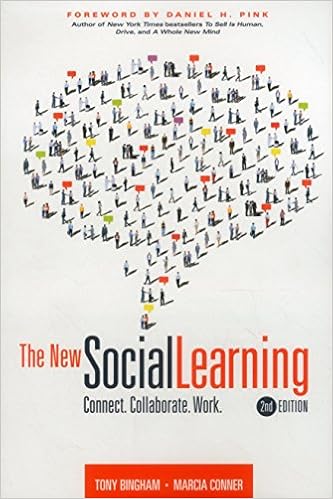
Five years ago I served as the developmental editor on the 2nd edition of “The New Social Learning.” I had the pleasure of working with the co-author of the 1st edition, who was the principal author of the 2nd, Marcia Conner. Marcia is one of a handful of people who recognized the need for, and the power of, such a transition . . . and this book was an attempt to help leaders and organizations move forward to adopt these new ways of working, and working together.

I recommend this book highly for everyone who is now finding themselves either working at home or dealing with today’s need to be more “distanced” from our colleagues. There’s a wealth of good info here. I urge you to check it out. It’s about far more than just learning.

“The Workplace Has Changed. At this moment, your people are already learning through social media. They’re reaching out and connecting in powerful ways. The question is, can you recognize, appreciate, and take advantage of the power inherent in this new level of communication? Do you want to facilitate or debilitate? Do you want to play a part in what and how people learn? Or do you want to try to stop them? Will you restrict them? Or will you free them to do the work they were hired to do—and will you do it with them?”


Easing Up

While I know it means more lost jobs, ever since we started staying at home, I’ve enjoyed seeing TV pundits and their guests having discussions from their homes. The lost jobs I refer to are primarily the people that see to the hosts’ and guests’ hair and makeup prior to going on camera. That’s not feasible now and it’s sometimes quite obvious that people are putting on their own makeup (if any) and letting their beards grow (that would be the men, that is.)

Trevor Noah and His Books

It’s interesting to see the different levels of technology available to the hosts and guests as well. Some will be using wired earbuds, some will have airbuds, and some are using their computer or phone’s speakers and mic. The hosts, I’m assuming here, have access to more sophisticated equipment, though that wasn’t the case at first. It’s also been interesting to see the evolution of some of these shows, as I’m sure some of the tech they normally use in production has been moved to the homes of the hosts.

I’m speaking here of many of the afternoon and evening shows on MSNBC, the Late Show with Stephen Colbert, The Daily Show with Trevor Noah, and Late Night with Seth Meyers. All of these shows have a plethora of guests, and each one is communicating from somewhere in their home.

Another aspect of this new reality I find fascinating is where these people choose to set up their “studio.” On MSNBC, many of the guests (especially now, when so much of the news centers on this pandemic and many of the guests are medical and epidemiology professionals, as well as public health and service professionals, there are lots of bookshelves in the background.

Some of the guests are situated so it’s possible to get a glimpse of the titles of a few of their books and it’s possible to gain a sliver of insight into who these people are or, at least, what they’re interested in. My entire adult life, whenever I am at the house of someone I know, if I have the opportunity I will always check out their bookshelves. It’s not different when I have the opportunity to do so via the Tube.

Just one example. If I remember correctly, at least until recently, Trevor Noah had two books laying down on a shelf over his right shoulder. I don’t recall if I could make out the titles, but the authors’ names were quite visible and, frankly, that’s enough to get a sense of what he’s giving credence to or what he’s enjoying learning about. The two authors in this case were. Ta-Nehisi Coates and Eddie Glaude, two men I admire.

There are two other shows I normally watch, and each of them has chosen a wildly different approach for how to go about having a show with no guests and no crew (at least not at their homes.) They are Last Week Tonight with John Oliver and Real Time with Bill Maher. John Oliver, whose show generally consists of him sitting behind a desk, with an audience, now sits in front of a white wall; that’s it. Bill Maher, on the other hand, has chosen to record his show in his backyard and he uses laugh tracks from old (and I do mean old – black and white) TV shows.

I can’t imagine how they’re thinking of doing original dramas, rom-coms, and the like, but I hope they never go back to doing reality shows. The last nearly three and a half years should have cured the majority of the nation from the need to ever see a reality show again.

Regardless, it’s interesting to watch the development of “workarounds” as their crews get more and more creative in dealing with working remotely. I’m hopeful it will result in a lasting change to how we view things like the need for men to wear a suit and tie almost any time a camera is on them. Or the need for women to have perfectly coiffed hair and painstakingly applied makeup. I’d like to see the world lighten up and relax a bit. We could use it.


Casual Everyday?

I wonder if this pandemic, and our response to it, will change how seriously we take ourselves. If you’ve been watching television—and I’m going to go out on a limb here and assume most everyone is—you may have noticed some changes in much of live news and late night programming.
Since nearly everyone who’s reporting is at home, by themselves, it’s obvious that the women anchors, reporters, and pundits are having to do their own hair and makeup. Regardless of how well they might do it, it’s not the same and it’s noticeable. I haven’t noticed how much, if any, makeup the men are wearing, but I have noticed a whole bunch of them has decided it’s not worth shaving right now (I’m one of them.)


So . . . what I’m wondering is, after we are able to return to some semblance of a normal life, where we can gather again so that newscasters and performers can return to the studio, when knowledge workers can return to their cube farms . . . will we? Better yet, should we? I spent the last few years of my career at Rocketdyne working from home. I’d like to think I was at least as productive, if not more so, than I was when I was going in to the office each day.


When I first started working there, I wore a suit and tie each and every day. By the time I left, the only time I wore a tie was if the “customer” (usually NASA) was visiting and we had to blow smoke up their asses. Knit polo shirts and chinos became acceptable and, on Fridays, everyone wore denim. I’d like to think one of the lessons we’ll glean from this (and there will be dozens, no doubt) is that we can be a lot more casual and still perform at a high level. And there are numerous ways to communicate, connect, and collaborate, especially if we’re not hamstrung by unnecessary and awkward notions of propriety.


What do you think?


Leading a Horse to Water

During my last eight years at Rocketdyne (which traversed ownership by The Boeing Company and United Technologies’ Pratt & Whitney Division) I was the Project Manager for an internal tool called AskMe. It’s original intent was to provide a method whereby people could find both experts and expertise, i.e. people with knowledge they needed or papers and other publications that expressed useful knowledge. I later came to realize what we were doing was using a social media tool.

During the entire eight years I worked on that system, it was a constant struggle to get people to use it. People clearly believed that sharing was not in their best interests. Either that, or they were too intimidated by the thought of putting their knowledge to the test of time, as the whole idea was to foster conversations that would be saved and could later be searched when that kind of knowledge was needed again.

At any rate, I tried lots of different ways of promoting the tool. This one, below, came about after I received an email (at home) for a penis enlargement product. I thought to borrow the concept and see if it flew. I have taken the liberty of blurring out my colleague’s face, as I’m not sure where he is and, frankly, I don’t even remember who he is!

BTW – Within a couple of years of my departure, much to the chagrin of many who had worked on it, the tool was gone. I’ll share later why I think this was so.


13 Reasons Why People Don’t Share Their Knowledge – and what to do about it

This is another paper I found on my computer. Truth to tell, I have no idea who wrote it. It could have been me, but I don’t remember. I searched the phrase from the title in Google, but could not find anything. Inasmuch as I retired from Rocketdyne (and the pursuit of enterprise-wide KM) nearly 10 years ago, it could be from something I encountered more than a decade ago. Nevertheless, I’m sharing it with the caveat that I’m not claiming to have written it; I’m only asserting it’s an important document for anyone who’s struggling with getting their organization’s people to share their knowledge for the benefit of their company. My experience, as well as my discussion with those who are still involved in the corporate world, is that knowledge sharing is still nowhere near as widespread as I think it should be. So, without further ado, here’s that Baker’s dozen of reasons people aren’t sharing:

  1. They don’t know why they should do it. Leadership has not made a strong case for knowledge sharing. Solution: Have the leader of the organization communicate regularly on knowledge sharing expectations, goals, and rewards.
  2. They don’t know how to do it. They have not received training and communications on how to share knowledge. Solution: Regularly communicate and conduct training, webinars, and knowledge fairs. Web-based training and webinar recordings should be available for all tools.
  3. They don’t know what they are supposed to do. Leadership has not established and communicated clear goals for knowledge sharing. Solution: Establish and communicate clear knowledge-sharing goals.
  4. They think the recommended way will not work. They have received training and communications but don’t believe what they are being asked to do will work. Solution: The KM leaders, knowledge brokers, and other members of the KM team have to convince people in small groups or one-on-one by showing them that it does work.
  5. They think their way is better. They are used to working on their own or collaborating only with a small group of trusted comrades and believe this is the best way. Solution: Regularly share stories of how others are benefiting from sharing knowledge using the recommended ways. This should help sway those stuck in their current ways to consider using better ways.
  6. They think something else is more important. They believe that there are higher-priority tasks than knowledge sharing. Solution: Get all first-level managers to model knowledge-sharing behavior for their employees, and to inspect compliance to knowledge-sharing goals with the same fervor as they inspect other goals.
  7. There is no positive consequence to them for doing it. They receive no rewards, recognition, promotions, or other benefits for sharing knowledge. Solution: Implement rewards and recognition programs for those who share their knowledge. For example, award points to those who share knowledge, and then give desirable rewards to those with the top point totals.
  8. They think they are doing it. They are sharing knowledge differently than the recommended ways (e.g., sending email to trusted colleagues or distribution lists). Solution: Assign people to work with each community and organization to show them how to use the recommended ways and how they work better than other ways. Providing a new tool or process which is viewed as a “killer app” – it quickly and widely catches on – is the best way for the old ways to be replaced with new ways.
  9. They are rewarded for not doing it. They hoard their knowledge and thus get people to beg for their help, or they receive rewards, recognition, or promotions based on doing other tasks. Solution: Work with all managers in the organization to encourage them to reinforce the desired behaviors and stop rewarding the wrong behaviors.
  10. They are punished for doing it. As a result of spending time on knowledge sharing, they don’t achieve other goals which are more important to the organization. Solution: Align knowledge-sharing processes and goals with other critical processes and performance goals.
  11. They anticipate a negative consequence for doing it. They are afraid that if they share knowledge, they will lose their status as a guru (no one will have to come begging to them at the time of need), that people they don’t trust will misuse it or use it without attribution, or that they will not achieve other more important goals. They are afraid of asking a question in public because it may expose their ignorance or make them appear incompetent. Solution: Position knowledge sharing as being a critical success factor for the organization. Facilitate ways for people to establish trusting relationships through enterprise social networks and face-to-face meetings. Recognize those who ask in public, and provide ways to ask questions on behalf of others.
  12. There is no negative consequence to them for not doing it. Knowledge sharing is not one of their performance goals, or it is a goal which is not enforced. Solution: Work with all first-level managers to get them to implement, inspect, and enforce knowledge-sharing goals. This needs to come from the top – if the leader of the organization insists on it and checks up on compliance, it will happen.
  13. There are obstacles beyond their control. They are not allowed to spend time sharing knowledge, they don’t have access to systems for knowledge sharing, or they don’t have strong English language skills for sharing with those outside of their country. Solution: Embed knowledge sharing into normal business processes. Provide ways to collaborate when not connected (e.g., using email for discussion forums). Encourage those with weak English skills to share within their countries in their native languages.