Category Archives: Professional

Our Switch to Solar Saves Thousands

Solar Panels

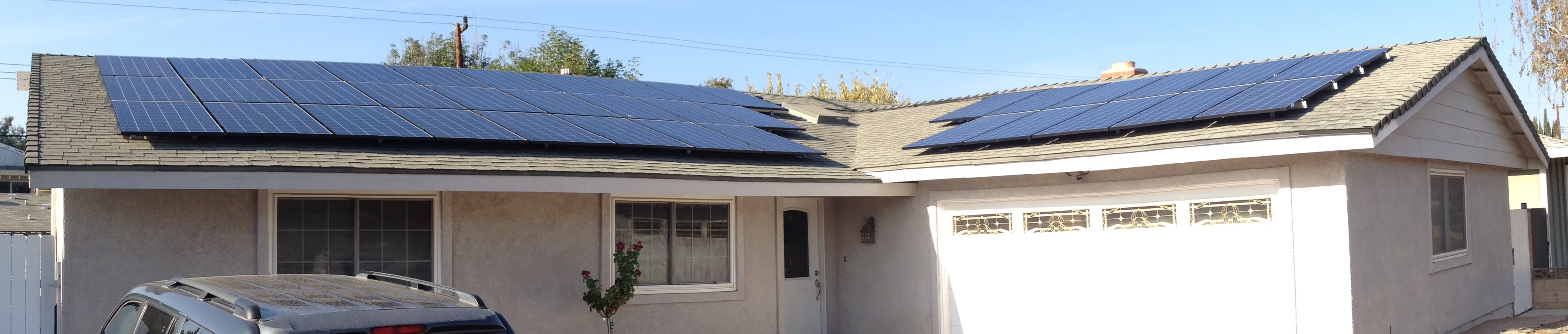
The Finished System – 38 Panels – 9.5 Kilowatts

Just received our latest electricity bill from Southern California Edison. Our total charges for delivery are $1.77, which is applied to a current credit balance of just over $200.00. Now that we’ve returned to bundled service from SCE, which means we are totally on a net energy metering account, we are consistently producing more energy than we’re consuming. I have been keeping close track of our total expenses since we had net metering fully enabled and I’m projecting we will save approximately $2,000 over last year’s bill. Think about that. This includes the amount we pay each month on the lease of the solar panels which, since we use a lot of energy, is a large system and is more than some people we know ever spend on a month’s worth of energy.

Some of our savings can be attributed to our being a bit more proactive in cooling the house in the evening and morning by opening up the windows and doors, and using an inexpensive box fan to pump the cooler outside air into the house before buttoning up as the temperature rises. Also, we’ve set our thermostat a bit higher in the Summer months, and have learned to be comfortable with an occasional high temp of 78 or even 80 degrees in the house.

Our two biggest expenses in terms of energy consumption are the pump for the swimming pool filter and our old, not terribly efficient air conditioner. We can’t do much about the pool, as we kind of would like to keep it and there’s nothing we can do to change the need to filter and circulate the water. So the pump remains a drain. I have tweaked the timing so it turns on after the Sun has reached an elevation that generates enough electricity to nevertheless keep our meter running backward, and turns off when the Sun is too low to be of much effect.
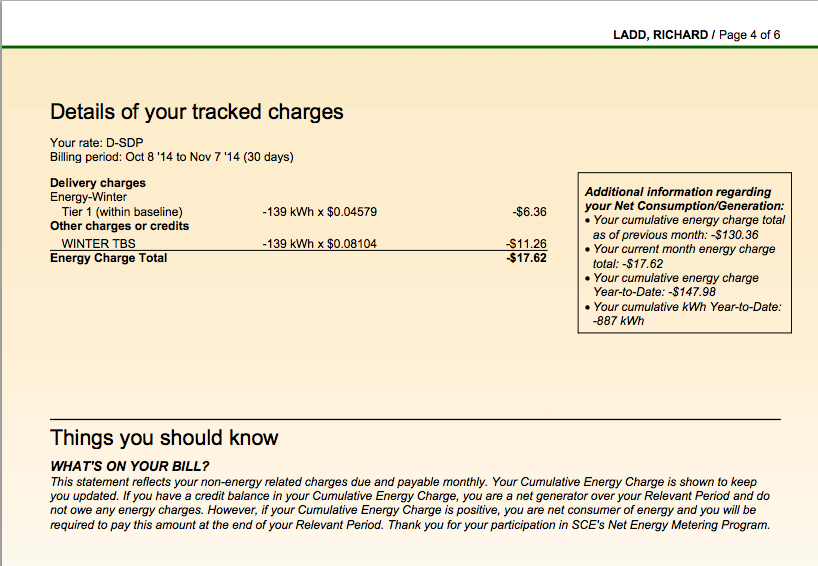
SCE Bill

A Portion of our October Bill, Showing Net Production.

Actually, during the Summer I experimented with different settings on our thermostat, which ran the gamut from cooling the house early in the day to take advantage of the abundance of solar energy our system was generating, and waiting until the inside temperature reached 78 degrees before switching on the A/C. Thanks to SCE’s online tools, I was able to track performance on an hourly basis and, by paying attention to the vagaries of the weather as well, I was able to fairly accurately determine what settings made the most sense in terms of production and conservation.

Another aspect of our particular situation is where our house sits relative to the path of the Sun. I don’t think we could have planned it any better if we could have picked the entire house up and planted it facing the perfect angle. Prior to installation of our panels, I’m pretty sure our house heated up far more quickly because of its placement. Now, not only do we have the maximum amount of energy produced by the two sets of panels, but I’m reasonably convinced we benefit as well from the fact the panels also shade the roof and absorb a fair amount of the heat energy as well, meaning the house heats up far slower than it used to.

I have to give kudos here to the company that designed and installed our system. They took into consideration our historical usage and the location of the house and the angle of the rooftops relative to the path of the Sun, and designed a system to provide the bulk of our energy needs. In fact, the system is efficient enough to offset whatever energy we use when the Sun is down, e.g. lights (most of which are CFLs, LEDs, and other fluorescents), TV, computers, etc. That company is Real Goods Solar, one of the first to enter the business and one that is local here in SoCal.

All things considered, I’ve concluded this was a very wise choice for us. Not only do we get to play a role in conserving energy, but we also save a rather substantial sum over what we had been paying for our overall electricity costs. I recommend you consider whether your overall energy consumption, coupled with the amount your house can produce based on its location and conditions, warrants the installation of a system. Not every home will benefit, but I’ll wager a considerable number will find the savings worthwhile. I seriously urge you to consider the alternatives.


Possibly Another Stellar Career Move?

USC Marshall Logo

Yesterday was a very good day. I didn’t make a penny and I don’t care. Jimmy could have cracked an entire bushel of corn and I still wouldn’t care. I had a good morning, posting a few items to my FB page, as well as a special item to my Rotary Club’s group and page. I spent a little time studying a request to get involved in the effort to bring open source, transparent voting technology to bear in California, and I enjoyed some interesting conversations with friends here on FB. I received a copy of a soon-to-be-released, transformational book that I had the privilege to help one of the authors with . . . and it was signed with a nice personal note. I also noticed I received a mention in the acknowledgements. All good stuff.

However, the pinnacle, the apex, the absolutely awesome apogee of my day was an interview at USC’s Marshall School of Business, where I had applied for a position as an Adjunct Professor. At this point I don’t even know who referred me to them. I thought it was a friend who teaches there, for whom I have been a guest lecturer a couple of times, but the woman who interviewed me thought it was a cousin who is a Professor in the Education department. I need to sort that out.

My appointment was for 2:30 pm and, since I live over forty miles from the campus and would have to traverse downtown Los Angeles to get there, I planned on leaving an hour and a half early. It turned out to be perfect, as I ran into the expected traffic, arriving at the entrance a half hour before the scheduled time. It took a couple of minutes to secure a parking permit (they had reserved a slot for me) and the gentleman who did so also gave me a map and instructions.

I parked on the fourth floor of a large structure and, noticing there were no elevators, I walked down the stairs to the street level. I guess I haven’t been in a building that tall in quite some time — at least one without an elevator — and, between the distortion of my bifocals, my being out-of-shape, and what I can only assume is an age related tendency to experience a little vertigo, I felt like a doddering old man, carefully stepping down each flight while holding on to the hand rail. I can remember a time when I could virtually skip down such stairs, but I guess those days are long gone.

As I walked the nearly quarter mile to the building I was headed to, I looked around at all the students walking and riding bicycles and skateboards, as well as the plethora of vehicles that included a large number and variety of electric carts and vans. Coming from the suburbs, I was struck by how closely packed everything seemed to be and I found myself thinking we are preparing the students for life as sardines.

USC Mascot

Tommy Trojan and Traveler – Fight On!

I had little trouble finding the Accounting building, where I was to report and, once inside, I sat down for a moment to get my bearings and to check in with my location on Facebook. I had posted about the interview and was pleased to find so many friends wishing me luck and I wanted to let them know I was there. I once read of a man who, asked to what he attributed his success, answered that he always arrived ten minutes early. As I had long believed a lack of punctuality was disrespectful, I adopted his tactic and, in this case, I was actually 15 minutes early. I don’t know if all this will translate into success, but I’m committed to the effort.

Based on a quick reconnoiter of the office numbers, I figured the one I was headed to was on the fourth floor, so I climbed up the first flight of stairs. At the top I found a sign indicating the stairs provided access to floors one through three, and that there was also access to the roof. I was pretty sure the office I was looking for wasn’t on the roof, but I couldn’t find any sign that pointed out where access to the fourth floor was located. I stopped a couple of students and asked them. They didn’t know, but one offered that she was going upstairs and she would walk with me. When we got to the third floor, it appeared there was another flight, but when we went around the corner it led to a locked door. We clearly weren’t going to the roof.

The student who had accompanied me offered to seek out advice and we ended up finding one of the Deans, who led me down a corridor to a door that opened up to stairs. Not in any way obvious, but . . . voila! I was near the end of my search and still 10 minutes early. I climbed the stairs and found the office I was seeking, announced my presence and the recognition I was early, and took a seat outside. Within minutes, the woman who was to conduct the interview popped her head out the door, introduced herself, and asked me to come on in.

I followed her inside, through the reception area, and into her office where she offered me a seat, closed the door, and sat down at her desk opposite me. We had an interesting opening chat which thoroughly confused me as to how my name had found its way to her, and I intend on researching that a little more, but it wasn’t really all that important. It did serve to show I had more connections to the University than I had realized, which was gratifying.

To make what is now a long story a little bit shorter, she told me I had a very impressive resume and she thought I would be perfect teaching both business communications and writing. She also told me they’re already set with their Spring schedule and that I would likely be offered a position after that, which would probably be teaching either Sophomores or Juniors, students she suggested would be very interested in my eclectic experience and knowledge. She also said I might be able to teach virtually, especially since they’re heading more in that direction and I had fairly recently completed my Masters degree in Knowledge Management entirely online. I would also be assigned a mentor, this being my first experience teaching at this level.

As it stands right now, in the interim I have the opportunity to be a guest lecturer, somewhat at my leisure and with subjects of my choosing. This, of course, would be uncompensated but I consider it valuable experience and a way of showing what I can do. I will soon send her a couple of synopses of what I propose to offer. Otherwise, I wait. Based on her enthusiasm and interest, unless she’s being disingenuous (and I have no reason to believe that to be the case), I expect I will begin what may be a new, interesting, and challenging chapter in my life’s journey within the next year.

One thing I find both interesting and ironic about all this is that I grew up believing I would attend UCLA, if I went to a local University. As it turns out, I never did go to undergraduate school, but UCLA likely would have been my first choice. That I may end up teaching at USC, their bitter crosstown rival, is kind of like growing up wanting to play baseball for the Los Angeles Dodgers, only to end up being drafted by the San Francisco Giants. There are far worse things I can think of.


Making Sense of All That Data

Deep Data

Transforming Big Data Information into Deep Data Insights

Yesterday I posted a question to several of the groups I belong to on LinkedIn. It was related to several of the things I’m interested and involved in: Systems Thinking, Knowledge Management, and Decision Modeling. It was somewhat informed, as well, by an article appearing in the Huffington Post, where Otto Scharmer, a Senior Lecturer at MIT and founder of the Presencing Institute, talks about the need to make sense of the huge and growing amounts of data we have available to us. He argues the importance of turning from “Big” data, where we mainly look outward in our attempt to understand what it is telling us about markets and our external influence, to “Deep” data, where we begin looking inward to understand what it’s telling us about ourselves and our organizations and how we get things done.

The question I asked was designed to seek out capabilities and functionality that people would like to have, but that is currently unavailable. My interests include working with others to understand and provide for those needs, if possible. I thought I would present the question here as well, where it will remain a part of my online presence and, hopefully, might elicit some useful responses. Here it is:

With the growing proliferation and importance of data — a development at least one author and MIT Lecturer has suggested is moving us from the information technology era to the data technology era — what tools would you like to see become available for handling, understanding, and sharing the new types of information and knowledge this development will bring?

In other words, what would you need that you don’t have today? What types of technology do you think would offer you, your colleagues, and your organizations a greater ability to make use of data to bring about a transformation from primarily siloed, outward looking data to collaborative, inward looking data as well?

I would love to hear of any ideas you might have regarding the kinds of tools or apps you could use to better deal with data by turning it into useful information and knowledge . . . perhaps even a smidgen of understanding and wisdom.


Does Your OCD Conflict With Your ADD?

OCD & ADD Hat

Do you find yourself bouncing from one thing to another? I do.

I have always had eclectic tastes and my interests are wide and varied. Couple that with being a bit of OCD in some respects and a little ADD in others, and you get . . . where was I? Seriously, I have long referred to myself as a stimulus magnet. For instance, I was never able to work anywhere near peak capacity if I listened to music, especially if lyrics were involved. It wouldn’t take longer than a minute or two before I’d be tapping my feet and wanting desperately to sing — which, of course, when sitting in a cube farm is not really a good thing to do.

A long time ago, I used to play a game with two friends where we would sit on a couch and the two on the outside would carry on separate conversations with the one in the middle. These conversations had to be more than just idle chit-chat as well; otherwise, it wouldn’t have been much of a challenge. I was pretty good at it and, in retrospect, I’m sure it helped me be able to multi-task, which we all know isn’t possible, except it actually is. I will, however, accept that doing so does reduces each task to being a little less efficient than it would otherwise be if one were to concentrate solely on it.

The advent of the Internet hasn’t made me more focused either. Like many people I know, my browser normally has a couple of dozen tabs open. Part of it is probably just related to my being an information pack rat, and my having a difficult time closing something interesting. I have a hard time escaping the nagging feeling that I’m going to want that document/page shortly after I close it, knowing if it’s any more than an hour or two afterward I’ll have difficulty finding it in my browsing history. I could bookmark it, and I often do, but that’s no guarantee I’ll either remember I did so or will be able to easily find it later.

I also bounce around a fair amount as a word, phrase, or sentence sends me scurrying off to find out more. Thankfully, Chrome includes the ability to highlight a word, right click on it, and look it up in the dictionary. The results also include info from wikipedia and a thesaurus as well . . . most of the time. This is becoming more and more useful as my internal dictionary and thesaurus are suffering from wear and the inevitable gumming up experienced as one ages.

Frankly, I don’t know if others experience these things, or if some of it is age-related as most of my online friends are considerably younger than I am. I’d send out a survey, but I’m quite certain it would piss off too many people or I would just be ignored . . . as I so frequently am normally.

All this greatly affects my ability to concentrate and causes me to constantly struggle to focus. Do you experience this? Is it just normal nowadays, given the firehose of information we are all inundated with via our computers, notebooks, and smartphones? I don’t think I’m the only one who deals with this, but I’m not entirely certain.


Dear everyone who keeps haranguing me to donate, donate, donate!!!

Political Donations

Give! Give! Give! There’s No End to it.

I am well aware the Republicans are threatening to take over the Senate and retain control of the House. I am also well aware that democracy as we think we know it is in danger of going the way of the Dodo bird and the very structure of the universe is threatened.

Unfortunately, I’m kind of stretched real thin and I’ve given about as much as I can for now. Do you want me to take out a second on my home? I receive about a dozen pleas each day, some of them worded so direly as to make me want to vomit.

I can only do so much, even if each one of my $3.00 donations will be tripled. I’d still end up donating a couple hundred dollars each and every week. You know that old saying, “You can’t squeeze dollars out of someone who’s living on a fixed income”, don’t you?

I’ve tried unsubscribing, but each time I sign an online petition about something I really do care about (even if I can’t afford to donate to it) I’m subscribed again because many of them don’t give me the opportunity to opt out. Really. I’m not even a Democrat; you’re too conservative for my tastes, but I am a pragmatist and I will generally vote Democratic. You’re beginning to make me wonder why.

PS – I would definitely vote for Bernie Sanders.

Update!

We have AT&T’s U-verse in our home and The Daily Show doesn’t air until 11:00 pm Mon – Thu, so I record it (along with The Colbert Report) and generally watch the next day. Shortly after I posted this, I went to watch last night’s show and, lo and behold, Jon Stewart addressed this very issue in his opening segment. It’s a great piece, so I’m adding it below in case you haven’t had the opportunity to see it. Unfortunately, I can only find it in two parts. Once again, he nails it and this time he’s skewering the Democrats, who richly deserve every word.

Here’s Part 1

Here’s Part 2


Boy Are Your Pipes Wasting Water!

Down the Drain

The Cost of Wasted Water Waiting for it to Heat

So . . . I finished taking out the trash, garbage, and recycling materials to the curb and, as is my wont, I took to the kitchen sink to wash my hands. Because I’m far more acutely aware of our water use due to the drought, I ended up washing them with cold water; I just didn’t want to let the water run long enough to get hot.

That got me wondering about how much water could be saved if we had instant water heating. I did a little research into tankless water heaters and quickly found out how little the technology seems to have progressed in the last 10 years or so. Most articles I came across suggested the break-even point for installing one that was reasonably efficient/effective would probably exceed your lifespan.

In the process, I came across figures for the number of gallons of water an average household runs down the drain while waiting for the hot water to push out the cold that’s in the pipes between the sink/tub/shower where it’s going to be used. The figure I came across is 26 – 29 gallons. I also looked at the US Census to see how many households there are in California. The number of housing units listed, as of 2013, is 13,790,495.

So, taking the number of households and multiplying by the more conservative number of 25 gallons per day down the drain, I determined the following. If we could find a way to heat water directly at the point of use, thereby not wasting that 25 gallons per day, the State of California would save 125,838,266,875 gallons of water per year. As it turns out, that’s a third of one percent of the water in Lake Tahoe. Drop in the bucket, or significant savings? Probably doesn’t matter, unless you’ve got an idea for how to provide on-demand, on-location hot water . . . cheap.


Twenty Years of Blogging – Congrats to Dave Winer

To Blog or Not to Blog

To Blog or Not to Blog

Dave Winer has played, mostly unbeknownst to me, a critical role in the development of blogging and other forms of online communication, including outliners and other types of online authoring and publishing software. I have been blogging for about ten years and I just recently came to realize his role. Actually, ever since I began following him on Facebook and experimenting with his numerous free offerings, e.g. Little Facebook Editor, which currently allows you to post to both Facebook and your WordPress blog, as well as edit and update both simultaneously, Little Card Editor, with which you can upload graphics (with added text) to both Facebook and Twitter, and Fargo, a quite useful outliner I’m using for a couple of things I’m working on.

Today, he posted in celebration of his twenty year anniversary of blogging. It’s an interesting explanation of what he’s been through (not exactly pretty) and what he thinks he’s learned from it. You can read it here. It’s really worth your while, especially if you’re a blogger and you sometimes wonder if it’s worth it.

I occasionally wonder why I’m doing this, as I’ve no intention of making any money off of my efforts but, rather, am merely looking for a way to express myself and, hopefully, reach a few people who like what I have to say. My biggest reason for blogging nowadays is to leave something of myself for my children, who may or may not find anything of value in it. I keep writing, though it’s sometimes a struggle – especially in terms of sharing some of my more personal thoughts, observations, and desires.

Anyway, this is my way of thanking Dave for what he’s done and recognizing his work in making all this possible. If you’re a blogger, you may not realize the role he’s played. Perhaps you should. At the very least, I always find it interesting to learn more about how we got to where we are. It’s frequently not terribly apparent unless you seek it out.

Mazel tov, Dave. Thanks for the ride. I, for one, am deeply appreciative.


The Helical Model of our Solar System

Picture our solar system hanging in space. What is it you see? Planets in nearly circular orbits, revolving at varying speeds around our central star, the Sun? What we don’t usually see is a depiction of what these orbits look like when you also factor in the movement of the Sun around the gravitational center of our galaxy, the Milky Way, and the vortex-like movement of the planets as they get dragged along behind it. This animation takes our star’s galactic motion into account as well, and the paths are much different than what we ordinarily see. Take a look.

Pretty cool, huh?


All Hail The Beneficent, Ubiquitous Keyboard

There’s a little sort of game going on in Facebook lately. Someone is challenged to list three things they’re thankful for for seven days, at the same time tagging a friend each day (or something like that) to do the same. I haven’t been asked to do it, and I have no plans of doing it either, as it just seems too spread out and broad to do justice to the recognition of those things we might be thankful for. Nevertheless, it does give me pause and I have been thinking about what I would say should I choose one or two specific things for which I’m thankful. There is one seemingly mundane thing that keeps popping into my head. My ability to type.

I can’t imagine how different my world would be if I had to use what an old girlfriend of mine called the “search and destroy” method of typing. Most people use the more pastoral term “hunt and peck”, but she spent several tours with the USO in Vietnam and her life was colored by her exposure to that war, the military, and her involvement in the movement to end it. If I were hampered by that inability, my social presence and my ability to communicate would be virtually non-existent.

I was fortunate. In Junior High School I took a typing class; instead of what I haven’t the faintest, but I recall it seeming to be the most useful option at the time. As a result, I learned to touch type. Later on, when I was in Law School, I secured a position as a legal secretary for a sole practitioner who did a lot of contract and property damage work for several of the largest car rental agencies in the country. We were very busy and my workload was challenging enough that my speed increased. I’ve never been as prolific as the best, but I was up to a little over 80 wpm, with few if any errors. That’s not quite as fast as the average person can speak, but it’s a respectable clip.

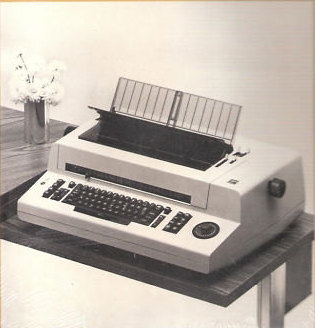
IBM Memory Typewriter

The IBM Memory Typewriter

The job turned out to be a major turning point in my life, as I was introduced to the early stages of office computing and word processing. We ended up getting an IBM Memory Typewriter, the one built on the correcting Selectric, but with a dial providing memory for 50 separate pages. We moved up shortly to an Artec Display 2000, which used two 8″ floppies and had a scrolling display of approximately 30 characters. I don’t remember if it was LED or LCD, but the characters were red. We used it for pleadings, and wills and trusts.

Back to typing speed and how critical it is to communication in today’s world. I don’t really have to imagine what it would be like, because I had an experience with a colleague that pointed it out rather clearly, though it took months for me to recognize what was happening. I was working with the Director of our newly formed Program Management Office at what was then the Rocketdyne Power & Propulsion business unit of The Boeing Company. We were at almost opposite ends of the main office building in Canoga Park and I was upstairs in what was called The Annex. The distance between his office and my cubesickle was around 400 yards; not a huge distance, but it took time to walk back and forth. Plus it meant passing through the Executive Office area and there were always distractions.

I can’t recall the exact dates, but it was very early in our use of Instant Messenger; so early that I had to point out its value, as most of the older staff (which meant all of the Executives) perceived it as only a toy their kids used to communicate with each other. I kept sending IMs to this Director, but he never answered them, nor did he respond in anything resembling a timely manner to emails, so I was forced to walk to his office repeatedly during the day.

It wasn’t until a couple of months had passed that I happened to be sitting with him in his office and he was answering an email. Watching him type . . . ever so slowly and painfully . . . made it clear why he never responded to me. He had to hunt anew for each letter and, with his two index fingers, peck them out in a long, excruciatingly difficult session. He clearly hated it. I know I was cringing as I watched. I never sent him an IM after that day.

I’m thinking the ability to type is one of those essential tools we seldom think about — perhaps take for granted — without which our world would be far less rich and fulfilling. I can type this post, tweet, post to Facebook, engage in lengthy, spirited debates with dozens of widely dispersed people, and participate in a plethora of other forms of communication or collaboration relatively easily, all because of my ability to type quickly and accurately. I imagine this is true for almost all, if not all, of my friends and acquaintances.

For this I am deeply thankful.


It Doesn’t Take a Rocket Scientist

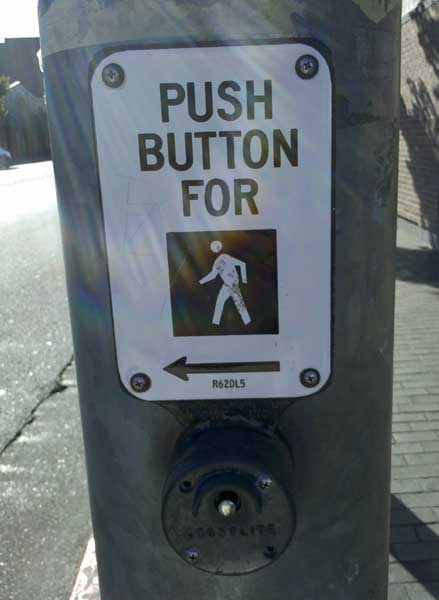
Crosswalk Button

This is a switch, not a pump!

I saw a video yesterday of a dog figuring out how to drink from a device set on the ground. It had to be stepped on and held down, but the dog would stomp on it a few times before finally standing on it to keep the water flowing. It reminded me of one of my favorite stories.

Many years ago, when I first started working at Rocketdyne, we had a couple of buildings on the other side of Canoga Ave. from the main office and factory structure. People were always having to cross the street and there was a controlled crosswalk there for that purpose. I was always amazed to find engineers repeatedly pushing the button (like this dog’s doing) to get the light to change.

I kept thinking – though I never said it out loud – “you know that’s a switch, not a pump.” It might be expected of the dog; but, rocket scientists? Maybe they were accountants.