Tag Archives: Systems Thinking

The Trump Vacuum and the Opportunity of Idealized Design


There’s a strange sort of energy in the air these days. You can almost feel it—the wheels coming off the rickety jalopy that is Trumpism. The man himself, once a master of chaos and distraction, is looking more and more like a washed-up carnival barker whose tricks have lost their shine. The legal walls are closing in, the rallies are less electric, and the “movement” has become less about a future and more about clinging to a bitter, grievance-soaked past.

But let’s not kid ourselves: while Trump has been busy turning the federal government into a shell of its former self—gutting agencies, stacking departments with yes-men, and driving out career professionals—he’s also unwittingly created a rare opportunity. Nature, as they say, abhors a vacuum. And what we’ve got, right now, is a vacuum the size of Pennsylvania Avenue.

If you’ve ever read Dr. Russell Ackoff—and if you haven’t, now would be a good time—he talks about something called “idealized design.” The gist? When the system you’ve got is broken, don’t just patch the leaks and slap on another coat of paint. Instead, ask yourself: If the current system disappeared overnight, what would you create to take its place? Not what’s possible within the old constraints, but what’s ideal given what we now know.

Well, look around. Thanks to the Trump wrecking ball, a lot of the old constraints are gone—obliterated, really. Agencies like the EPA, Education, even the Post Office, have been hollowed out to the point of absurdity. The courts are in crisis, the CDC is a shell, and the State Department looks like a ghost town. There’s nothing left to “fix.” So, what if we stopped trying to resuscitate the corpse and started imagining a new body politic altogether?

Here’s the opportunity: We get to ask, “What do we want government to look like, now?” Ackoff would tell us to ignore the nostalgic call for a return to the “good old days.” Instead, let’s design forward. A government that’s transparent, accountable, and explicitly built to serve all its people, not just the one percent or the loudest megaphones. What would a Department of Justice look like if it truly prioritized justice? What about immigration—not as a problem to be “solved,” but as a vibrant source of national renewal?

The Trump era, for all its destruction, has left us with a blank page. The lesson is not to cower in fear or yearn for the status quo ante. It’s to seize the moment, roll up our sleeves, and start sketching out the kind of institutions we wish we’d always had. It’s the ultimate act of resistance: refusing to settle for less than the ideal, and demanding a government worthy of the people it serves.

Let’s not waste the vacuum. Let’s fill it—creatively, bravely, and with the best of what we can imagine.


Don’t Call Me a Guru, Dammit!

NB: I published this article sometime in 2010, around the time I accepted an early severance package from Pratt & Whitney Rocketdyne and retired. It was published using WordPress’s old classic editor and didn’t render well any longer, so I’ve upgraded it to their current block editor format. This should explain why the date associated with it is May 16, 2023.


This article is a few years old, but there’s so much good stuff in here I’m thinking I should post it every other week for the rest of my life. Seriously, with all the talk lately about how you need to be careful of people who hold themselves out as Social Media Experts, Russ’s words are even more impactful.

This October Russ will have been gone for a year. I’m willing to bet I speak for a lot of people when I say he is sorely missed. He is surely not forgotten. Read the whole article; then get the book f-Laws.

Update (Thanksgiving, 2013) This post was originally published from www.telegraph.co.uk using Amplify, a curation service that no longer exists. Below is the excerpt as Amplify prepared it.

Anti-guru of joined-up management

Published: 12:01AM GMT 08 Feb 2007

My Last Visit With Russ
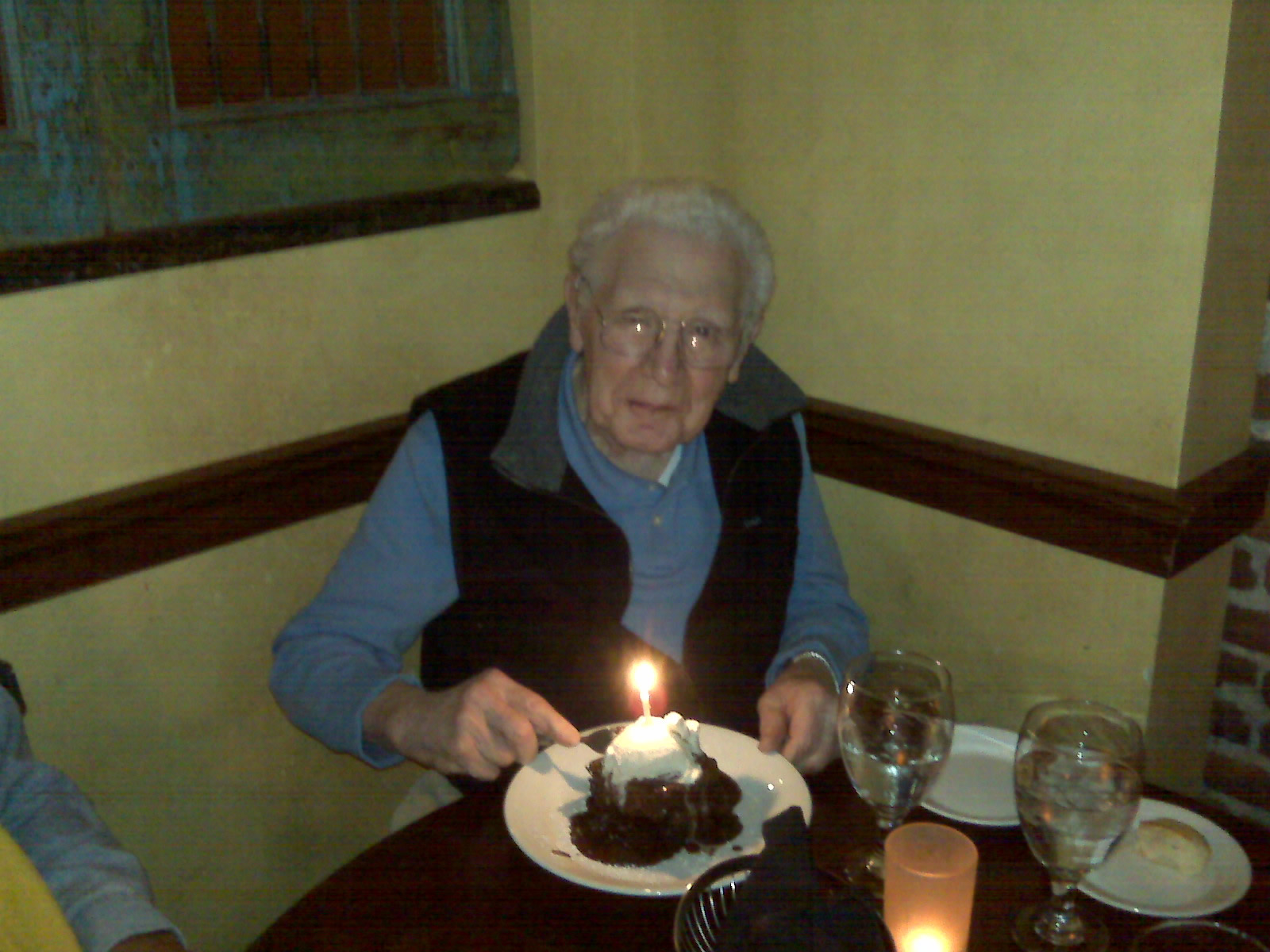
I was fortunate to spend Russell’s 90th birthday with him in Philly, I took this photo when Bill Bellows and I had dinner with Russell and his wife, Helen

If you were asked to picture what a management guru should look and sound like, you might come up with a description of someone very like Russ Ackoff. Grey-haired, distinguished, softly spoken, Ackoff fits the bill. And also, since he turns 88 on Monday, he can claim the benefit of wisdom earned over the course of six decades studying and working with businesses and organisations.

Except, of course, that “guru” is not a label that Ackoff is keen to accept.

“A guru produces disciples, and a discipline, and a doctrine,” he says. “If you are a follower of a guru, you don’t go beyond his thoughts, you accept his thoughts. He gives you the questions and the answers – it’s an end to thought. An educator is exactly the opposite,” he says. “You take off where he sets you up for the next set of questions. One is open-ended, the other is closed. Most consultants are gurus. They are ‘experts’, not educators.”

So please don’t refer to Ackoff’s body of work as gurudom and please don’t describe his work with clients as management consulting.

“We don’t call it consulting,” he states firmly. “We make a distinction between consulting and being an educator. A consultant goes in with a solution. He tries to impose it on a situation. An educator tries to train the people responsible for the work to work it out for themselves. We don’t pretend to know the way to get the answer.”

In his distaste for gurudom, Ackoff is of a mind with his old friend and colleague, the late Peter Drucker. Drucker famously once observed that the only reason people called him a guru was that they did not know how to spell the word “charlatan”.

“Peter Drucker made a great distinction between doing things right and doing the right thing,” Ackoff says. “All of our social problems arise out of doing the wrong thing righter. The more efficient you are at doing the wrong thing, the wronger you become. It is much better to do the right thing wronger than the wrong thing righter! If you do the right thing wrong and correct it, you get better.”

Read more at www.telegraph.co.uk (I don’t believe you can see the entire article without accepting a “free” monthly subscription, which you will have to cancel if you don’t want to be charged.)


Memories

This month will be 13 years since I retired from Rocketdyne. At the time it was owned by United Technologies’ Pratt & Whitney division. When I first joined the organization in 1987 the mother ship was Rockwell International. Later it was sold to The Boeing Co. It is currently owned by Aerojet, but negotiations are continuing to complete its sale to L3Harris.

Throughout all these changes, which I have either experienced or watched somewhat closely from not too far, one thing has remained relatively constant. The quality of the people who work there. I believe I was privileged to work with some of the smartest, most competent people on the planet. After all, it WAS rocket science. To be more precise, Rocket Engine science.

Now, I’m neither an engineer, nor a scientist. I am not a machinist, technician, or mechanic. I had nothing to do with the actual design, manufacture, assembly, test, or flight of the rocket engines we manufactured and provided to NASA. Not directly, that is. An organization such as Rocketdyne cannot operate without ancillary functions to ensure lines of communication are robust and effective between and amongst each of the dozens of functions such an org needs and I am happy I was able to provide some of the skills and knowledge necessary to facilitate those connections.

When I left the company in May of 2010, I took home with me numerous mementos of my time there. These include printed editions of studies I played a major role in conducting, training materials for a tool I was the project manager for, internal awards I received, and other items that had some meaning for me. Today I once again came across this simple ticket. I’ve kept it all these years because it reminds me of one of my favorite people ever. Myrna Beth Thompson or, as we knew her, Beth.

She was one of the first people I met and became friends with when I joined the Program Office of the Space Shuttle Main Engine team. In an organization composed of very conservative people, she was another progressive I could relate to and she wasn’t shy about her beliefs. She was also kind, caring, empathetic, and always available to help anyone who needed it. Tragically, she died of a massive heart attack nine years ago this month.

The ticket is a prop from a class Beth championed and taught as part of our efforts to instill the concept of Systems Thinking into the heart of the organization for which we labored. It was based on Barry Oshry’s book, Seeing Systems: Unlocking the Mysteries of Organizational Life. If I recall correctly, one of the concepts taught was that of the Abilene Paradox or, as many people refer to it, The Road to Abilene. You can read about it here. It’s understanding, however, is ancillary to my reason for posting this.

Beth has been gone nearly a decade. I don’t think of her often, much as I don’t think of my father, mother, and others who have passed on. But I’ve kept this simple little ticket all these years because it reminds me of her and our friendship. I can’t bring myself to part with it. I’m pretty sure it will be one of those things my children will unceremoniously dump when I am gone. It has absolutely no intrinsic value any longer. Its value is entirely dependent on my memories and my life. I consider that extremely valuable.

PS – In case you’re wondering, SSME stands for Space Shuttle Main Engine (the program we both worked on for many years) and O.E. stands for Organizational Excellence, one of the numerous efforts we indulged in over the years to improve how we did business. They were often spectacularly unsuccessful, but that’s another story.


Test Driving Google’s AI, Bard

In early 2009 I was privileged to spend a weekend with Dr. Russell Ackoff thanks to a friend and former colleague. I recall one incident where, while we were at Russ’s home, I mentioned my belief there was a similarity between the philosophy of dialectical materialism and the concept of systems thinking. As I recall, he was pretty upset with me for saying this. It’s stuck with me over the years.

Thanks to another friend on Facebook, I now have access to a set of AI tools, one of which is Google’s Bard. The other day, in an effort to test drive it, I proposed the following task and received the following reply:

Me:

Compare the philosophy of dialectical materialism as expressed by Karl Marx and Friedrich Engels to the concept of systems thinking as expressed by Russell Ackoff and others.

Bard:

Dialectical materialism

• Dialectical materialism is a materialist philosophy that emphasizes the role of conflict and change in history.

• It is based on the idea that the world is constantly changing and evolving, and that this change is driven by the conflict between opposing forces.

• These opposing forces can be social, economic, or political, and they can be found at all levels of society, from the individual to the global.

• Dialectical materialism is a dynamic and evolving philosophy that has been used to explain a wide range of historical events, from the French Revolution to the fall of the Soviet Union.

Systems thinking

• Systems thinking is a holistic approach to understanding the world that views it as a complex system of interacting parts.

• It is based on the idea that the whole is greater than the sum of its parts, and that it is impossible to understand any part of a system without understanding the system as a whole.

• Systems thinking has been used to understand a wide range of problems, from environmental degradation to economic inequality.

Comparison

• Both dialectical materialism and systems thinking are complex and sophisticated philosophies that have been used to understand the world in different ways.

• Dialectical materialism is more focused on the role of conflict and change in history, while systems thinking is more focused on the holistic nature of the world.

• Both philosophies have their strengths and weaknesses, and they can be used to complement each other.

For example:

• Dialectical materialism can be used to explain how conflict between social classes leads to social change, while systems thinking can be used to understand how the different parts of a society interact with each other.

• By combining these two approaches, we can gain a more complete understanding of the world and how it works.

Not quite as in-depth as I would have liked, but it does kind of jive with my understanding of the overlap of the two outlooks.


Capitalism vs. Humanism

I’m beginning to think nobody (at least not progressives) should use the word “socialism” any longer. We should replace it with the word “humanism.” This way it’s easier to point to the most important distinction between the two. Capitalism is concerned with capital, i.e. profit/money/wealth/things. Humanism is concerned with humans. Capitalism exalts things over everything else unless there’s a huge regulatory environment seeking to ensure capitalists don’t overreach. Humanism exalts humans over things, and seeks to ensure everyone has the basic things (shelter, food, clothing, healthcare, education) to become a fully realized, contributing member of society.

I know humanism is used differently, but socialism has been saddled with this connotation of authoritarianism, and too many people don’t see the difference between economic systems and systems of governance. Using the word humanism puts emphasis on who we want to benefit from our economic activity … the pipples.

Fight me!


Power To The People

Corporations, conglomerates, and industrial organizations aren’t the enemy, ipso facto. In fact, they make socialism not only possible, but necessary, IMO.

What is the enemy is unbridled greed, rampant cronyism, nepotism and, especially, the codification of deep income inequality. It is not good for a society when individuals can amass fortunes they can’t possibly spend. That they then turn some of that fortune into philanthropy and charitable organizations doesn’t change the fact that it should be criminal for one individual to take that much surplus value from the workforce that made their fortune possible. It’s estimated Jeff Bezos makes (not earns) around $2,500/second. Dafuque does he do, other than own Amazon stock?

I’m not saying inventors, creators, entrepreneurs, etc. aren’t entitled to profit from their efforts, but they shouldn’t be able to continue siphoning profit off an organization that has reached a point where it could easily survive without them. By the same token, intellectual property law has expanded patent and copyright protections way beyond their original intent, creating other avenues of indecent profit-making.

And getting back to what I said about making socialism possible and necessary, without large profitable organizations, we’d all be living off mom & pop’s and craft-making. Many of the products we enjoy, and that provide the grease that skids civilization as we know it, would not be possible without large factories, laboratories, and other institutions. By their very nature, though, they transcend the control and direction of any one individual, and I believe our pay/profit structure needs to take that much more into consideration, providing a larger share to the workers who have helped make the org successful.


How To Be A Patriot

Photo by Pixabay on Pexels.com

It seems to me that anyone who really cares about their country, who is a genuine patriot, has to care for everyone. Life is NOT a zero-sum game, where the gains enjoyed by others are a loss to you and yours. No, life and human society are highly complex, interdependent systems where every part has a role to play, and when we don’t provide optimal conditions for the health and well-being of some of the parts, the whole body suffers. Would you want your car’s engine to go without one of its spark plugs? While it would still get you to where you were going, it wouldn’t do it as efficiently, nor as effectively. In the end, it would almost certainly cost more to deal with the results of an imbalance in the engine than it would to ensure all its components were kept in good working order.

Yet many approach life as though they are living on an island. It’s difficult to fathom the level of insensitivity, blindness to reality, and the callous lack of empathy it takes to turn one’s back on people who may not directly affect your life in a way you can feel immediately, but who nevertheless impact the organizations and institutions you deal with all the time.

For instance, by not ensuring all children receive healthcare, adequate nutrition, and early education, we ensure our up and coming workforce will be less prepared than they otherwise could be for the kinds of jobs that will be available in the near future. The net result is we not only handicap those children, we also handicap their families, their friends, and the entire nation. By guaranteeing they need more help for far longer than might otherwise be the case, we add to both their burden and ours.

We hobble ourselves with mistaken, outdated, unsupportable notions that give far more importance to diversity as a bad thing; as something that takes away from our sense of worth, of self. Instead of understanding, celebrating, and taking advantage of all the ways in which we complement and enhance each other, too many of us turn those virtues into imaginary vices and use them to divide and separate us. What a pity.


The Quiet Leadership That Matters Most

Well . . . this came at an auspicious time. This article was just shared by a friend on FB, in a local Indivisible group. It’s very short, but contains a TED Talk that’s a little over six minutes long. It’s really worth watching; game me the chills. Also, think about what we’re doing right now by staying home and practicing social distancing. I am certain it’s making a difference, thought it may be another couple of weeks before the numbers will make it clear. And, since I’m one of the people who’s theoretically inside the bullseye (age and comorbidities) I’m thankful to everyone who’s taking this seriously. I certainly am.

This moment that we are living through right now, is really rather extraordinary. Tens of millions of us are sitting at home. We don’t have our military patrolling the  streets, threatening to…

With respect to the subject of the video, there was a group of us at Rocketdyne who used to constantly say, “lead from where you are,” meaning “don’t wait for others to tell you what to do or how to do it; step up and step out. You know what to do. Now do it!” So, in addition to the speaker’s assertion that we need to accept ourselves as leaders, I would add we need to recognize the opportunities presented to us to do so. Enjoy the talk.

Source: The Quiet Leadership That Matters Most – Political⚡Charge


The Consequences of NOT Seeing Systems

Senge on Seeing Systems

Want to understand Systems better? Check out Peter Senge, Russell Ackoff, W. Edwards Deming, or just search Google for some info

When I first started this blog, one of my goals was to bring a systems perspective to my posts. Circumstance made that goal a bit difficult at times, and my interests are a bit too eclectic for me to stay in a single lane, but it is a perspective I feel most comfortable with and believe is useful in understanding the world and human society and relationships.

It’s long been clear to me that many people haven’t the faintest idea how systems work and how not understanding the interplay of their aggregate parts makes it virtually impossible to make quality, informed decisions.

In order for democracy to be spread and actually implemented in ways that are meaningful to ordinary people (who are often really afterthoughts to our institutions and those who lead them) I am convinced we need to become not merely critical thinkers, but also “systems thinkers”, i.e. we need to learn how to “see” systems. We, meaning “the people”, need to recognize how all things are parts of systems and that smaller systems are parts of other, more encompassing systems. Whether closely or remotely, we need to recognize how things are related to each other, such that we can appreciate the ways in which they affect and sometimes transform each other.

When this happens without our fully (or even partially) understanding these effects, we call them “unintended consequences.” However, these generally come about not because we failed to appreciate their possibility, but because we didn’t even see how they were related. It is our ignorance — in the non-pejorative sense — that’s causing us harm, because we just don’t see the subtle interplay of forces or the way they interact with each other. I plan on continuing to touch on this subject, as well as the other things that interest me. Stay tuned!


Empathy: The Core of Complex Decisions

Having worked with Dr. Pratt and her company, Quantellia, I have long been convinced their approach to decision making is one of, if not THE, best methodologies I’ve encountered. After what I consider to be one of the most disastrous general elections in my lifetime, it would seem we need help in navigating the complexities of the world and our place in it. Lorien’s work can, I believe, help us understand the consequences of our decisions, before we make them. I urge you to watch this video and become more conversant in the issues Dr. Pratt raises. What follows below the video are some of the “liner notes” that go with her TEDxLivermore talk.

Making decisions based on invisible inputs is like building a skyscraper without a blueprint. Yet that is the norm, even for very complex problems. Contrary to how most of us think about making a decision as being the act of choosing, a decision is the last piece of a long, almost completely invisible, process. The good news: it is possible to make the invisible part of decisions visible.

In working with the Community Justice Advisor Program in Liberia, Africa, Lorien and colleagues helped The Carter Center (founded by Jimmy and Rosalynn Carter) use decision models to increase positive outcomes in the domain of civil justice, by identifying the most effective levers for change.

Using deep learning artificial intelligence, the interconnections between inputs become visible, and unintended consequences can be identified before implementation. Vicious cycles can be reversed, and virtuous cycles of improvement can be built in place and nurtured through intelligent decision metrics.

As co-founder of Quantellia, Dr. Lorien Pratt co-created the decision intelligence methodology and the company’s award-winning World Modeler™ software. She consults and speaks worldwide, and is known for her neural network research and the book Learning to Learn. A former college professor, Pratt is widely known as the former global director of telecommunications research for Stratecast, a division of Frost & Sullivan. A graduate of Dartmouth College and Rutgers University, Pratt holds three degrees in computer science. She received the CAREER award from the National Science Foundation, an innovation award from Microsoft, and is author of dozens of technical papers and articles.

This talk was given at a TEDx event using the TED conference format but independently organized by a local community. Learn more at http://ted.com/tedx