Category Archives: Systems Thinking

Charity Sucks

When I feed the poor,
they call me a saint.
When I ask why the poor have no food,
They call me a communist.

~ Dom Helder Camara

Most of us would agree charity is important. There are, after all, large numbers of people who need a helping hand at times and who, without help, would fall between the cracks of society and suffer needlessly; perhaps perish as a result.

But we don’t seem to ever ask ourselves why charity is necessary; why there are always millions who haven’t enough to get by comfortably. It’s understandable in the face of natural disasters and unfortunate accidents, but more difficult to accept when it’s merely the “way things are.” I haven’t always done so myself.

Shortly after my retirement from Pratt & Whitney Rocketdyne, I was asked to join one of my city’s local Rotary clubs. I knew many of the city’s leaders were involved in Rotary and I also knew the club I was asked to join held a yearly Cajun & Blues festival on Memorial Day each year that was wildly successful and raised a lot of money for the community.

I was happy to join and discovered one of Rotary International’s projects was to eradicate Polio—a worthy endeavor in my estimation. I became fairly active in my club, taking on the responsibility of using social media to promote our activities and volunteering for many of the club’s activities, including providing a full Thanksgiving meal at our senior center, assembling bicycles to give to children for Christmas, and spending an entire weekend (sometimes more) during the Cajun & Blues festival.

Nevertheless, I was somewhat uncomfortable with the realization that quite a few of the members of my club were uncomfortably conservative; some of them clearly harboring deeply bigoted concepts of entire groups of people I felt were undeserving of their scorn. After all, I live in Simi Valley, home of the Ronald Reagan Presidential Library and also known for the acquittal of the police officers who beat the crap out of Rodney King.

I celebrated my fourth anniversary with the club in October of 2016, though I had been attending breakfast meetings for nearly six months prior to becoming an official member (there was some kind of SNAFU that held up my membership.) I had long been uncomfortable with a large segment of the members and, after the election of Donald Trump, I decided I needed to use my limited discretionary funds for something other than rubber chicken circuit breakfasts and a glossy magazine I seldom had time to read.

I tendered my resignation in December and immediately started monthly contributions to five advocacy groups I felt were more aligned with the direction I wished to see society go in. Those organizations included Planned Parenthood, the ACLU, the NAACP Legal & Defense Fund, MALDEF, and the Standing Rock Water Defenders. The last of these stopped accepting donations when they were unceremoniously kicked off the land, and I replaced them with my local Democratic club, of which I had also become a member.

So . . . my point here is that, while charity is important because many are struggling and need a helping hand, it is also an indication (a powerful one, IMO) that something is wrong with our society. Why does such a wealthy nation have such a large population of people living on the razor’s edge of existence? Why are people like Jeff Bezos allowed to amass fortunes in the billions while others are left to starve on the streets? I know it’s the logic of capitalism, but I don’t think it makes much sense from a systems or holistic view of humanity and society . . . even of economics. At twice the national poverty line (~$50K/yr) Bezos’s worth of $110,000,000,000 would bring a reasonably comfortable level of income to 2,200,000 families of four (that’s approximately 8,800,000 people.)

Many are beginning to realize income inequality is deeply hurtful to a society. Large segments of the population can’t possibly contribute as much as they’re capable of when they’re struggling to stay alive and healthy. I’m of the opinion we have a hard time understanding this because we are not conversant in the language of systems; we don’t see the interconnections between all of us and our actions and how such large segments of our population who are under stress is stressful to our society as a whole.

Whether it’s Universal Basic Income or a shift to a more socialistic economic system, I believe something needs to be done to allow as many as possible to reach closer to their full potential as contributing members of our society. Until such time, I don’t see how we can truly call ourselves “the land of the free, and the home of the brave.” The status quo is anything but freedom enhancing, and its acceptance is hardly an act of courage.


Leading a Horse to Water

During my last eight years at Rocketdyne (which traversed ownership by The Boeing Company and United Technologies’ Pratt & Whitney Division) I was the Project Manager for an internal tool called AskMe. It’s original intent was to provide a method whereby people could find both experts and expertise, i.e. people with knowledge they needed or papers and other publications that expressed useful knowledge. I later came to realize what we were doing was using a social media tool.

During the entire eight years I worked on that system, it was a constant struggle to get people to use it. People clearly believed that sharing was not in their best interests. Either that, or they were too intimidated by the thought of putting their knowledge to the test of time, as the whole idea was to foster conversations that would be saved and could later be searched when that kind of knowledge was needed again.

At any rate, I tried lots of different ways of promoting the tool. This one, below, came about after I received an email (at home) for a penis enlargement product. I thought to borrow the concept and see if it flew. I have taken the liberty of blurring out my colleague’s face, as I’m not sure where he is and, frankly, I don’t even remember who he is!

BTW – Within a couple of years of my departure, much to the chagrin of many who had worked on it, the tool was gone. I’ll share later why I think this was so.


Outside Agitator

I serendipitously came across this photo a few days ago and shared it with a group that’s fighting the recall of our very first progressive Latina elected to our City Council. I shared it with them not because of the irony (which is substantial) but because the guy with the Latinos for Trump sign has shown up at our City Council meetings to agitate in favor of recalling her. I’m told he’s from Apple Valley, which is well over 100 miles from Simi Valley. There were at several other “protestors” at these meetings that are from nowhere near Simi Valley.

Morons for Stupdity

I only recently learned the Republican Party, recognizing they can’t win control of many Western States via fair elections, have taken up this tactic of recall, which they time to occur when voter turnout is historically likely to be comparatively light. One of the primary organizers of this effort is a contributor to Red State and other right-wing publications and many believe one of her goals to be self-promotion.

Simi Valley suffers from an unfortunately deserved bad reputation for racism, thanks to the Rodney King trial which, if unfamiliar to you, you should Google. When I first retired from Rocketdyne, in 2010, I did some research on Simi. At the time, a Google search turned up essentially three things the city is known for: The Ronald Reagan Presidential Library, the worst nuclear reactor meltdown (at SSFL) in U.S. history, and the Rodney King trial. The trial was the most frequently appearing result of the three.

I tried to get some of the city’s leaders to support doing something about it via targeted blogging and social media campaigns, but they didn’t understand what I was getting at, and they weren’t really interested. Now they’re doubling down on their deep animosity for anyone who doesn’t buckle under to the weight of their limited vision.

Simi Valley’s leadership is, for the most part, highly conservative. I would label them reactionary. I’m told they’re corrupt as well, though I haven’t enough knowledge to make a judgment call on that issue. I will, however, be well-educated on it soon. Stay tuned.


RAIDI

Robot and Human hands touching

I have no doubt I am a very lucky person. Although I do not have an education in any science, I was able to spend approximately two decades working on the Space Shuttle Main Engine (SSME) program at Rocketdyne (through four major aerospace corporations). I spent a lot of time working with some of the brightest rocket scientists (for realz) as well as world-class engineers and scientists in literally dozens of disciplines.

Since my retirement from (what was then) Pratt & Whitney Rocketdyne, I have worked intermittently with Quantellia, LLC, an artificial intelligence / machine learning software development firm. Needles to say, I have no formal education in any computer field, with the exception of two Visual Basic classes I took at a nearby Junior College. I was introduced to one of the co-founders of Quantellia shortly after my retirement. She showed me a tool they had been developing called “World Modeler”. It was the most exciting thing I’d seen in a long time, and I was especially impressed with how it brought a highly systemic approach to modeling and forecasting in complex situations. I ended up writing several papers and a bunch of case studies for them.

In 2015 I returned to work at what was then Aerojet Rocketdyne (still is, for now) where I worked on a small rocket engine program for a little over two years. After leaving, I started doing some selling for Quantellia and, beginning in March of 2018, I became the company’s Business Manager, a position I’m still working at.

Last year we held a summit, in conjunction with SAP Global Services, at their Labs in Palo Alto. It was called the “Responsible AI/DI Summit.” In this context AI stands for “Artificial Intelligence” and DI stands for “Decision Intelligence.” One of the main purposes of the summit was to discuss how we can develop artificial and decision intelligence such that we concentrate on using them to solve humanity’s most “wicked” problems, rather than merely work at developing apps, the main purpose of which is to make money for the developers, investors, and entrepreneurs involved in the business.

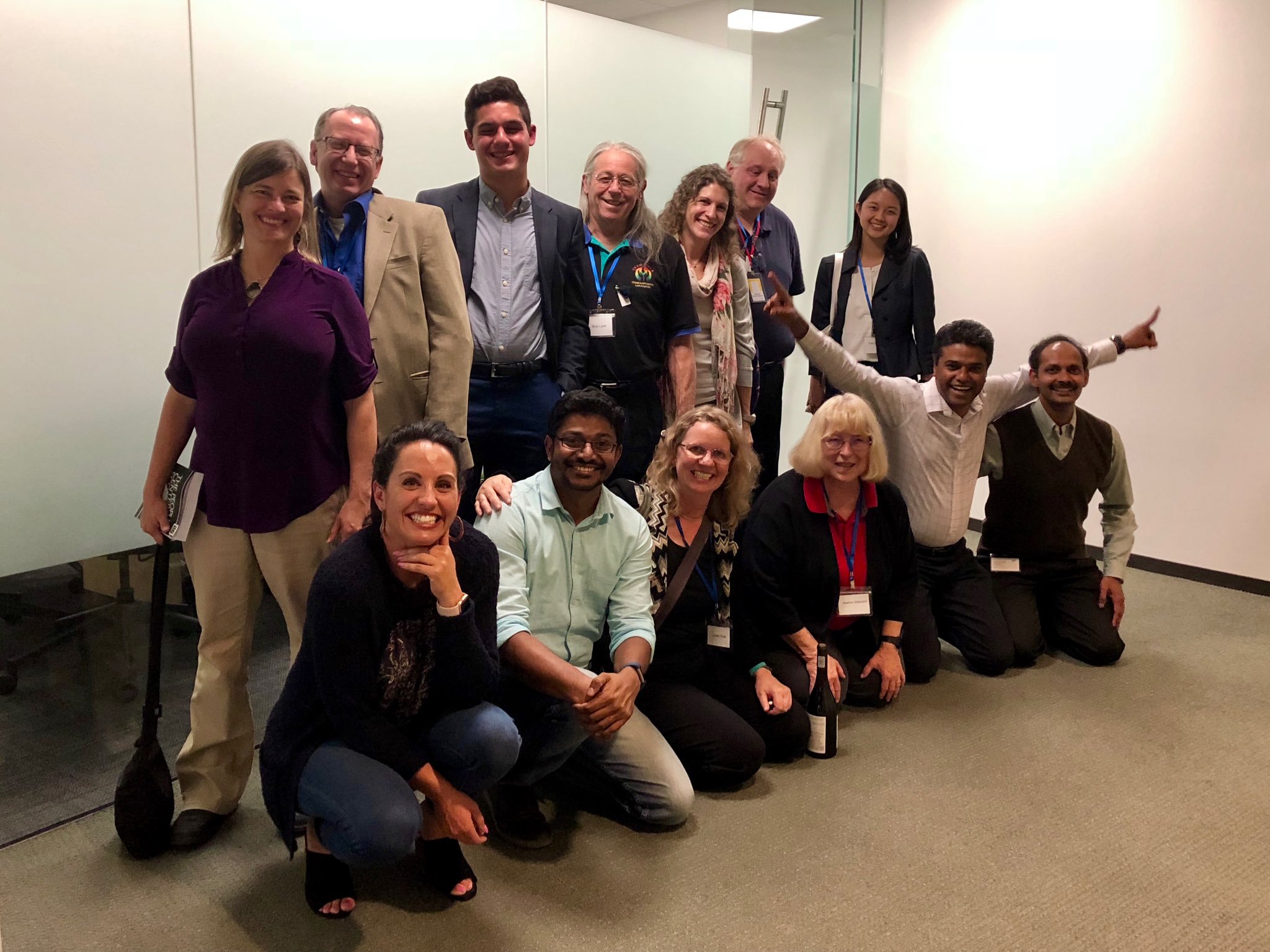
Below are some of the folks who worked on the Summit, including me (the long-haired guy in the middle of the back row). Also, here’s a link to this year’s second Summit – Responsible AI/DI Summit 2019, as well as a link to the RAIDI Blog.

Quantellia and SAP folks who worked on putting it all together

As I learn more about machine learning, artificial intelligence, and decision intelligence, I will work at sharing my knowledge and understanding of these tools, and the issues they raise. I know the people I’m working with are dedicated to serving humanity, not merely milking it for profit. That pleases me and I hope we’ll be able to prove we’re doing the right things to ensure such service continues to exist and grow.


Will Someone Stand Up?

In the 2020 General Election, coming up waaaaay sooner than you think, time being what it is, there are eight (count ’em, eight) Republican Senators who are up for election unopposed. Actually, two of the eight are retiring but, in all cases, whether it’s a replacement or the incumbent, they’re all running unopposed. This is an intolerable situation, IMO.

Allowing any Republican, all (save for Justin Amash) of whom have shown themselves to be hapless sycophants, bowing to the whims of the most destructive and inhumane President in modern history, to run without any Democratic opposition is something we should avoid at all costs.

  • Bill Cassidy, Louisiana (In 2014 he beat three-term incumbent, Democrat Mary Landrieu, 56 percent to 44 percent. Don’t know if there are any Democrats in the running at present.)
  • Mike Enzi, Wyoming (Retiring – This seat is considered safe by most people.)
  • Cindy Hyde-Smith, Mississippi (Hyde-Smith defeated Mike Espy last November in a racially charged campaign.)
  • James Inhofe, Oklahoma (This is the schmuck who brought a snowball into the Senate chambers to make the argument that global warming can’t be possible because it’s still cold somewhere.)
  • Pat Roberts, Kansas (Retiring – Maybe a lost cause, as he ran unopposed last time and Kansas is a deep red state)
  • Mike Rounds, South Dakota (The entire state has approximately a quarter of a million voters. Unknown if there are enough Democrats to matter.)
  • Ben Sasse, Nebraska (In the 2014 election, there were a little over a half million voters; Sasse won every county in the State – 64% to 31%)
  • Dan Sullivan, Alaska (In the 2014 election, Sullivan won by 2.2% with a total of only a little over a quarter million voters. This state could be ripe for a flip.)

After the 2016 General Election, I worked with a group of people who were creating a canvassing tool that was designed to use AI to better prepare people who were out knocking on doors. It would have used demographics and historical voting data to train a machine learning algorithm on the patterns to be found in the data. Unfortunately, our primary investor kept adding requirements and ultimately squeezed the value right out of the app.

Nevertheless, our original concept we had discussed was to use machine learning to help political organizations make the most effective (not merely efficient) use of their various resources, e.g. time, money, people, connections, as well as understanding the political environment based on polls and overall news coverage.

Frankly, nobody I know of has sat down and begun to develop such a decision model, though I would dearly love to see it happen. It’s what we envisioned after Trump “won” and I still think it’s a viable approach. It does look like it’s a somewhat daunting challenge, however, when it comes to how expensive it would be to gather all the data we’d need access to, as well as develop the algorithms that would analyze and correlate the data.

Regardless, it seems a shame so many Republicans might run without any Democratic opposition. You’d think the least we can do is make them fight for their seats, which would include forcing them to shift resources around as well. It should be part of the overall pattern of the elections, which I’m unconvinced the Democratic Party really understands.


The Strategic Complexity Framework – for Dummies

Based on a post from my friend, John Husband, I came across this great article by Vinay Gupta, which simply and (I think) quite elegantly lays out an understanding of an issue I have long sought to internalize . . . but which I’m loathe to claim I actually understand or can clearly articulate. Part of the reason I’m posting this is so I have access to the two simple explanations of the framework. What follows is a bit of Gupta’s post, with a link at the end to the original.

I recently pestered my friend Noah Raford to summarize his understanding of Cynefin and complexity in a single page document. Noah called it the Strategic Complexity Framework.

I, being still a bit dyslexic, can never keep the “simple, complicated, complex, chaotic” thing from Dave Snowdon‘s Cynefin framework straight in my head. And I think about complexity as having three domains (but that’s another story.)

So I’ve taken advantage of open licensing to produce a version of Noah’s Strategic Complexity Framework, called the Strategic Complexity Framework… for Dummies.

A translation guide:
Simple (= Simple): put stuff in boxes.
Hard (= Complicated): build a rocket ship.
Fickle (= Complex): weather, economy, farming.
Borked (= Chaotic): war zones, collapses, volcanos.

There’s a ton of great work out there on the background to all of these models, but I have conveniently filed knobs off. Simple!

Source: The Strategic Complexity Framework – for Dummies | The Bucky-Gandhi Design Institution


Why You Don’t Want to Retire

When I joined the Space Shuttle Main Engine program at what was then Rockwell International’s Rocketdyne division, I had never heard the men in my life use the word “retirement.” The reason; they were mostly small businessmen who expected to work until they dropped dead. And that’s exactly what happened to every one of them.

At Rocketdyne, however, it seemed everyone I worked with talked incessantly about retirement. They also talked a lot about what they’d do if they won the lottery, but that’s another story.

A year later, I secured a position as a regular employee (I had been a temp; what they called a “job shopper”) and had to make decisions regarding my future retirement. Most notable of those decisions was whether or not to participate in the company’s 401K program. At the time, the decision was a no-brainer. The company matched employee contributions dollar for dollar, up to 8% of one’s gross income. It was a way to save up a fair amount of money as a nest egg.

Even so, I never saw myself as retiring; I felt I needed to work at something until I either died or was so infirm or incapacitated I wouldn’t be capable of anything useful. I fully expected to work at Rocketdyne until I was at least eighty, despite the fact I had little reason to believe I would live that long.

I ended up leaving what by that time was United Technologies’ Pratt & Whitney Rocketdyne division. That was over seven years ago and I’m still not retired. I don’t expect I ever will retire and, frankly, the concept still means little to me. I do, however, enjoy some retirement income from that original 401K, as well as a small pension and social security. It’s not enough for me to stop working, but I really don’t want to stop. Here’s why.

Yesterday, Jeremiah Owyang posted a graphic on Facebook that caught my eye. It depicts a Japanese concept called Ikigai, which the people who live in Okinawa, Japan live — and live long — by. The concept translates roughly into “the reason you get out of bed in the morning.” It makes an interesting Venn diagram, as you can see below.

Ikigai

The “Sweet Spot” Most All of us Would Like to Achieve

I shared his post with the following comment:

I believe I’ve hit this sweet spot a couple of times in my life, most notably when I worked on the Space Shuttle Main Engine program. I’m pretty close to it now as well, working with Quantellia and machine learning. How about you?

A few of my former colleagues chimed in and one of them actually found the original article in which the graphic had appeared. It’s short and not that old. The title is “Why North Americans should consider dumping age-old retirement.” You can find it here if you’d care to read it.

This is what I think we should all strive for. This is the kind of balance that brings peace of mind and contentment. I’m lucky to have experienced Ikigai in much of my work life. In explanation of how I felt I was working on “What the world needs,” I later commented:

I should point out, especially, I believe we need to establish not merely a scientific outpost off-planet, but a cultural outpost as well. I have no doubt Earth will experience an ELE someday and we need to get established elsewhere, if for no other reason than to repopulate the Earth after such an event, and have a leg up recalling all that we’d accomplished until that unfortunate event. Perhaps we’ll be able to divert any asteroids or comets we discover heading our way, and such a place won’t be necessary, but there’s no way to be completely sure of our ability to avoid catastrophe. I, therefore, felt it was somewhat of a sacred duty to play whatever small role I could to get humans into space. It’s why the cancellation of the Shuttle program – when there was nothing in the pipeline to replace it – was so disconcerting to me. It was a big reason I accepted an early severance package offered to all employees over 60 (I was almost 63 when they made it).

Now, over seven years since my “retirement”, I’m still fortunate to be working on something I believe the world needs (though there’s considerable dispute over whether it will destroy us in the long run). The only place I fall short is in the area of doing what I’m good at. This is because I’m not a data scientist or a designer or programmer. I am, however, a reasonably good salesman and have other skills I’m bringing to bear on my work with Quantellia. I expect my studies and experiences will fill up this hole reasonably soon.

I do believe everyone should be able to approach Ikigai. There is much the world needs and, despite the predicted crisis expected when the machines take over the world and millions of jobs disappear, there will still be lots we can do to lead fulfilling lives. I am a supporter of universal basic income (UBI) and find Jeremiah’s closing words from his Facebook post instructive:

Soon, automation will disrupt Ikigai, in the looming Autonomous World, and we’ll need to reset what our “reason for being” is.

I’m betting that we’ll accept the imperfect arts, humanities, and engage in wellness and fitness for longevity.

I happen to go along with those who believe UBI will unleash creativity and entrepreneurship, though I recognize the pitfalls it may present as well. Regardless, there is a looming crisis and, frankly, my current efforts in selling machine learning services and products, is accelerating it. I doubt we can step back from the cliff, so it may be time to give everyone a kind of “golden parachute”; at least one sufficient to allow them a soft landing when that crisis arrives.


The Consequences of NOT Seeing Systems

Senge on Seeing Systems

Want to understand Systems better? Check out Peter Senge, Russell Ackoff, W. Edwards Deming, or just search Google for some info

When I first started this blog, one of my goals was to bring a systems perspective to my posts. Circumstance made that goal a bit difficult at times, and my interests are a bit too eclectic for me to stay in a single lane, but it is a perspective I feel most comfortable with and believe is useful in understanding the world and human society and relationships.

It’s long been clear to me that many people haven’t the faintest idea how systems work and how not understanding the interplay of their aggregate parts makes it virtually impossible to make quality, informed decisions.

In order for democracy to be spread and actually implemented in ways that are meaningful to ordinary people (who are often really afterthoughts to our institutions and those who lead them) I am convinced we need to become not merely critical thinkers, but also “systems thinkers”, i.e. we need to learn how to “see” systems. We, meaning “the people”, need to recognize how all things are parts of systems and that smaller systems are parts of other, more encompassing systems. Whether closely or remotely, we need to recognize how things are related to each other, such that we can appreciate the ways in which they affect and sometimes transform each other.

When this happens without our fully (or even partially) understanding these effects, we call them “unintended consequences.” However, these generally come about not because we failed to appreciate their possibility, but because we didn’t even see how they were related. It is our ignorance — in the non-pejorative sense — that’s causing us harm, because we just don’t see the subtle interplay of forces or the way they interact with each other. I plan on continuing to touch on this subject, as well as the other things that interest me. Stay tuned!


Empathy: The Core of Complex Decisions

Having worked with Dr. Pratt and her company, Quantellia, I have long been convinced their approach to decision making is one of, if not THE, best methodologies I’ve encountered. After what I consider to be one of the most disastrous general elections in my lifetime, it would seem we need help in navigating the complexities of the world and our place in it. Lorien’s work can, I believe, help us understand the consequences of our decisions, before we make them. I urge you to watch this video and become more conversant in the issues Dr. Pratt raises. What follows below the video are some of the “liner notes” that go with her TEDxLivermore talk.

Making decisions based on invisible inputs is like building a skyscraper without a blueprint. Yet that is the norm, even for very complex problems. Contrary to how most of us think about making a decision as being the act of choosing, a decision is the last piece of a long, almost completely invisible, process. The good news: it is possible to make the invisible part of decisions visible.

In working with the Community Justice Advisor Program in Liberia, Africa, Lorien and colleagues helped The Carter Center (founded by Jimmy and Rosalynn Carter) use decision models to increase positive outcomes in the domain of civil justice, by identifying the most effective levers for change.

Using deep learning artificial intelligence, the interconnections between inputs become visible, and unintended consequences can be identified before implementation. Vicious cycles can be reversed, and virtuous cycles of improvement can be built in place and nurtured through intelligent decision metrics.

As co-founder of Quantellia, Dr. Lorien Pratt co-created the decision intelligence methodology and the company’s award-winning World Modeler™ software. She consults and speaks worldwide, and is known for her neural network research and the book Learning to Learn. A former college professor, Pratt is widely known as the former global director of telecommunications research for Stratecast, a division of Frost & Sullivan. A graduate of Dartmouth College and Rutgers University, Pratt holds three degrees in computer science. She received the CAREER award from the National Science Foundation, an innovation award from Microsoft, and is author of dozens of technical papers and articles.

This talk was given at a TEDx event using the TED conference format but independently organized by a local community. Learn more at http://ted.com/tedx


The Elements of Dialectical Materialism

Yin Yang Symbol

My Favorite Representation of The Concept of The Dialectic

I am not an academic. Neither am I a philosopher or a journalist. Nevertheless, I do write on occasion and make an effort to share my thoughts in a somewhat coherent manner. I have to admit it’s gotten a little bit more difficult over the last few years, what with Twitter, Facebook, and other social media apps, platforms, and sites, slowly turning me into a scattershot reader of content.

My goal for the foreseeable future is to reverse that trend somewhat and spend more time writing and sharing my thoughts, perhaps some of my dreams, and a few (or more) of my memories. I’ll be 70 years old next June and, in mid-April of next year, will have outlived my father by a decade. Although relatively healthy, I do have my share of ailments that seem to come to everyone eventually: Mild Hypertension; Type II Diabetes (though, thanks to Fitbit and a little willpower made easy by the data retrieved from my Aria scale and Charge HR (link is to their latest version), I’ve lost a little over 30 pounds in a little over a year — and it’s had its salutary effect on my blood sugar); surgery for a Melanoma; Dupuytren’s Contracture; trigger finger; and a bunch of weird-ass nerve issues that are making many reaching movements with my hands problematic. In other words, I’m doing pretty good for an old guy.

I’m hoping to live long enough to share a little of the adult life of my children, who are currently 15 and 13, but there’s no way to know if that will happen. A lot of folks around my age have been dying off lately, and I can feel the inexorable decline of my physical strength, stamina, and overall health accelerating as I age. It’s a strange trip, I must say. Sometimes I worry a bit that I’m paying too much attention to the end, but I have always been one who has enjoyed the ride and I’m not really too concerned with its conclusion. I just happen to be fascinated by the concept of nothingness, which I contend is nigh onto impossible for we humans to comprehend. I also believe it is a big part of what has long attracted people to religion; they need to believe there’s some sort of consciousness after they die. I don’t believe that’s possible.

As someone who has embraced (if not always lived up to the practices inherent in doing so) Systems Thinking, I long ago came to the conclusion that the philosophy of Karl Marx and Friedrich Engels, Dialectical Materialism, is the framework from which systems thinkers can best view the development of the natural world which, of course, includes human beings and our social constructs.

In that regard, I thought I would share this compilation of the elements of the philosophy, as culled from the works of Vladimir Ilyich Lenin, one of the world’s clearest explicators of the work of Marx. Here are the 16 elements I’ve been able to find. I once had a slightly shorter version, which I had printed out and displayed at my desk. Several years before I retired, someone had the audacity to take it down from the wall, rip it in half, and leave it on my seat. I’ve never quite understood the cowardice it takes to do something like that but, no matter, the words — and the concepts they represent — can’t be erased quite that easily. Here’s the list:

Summary of Dialectics

Vladimir Ilyich Lenin

  1. The objectivity of consideration (not examples, not divergences, but the Thing-in-itself).
  2. The entire totality of the manifold relations of this thing to others.
  3. The development of this thing, (phenomenon, respectively), its own movement, its own life.
  4. The internally contradictory tendencies (and sides) in this thing.
  5. The thing (phenomenon, etc.) as the sum  and unity of opposites.
  6. The struggle, respectively unfolding, of these opposites, contradictory strivings, etc.
  7. The union of analysis and synthesis — the breakdown of the separate parts and the totality, the summation of these parts.
  8. The relations of each thing (phenomenon, etc.) are not only manifold, but general, universal. Each thing (phenomenon, process, etc.) is connected with every other.
  9. Not only the unity of opposites, but the transitions of every determination, quality, feature, side, property into every other [into its opposite?].
  10. The endless process of the discovery of new sides, relations, etc.
  11. The endless process of the deepening of man’s knowledge of the thing, of phenomena, processes, etc., from appearance to essence and from less profound to more profound essence.
  12. From coexistence to causality and from one form of connection and reciprocal dependence to another, deeper, more general form.
  13. The repetition at a higher stage of certain features, properties, etc., of the lower and
  14. The apparent return to the old (negation of the negation).
  15. The struggle of content with form and conversely. The throwing off of the form, the transformation of the content.
  16. The transition of quantity into quality and vice versa.

As I said, I am hardly a philosopher; merely a person who has found Materialism, whether it be Dialectical or Historical, to be the best method available to understand history and the development of society without — and this is important — the intervention of the supernatural. I try to apply this type of thinking to everything I ponder, but I do fall short at times. I, like most of us, am a work-in-progress. More to come.