Tag Archives: Technology

How I’m Using AI

I have been using ChatGPT as a sort of medical/lifestyle partner/advisor for several months now. I created a project specifically for the purpose of sharing my vitals and other health related data, e.g. sleep patterns from my Apple watch, BP info from my weekly visits for Epoetin injections, weight and blood sugar measurements, as well as the results of blood tests, which Kaiser gives me access to.

When I arise in the morning, I get a nice graphical display of how much time I spend awake, in REM, in Core Sleep, and in Deep Sleep. All I do is take a screenshot from my phone and upload it to the project and it recognizes exactly what it is and incorporates the data into my overall health assessment.

Yesterday, I received the results from a CAT scan of my lungs. There was a plethora of medical terminology I am hardly familiar with. However, when I copied and pasted the results into my project, ChatGPT not only recognized what it was, but provided me with a layman’s analysis of each finding, the most important of which was the absence of cancer (whew!).

Anybody else using AI in a personally helpful way?


A Chatbot Experiment

Is Marxism Still Relevant in the 21st Century?

Karl Marx, the bearded revolutionary with a penchant for manifestos, left an indelible mark on history. His economic theories and philosophy of dialectical materialism ignited revolutions, shaped political landscapes, and inspired countless thinkers. But in the 21st century, with globalization, technological advancements, and shifting social dynamics, one can’t help but wonder: is Marxism still relevant?

The Spectre of Capitalism Haunts the World

Marx’s core critique of capitalism remains eerily relevant. He argued that capitalism inherently generates inequality, with the wealthy owning the means of production (factories, machines) and exploiting the labor of the working class for profit. Today, we see this play out in stark income gaps, wealth concentrated in the hands of a few, and precarious job markets that leave many struggling to make ends meet.

Globalization has further intensified these issues. Corporations can now exploit cheap labor in developing countries, further widening the gap between rich and poor. The 2008 financial crisis, triggered by reckless financial speculation, exposed the inherent instability of a system driven by the pursuit of profit at all costs.

Technology: Friend or Foe of the Proletariat?

Technological advancements, a cornerstone of the 21st century, present both challenges and opportunities for Marxist analysis. On the one hand, automation threatens to displace large swathes of the workforce, potentially exacerbating unemployment and inequality. On the other hand, technology can also be a tool for empowering workers. Communication platforms and social media enable workers to connect and organize across borders, potentially building solidarity and challenging corporate power.

However, the benefits of technology are not evenly distributed. Access to education and training is crucial for workers to adapt to changing technological landscapes, but these opportunities are often limited by socioeconomic factors. The digital divide can further marginalize vulnerable groups and exacerbate existing inequalities.

The Metamorphosis of Class

The nature of social class has also undergone significant transformations since Marx’s time. The traditional working class of factory laborers has shrunk, replaced by a more diverse and service-oriented workforce. This makes it harder to identify clear class divisions and build class solidarity.

Furthermore, identity politics have risen in prominence, with groups emphasizing shared experiences based on race, gender, or sexual orientation. While these movements are crucial for addressing specific forms of oppression, they can also complicate the traditional Marxist focus on class as the primary driver of social conflict.

Beyond the Manifesto: Rethinking Marxism for the 21st Century

So, is Marxism still relevant? The answer is not a simple yes or no. While some of Marx’s specific predictions haven’t materialized (like the inevitable proletarian revolution), his core critique of capitalism’s inherent inequalities remains as sharp as ever. However, to remain relevant in the 21st century, Marxism needs to adapt to the changing realities of globalization, technology, and the evolving nature of social class.

This could involve developing new strategies for worker organizing that leverage technology and social media. It could mean acknowledging the importance of identity politics while still recognizing the role of class in shaping broader social structures. Ultimately, a 21st-century Marxism should be flexible, adaptable, and open to incorporating new ideas and perspectives.

Marxism may not offer all the answers, but it provides a valuable framework for analyzing the power dynamics and inequalities inherent in our current economic system. By critically engaging with its core ideas and adapting them to the realities of the 21st century, we can build a more just and equitable future for all.

Remember, the conversation on Marxism’s relevance is far from over. This blog post is just a starting point. What are your thoughts? Do you think Marxism still has something to offer us today? Share your views in the comments below!


Legal “Goofing”

In my second year of law school I was able to secure a position with a sole practitioner in Beverly Hills. His name was Michael David Freeman and he hired me to be his legal secretary.

Although I had not done secretarial work before, I was a pretty good, fast, and accurate touch typist and I was doing well in school and kind of knew my way around the issues I would be dealing with.

MDF specialized in personal liability and property damage as the representative of three major car rental firms: Thrifty, Budget, and Dollar. He had previously been a C-level executive of one of them and had numerous connections.

We did some other work as well: a little contracts; some wills and trusts; and maybe a little family law. This was from (approximately) late ‘74 to late ‘76.

Shortly after I started working for him, he purchased an IBM memory typewriter and sent me to a one-day class in Century City to learn how to use the thing. It was my introduction to word processing, pretty much at the inception of the concept.

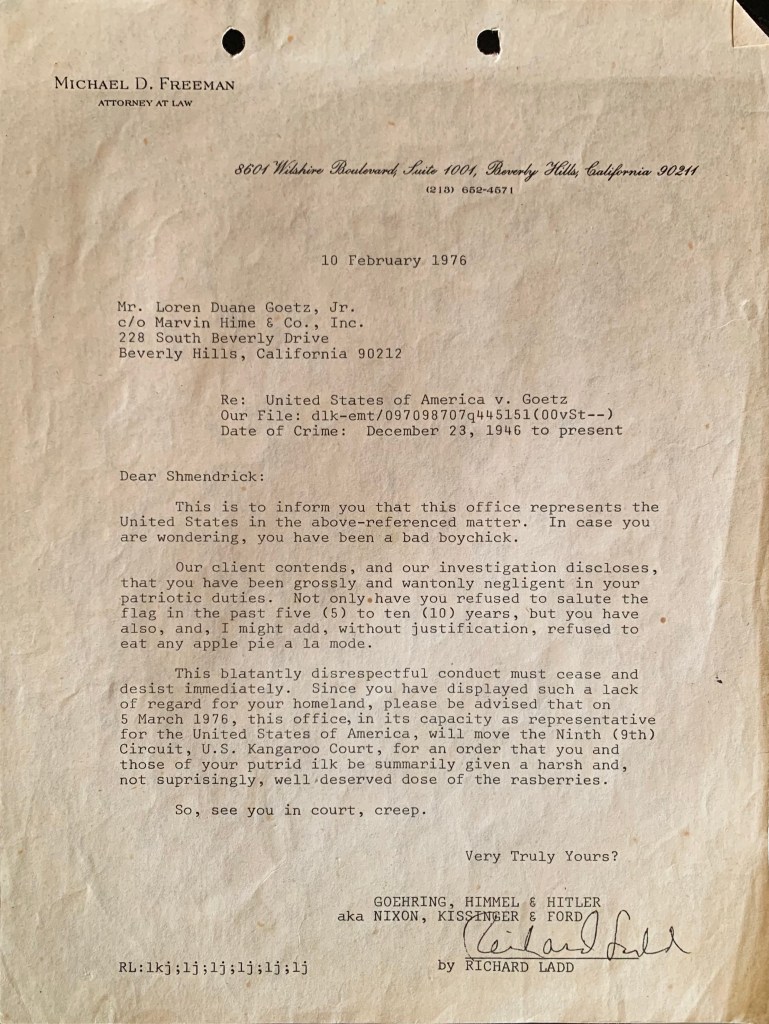
Between learning to skillfully use the device and sending out demand letters, discovery requests, and other miscellaneous documents, I sometimes riffed on the concepts I was conveying with a mix of facts and legal mumbo jumbo, and now and again would fire off a letter or two to friends … just for the fun of it.

Yesterday, while desperately searching for a document I needed in another context, I accidentally came across a couple of those letters. What follows is one of them I sent to my long-time, dear friend Loren.

Clearly, I had far too much time on my hands.

Hope This Is Legible

Power To The People

Corporations, conglomerates, and industrial organizations aren’t the enemy, ipso facto. In fact, they make socialism not only possible, but necessary, IMO.

What is the enemy is unbridled greed, rampant cronyism, nepotism and, especially, the codification of deep income inequality. It is not good for a society when individuals can amass fortunes they can’t possibly spend. That they then turn some of that fortune into philanthropy and charitable organizations doesn’t change the fact that it should be criminal for one individual to take that much surplus value from the workforce that made their fortune possible. It’s estimated Jeff Bezos makes (not earns) around $2,500/second. Dafuque does he do, other than own Amazon stock?

I’m not saying inventors, creators, entrepreneurs, etc. aren’t entitled to profit from their efforts, but they shouldn’t be able to continue siphoning profit off an organization that has reached a point where it could easily survive without them. By the same token, intellectual property law has expanded patent and copyright protections way beyond their original intent, creating other avenues of indecent profit-making.

And getting back to what I said about making socialism possible and necessary, without large profitable organizations, we’d all be living off mom & pop’s and craft-making. Many of the products we enjoy, and that provide the grease that skids civilization as we know it, would not be possible without large factories, laboratories, and other institutions. By their very nature, though, they transcend the control and direction of any one individual, and I believe our pay/profit structure needs to take that much more into consideration, providing a larger share to the workers who have helped make the org successful.


Hey! Long Time, No See.

QuantelliaLogoPaleI know it’s been quite a while since last I posted here. I’ve been continuously active on Facebook and have begun tweeting quite a bit as well, but that’s not why I haven’t posted to this blog in the past nearly three months. As of March 1 I began a new career, probably not the kind of thing you hear about 70-year-olds doing all that often. Since then I have been working as the Business Manager for Quantellia, LLC. You may recall I’ve done work for and with Quantellia on and off for the past six years.

Quantellia is a small AI/ML software development house and, until now, one of the co-founders has been running the business. Inasmuch as she is also the organization’s Chief Scientist, and a well-known pioneer in Machine Learning, this was not exactly the optimal thing for her to be doing. I had been touching on the subject and, since she was having such a hard time getting someone competent to run the business, I pressed my offer to do so. She finally relented and things have been going swimmingly, although there have been times I was swimming against the current. I’m definitely climbing a steep learning curve, which sometimes has me questioning if I’m losing my edge.

Actually, at times I can’t quite tell if my intellect is slipping a little bit, or if I just don’t care as much as I used to and I’m not quite as arrogantly sure of myself. My memory seems to be intact, along with my ability to learn and adapt. I’m going to go with the “I just don’t care as much about things as I used to; I’m more sanguine about life, work, and the need to control everything.

At any rate, I’m having a lot of fun. I was once partnered with two CPAs, doing royalty accounting for some big acts: Jackson Browne, Joni Mitchell, The Cars, Dollie Parton, Ronnie Milsap, The Commodores, even Jimi Hendrix’s estate. I learned a fair amount about accounting back then, and now I’m getting the opportunity to revisit what I learned, applying it in different circumstances. I’m also learning about artificial intelligence and machine learning, and hope to convey some of what’s going on in these fields. Although not a data scientist, I am quite capable of seeing where AI can be applied in business to assist with all kinds of issues. I’m sure you can as well.


They’re Finally Catching Up To Me

The last few years I was employed at Rocketdyne, my job – which I essentially created – was to research social media for the purpose of bringing it inside the firewall for internal communication and collaboration.

As a result, I became both well educated in the use of numerous apps and platforms, and excited about the possibilities they represented. When the Space Shuttle program was nearing it’s end, everyone over sixty was offered an early severance package.

After some research I decided to accept the offer, which I characterized as a “gold-leafed handshake.” I was pretty excited about going out on my own and offering social media marketing services to local small businesses. Unfortunately, very few people knew what I was talking about and most businesses remained content to spend $200/month on a Yellow Pages ad that likely got thrown in a recycle bin the moment it arrived.

I’m not entirely certain, but it does seem like things have changed and many more businesses understand the value in promoting via Facebook, Twitter, Pinterest, etc. As a result in finding it easier to get clients to help and supplement my retirement income.

This year promises to be very interesting.


A Career Change at 70

When I was in High School (1962 – 1966) it took me three and a half years to escape) there were no computer classes. Although there seems to be some disagreement on when the first personal computer was invented, even the earliest claim puts the date six years after I graduated. There was no such thing as a computer, let alone a programming or coding, class. Also, I did not attend university and, to my recollection, nobody I knew at the time was interested in computers or information technology. Actually, I was a terrible student and wasn’t interested in much of anything by the time I finished High School.

IBM Memory 50

The IBM Memory 50 Typewriter

Fast forward to 1974. Despite having no undergraduate education, I was able to secure admission to an accredited Law School, located not far from my home in the San Fernando Valley. I began in the fall of 1973 and the following year I managed to get a job in the law office of a sole practitioner in Beverly Hills as a legal secretary/law clerk. Shortly after I began, the lawyer I worked for purchased an IBM Memory 50 Typewriter. I attended a one-day class where I learned how to use it. This was my first introduction to anything resembling “computing.”

The office later upgraded to an Artec Display 2000, which had an LED readout of approximately 30 characters. There was no CRT display. It used two 8″ floppy disks and had a document/data merge capability that made it perfect for boilerplate documents, e.g. Pleadings, Interrogatories, Summonses, etc. It was a great leap forward in word processing.

Edward Ladd & Sons

The Family’s Wholesale Food Business

Shortly after graduating from law school I had, for numerous reasons, decided spending the rest of my work life around the judicial system was not something I really had my heart in and, after much gnashing of teeth and going over my alternatives, I decided to join my family’s wholesale food distribution business. One large factor in making this determination was my father suffering his second major heart attack. The business was supporting my mother and my sister, who was only 10 years old at the time. I felt the need to help the business grow, ensuring they would be taken care of if my father were to die . . . which he did eight years later.

Edward Ladd & Sons Jacket

Our company jackets. Logo design by me, jackets created by Cat’s Pyjamas.

After a couple of years, the business had grown substantially and, given my desire for another type of challenge, I once again struck off on my own. I dabbled in a few things, then joined forces with a couple of CPAs and formed a royalty auditing business, serving some very high-end artists. The company first purchased an Apple computer (I can’t recall if it was a II or a IIe but, based on the release dates of the two, I’m inclined to think it was a II). We later purchased a Northstar Advantage, which used the CP/M OS and two 160 KB, 5.25″ floppy disks. We also purchased a dot matrix printer and, in anticipation of taking the system out on the road, we had Anvil make a hardened case for the two, with room for cabling, paper, and instructions to be packed inside.

At that point our audits required us to visit the artists’ recording companies, and my first visit was to RCA records in the Meadowlands of New Jersey. Standard procedure for the record company was to stick us somewhere that was relatively uncomfortable, then bring us stacks of paper, which we then transferred to ledger pages. Upon returning to our office in Playa del Rey, we would then have to transfer all the data to a spreadsheet; we were using SuperCalc on the Northstar Advantage, though we had started with VisiCalc on the Apple.

I suggested taking the computer with us when we performed audits, so the people who went out on the road could enter the numbers they received directly into an electronic spreadsheet, thereby saving a huge amount of time and stress. We were also using WordStar at the time for writing the narratives that would accompany our audit analysis.

My first experience with programming came when we were contemplating taking the system out on a European tour with Neil Young. I sat with my friend and partner, who had performed many a box office reconciliation, and we sketched out the different scenarios that were used to close out the night’s receipts. Doing so required the use of nested “if” statements, which determined the precise equation to use for each venue. Unfortunately, that same friend who had worked so diligently with me to create the formulae that would power the spreadsheet never felt comfortable with using it by himself and it never went out on the road.

Sinclair ZX81

My Very First Computer, the Sinclair ZX81

It was also around this time I purchased a Sinclair ZX81, which was a small computer that had a membrane keyboard and used a cassette recorder to save programs on. It also had its own OS, as well as its own version of Basic, which I endeavored to learn. The first program I wrote, which took me all night to complete, counted down from 10 to 0, in the center of the screen. It then plotted a single pixel (resolution was 64 x 48) at a time, starting from the bottom and, after reaching a height of six pixels, began plotting another pixel above the previous six and erasing a pixel from the bottom of the stack, until it left the screen at the top. This required me to learn how to use either (I don’t recall the exact commands; it’s only been a little over thirty-five years) nested “if” statements or “do while” commands.

Fast forward to 1984, the year my father died. Shortly afterward, I returned to help my brother keep the business going. We purchased a more advanced Northstar Advantage, which had a huge hard disk that could store 5MB of data! At the time, we also purchased a copy of dBase II, which was one of the first database systems written for microcomputers. I taught myself how to write systems using their programming language, which I wrote using WordStar. I wrote an entire accounting system for the business. My favorite component was the preparation of a deposit ticket, where I laboriously emulated the workings of a calculator in allowing for numerous methods of inputting dollars and cents (whether or not a decimal point was included) was the real differentiator and sticking point for me but, after much trial and error, I figured it out.

Unfortunately, my brother and I didn’t see eye-to-eye on the direction the business should go in and, after a while I left again, this time taking temporary jobs to keep me afloat. It was during this time I worked for a while at a litigation support firm that used a DEC minicomputer and several of the earliest versions of the Macintosh. All of my work with computers was novel for me, as I never took any classes — with the exception of that class I took to learn how to use the IBM Memory 50 typewriter. I taught myself how to program through reading and doing, sometimes taking dozens of iterations to get a bit of code correct.

In 1987, I had been working for a company that made hard drives (Micropolis). Their business was highly seasonal and, on one particular Friday, all the temps got summarily laid off. I was using Apple One at the time to send me out on engagements and, thanks to my willingness to show up wherever, and whenever, they would offer me a job, I got a call from them on that very Friday, telling me to report to Rocketdyne the following Monday.

By this time I had been shifting my focus from working under the hood, to figuring out how to best use the systems and tools that were rapidly evolving as business tools. I was beginning to focus more on business results with whatever was available. My first responsibility at Rocketdyne was to enter text I received from Engineers into a document called a Failure Modes and Effects Analysis / Critical Items List (FMEA/CIL). It was in direct support of recertifying the Space Shuttle Main Engine (SSME) for eventual return to flight after the Challenger disaster.

SSME

SSME Hotfire Test

It was a strange task, as the document was clearly text-based, yet we were using a spreadsheet to create it. I suppose it made some sort of sense, as the company was an engineering company and that’s kind of how engineers see the world; in numbers, rather than words.

I also worked with a stress engineer on creating an app (we didn’t use the term back then, but that’s what it was) that could be used to predict crack propagation and its effects. I was unfamiliar with the equations behind the program, but my job was to use dBase II to create an interface that allowed for data input and crunched the numbers. It was fun and was successfully used for some time after that.

One year after joining as a temp (referred to as a “job shopper”) I hired in full-time and began working with the Flight Ops team. It was exciting and I spent much of my time massaging telemetry data from hot fire tests of the SSME. I received flat files from a Perkin-Elmer mainframe and eventually ported the data to Microsoft Access, which allowed for further massaging and reporting.

In October of 1988, a little over eight months after hiring in, the U.S. Space Program returned to flight with the successful launch of Discovery. At a celebratory event that evening I met one of the managers of the Program Office. As we talked and he discovered my background, he offered me a job. I did some research and talked to my current managers, who advised me to take it, which I did. As time went on, I moved further away from anything resembling coding and, eventually, wound up concentrating on the use of software and computing tools to increase the effectiveness of me and my colleagues.

Not quite 22 years later, I took an early severance package (which was offered to everyone over 60) and retired. I would turn 63 less than a month after leaving the company. In 2015, I returned as a contractor doing something I had done nearly 20 years previously. I spent the next two years (until February 17 of 2017, to be exact) providing program scheduling for two small rocket engine programs.

Last month I turned 70. I recently signed a referral partnership agreement with an organization I worked with a few years ago. They specialize in machine learning (ML) though I was unaware of that back then. My primary responsibility will be selling their services and, when possible, any product they may create. In order to be effective, I am now studying statistics and ML, partly to better understand what it is I’m selling and partly because I’m fascinated by the algorithms that power these efforts.

I do worry that my comprehension is somewhat hampered by, if not the years, the considerable mileage I’ve managed to accumulate. There’s also a minor problem with my “just don’t give a shit” attitude about a lot of things. Nevertheless, I will persist. I intend to share what I’m learning but, as with most things these days, it may be sporadic and somewhat unfocused.

I do believe machine learning is going to drastically change just about everything humans do and I’m well aware of the disruption it might entail. I don’t however, believe that to be a show stopper. We’ve opened Pandora’s box and there is no closing it. Let’s roll!


Empathy: The Core of Complex Decisions

Having worked with Dr. Pratt and her company, Quantellia, I have long been convinced their approach to decision making is one of, if not THE, best methodologies I’ve encountered. After what I consider to be one of the most disastrous general elections in my lifetime, it would seem we need help in navigating the complexities of the world and our place in it. Lorien’s work can, I believe, help us understand the consequences of our decisions, before we make them. I urge you to watch this video and become more conversant in the issues Dr. Pratt raises. What follows below the video are some of the “liner notes” that go with her TEDxLivermore talk.

Making decisions based on invisible inputs is like building a skyscraper without a blueprint. Yet that is the norm, even for very complex problems. Contrary to how most of us think about making a decision as being the act of choosing, a decision is the last piece of a long, almost completely invisible, process. The good news: it is possible to make the invisible part of decisions visible.

In working with the Community Justice Advisor Program in Liberia, Africa, Lorien and colleagues helped The Carter Center (founded by Jimmy and Rosalynn Carter) use decision models to increase positive outcomes in the domain of civil justice, by identifying the most effective levers for change.

Using deep learning artificial intelligence, the interconnections between inputs become visible, and unintended consequences can be identified before implementation. Vicious cycles can be reversed, and virtuous cycles of improvement can be built in place and nurtured through intelligent decision metrics.

As co-founder of Quantellia, Dr. Lorien Pratt co-created the decision intelligence methodology and the company’s award-winning World Modeler™ software. She consults and speaks worldwide, and is known for her neural network research and the book Learning to Learn. A former college professor, Pratt is widely known as the former global director of telecommunications research for Stratecast, a division of Frost & Sullivan. A graduate of Dartmouth College and Rutgers University, Pratt holds three degrees in computer science. She received the CAREER award from the National Science Foundation, an innovation award from Microsoft, and is author of dozens of technical papers and articles.

This talk was given at a TEDx event using the TED conference format but independently organized by a local community. Learn more at http://ted.com/tedx


The Elements of Dialectical Materialism

Yin Yang Symbol

My Favorite Representation of The Concept of The Dialectic

I am not an academic. Neither am I a philosopher or a journalist. Nevertheless, I do write on occasion and make an effort to share my thoughts in a somewhat coherent manner. I have to admit it’s gotten a little bit more difficult over the last few years, what with Twitter, Facebook, and other social media apps, platforms, and sites, slowly turning me into a scattershot reader of content.

My goal for the foreseeable future is to reverse that trend somewhat and spend more time writing and sharing my thoughts, perhaps some of my dreams, and a few (or more) of my memories. I’ll be 70 years old next June and, in mid-April of next year, will have outlived my father by a decade. Although relatively healthy, I do have my share of ailments that seem to come to everyone eventually: Mild Hypertension; Type II Diabetes (though, thanks to Fitbit and a little willpower made easy by the data retrieved from my Aria scale and Charge HR (link is to their latest version), I’ve lost a little over 30 pounds in a little over a year — and it’s had its salutary effect on my blood sugar); surgery for a Melanoma; Dupuytren’s Contracture; trigger finger; and a bunch of weird-ass nerve issues that are making many reaching movements with my hands problematic. In other words, I’m doing pretty good for an old guy.

I’m hoping to live long enough to share a little of the adult life of my children, who are currently 15 and 13, but there’s no way to know if that will happen. A lot of folks around my age have been dying off lately, and I can feel the inexorable decline of my physical strength, stamina, and overall health accelerating as I age. It’s a strange trip, I must say. Sometimes I worry a bit that I’m paying too much attention to the end, but I have always been one who has enjoyed the ride and I’m not really too concerned with its conclusion. I just happen to be fascinated by the concept of nothingness, which I contend is nigh onto impossible for we humans to comprehend. I also believe it is a big part of what has long attracted people to religion; they need to believe there’s some sort of consciousness after they die. I don’t believe that’s possible.

As someone who has embraced (if not always lived up to the practices inherent in doing so) Systems Thinking, I long ago came to the conclusion that the philosophy of Karl Marx and Friedrich Engels, Dialectical Materialism, is the framework from which systems thinkers can best view the development of the natural world which, of course, includes human beings and our social constructs.

In that regard, I thought I would share this compilation of the elements of the philosophy, as culled from the works of Vladimir Ilyich Lenin, one of the world’s clearest explicators of the work of Marx. Here are the 16 elements I’ve been able to find. I once had a slightly shorter version, which I had printed out and displayed at my desk. Several years before I retired, someone had the audacity to take it down from the wall, rip it in half, and leave it on my seat. I’ve never quite understood the cowardice it takes to do something like that but, no matter, the words — and the concepts they represent — can’t be erased quite that easily. Here’s the list:

Summary of Dialectics

Vladimir Ilyich Lenin

  1. The objectivity of consideration (not examples, not divergences, but the Thing-in-itself).
  2. The entire totality of the manifold relations of this thing to others.
  3. The development of this thing, (phenomenon, respectively), its own movement, its own life.
  4. The internally contradictory tendencies (and sides) in this thing.
  5. The thing (phenomenon, etc.) as the sum  and unity of opposites.
  6. The struggle, respectively unfolding, of these opposites, contradictory strivings, etc.
  7. The union of analysis and synthesis — the breakdown of the separate parts and the totality, the summation of these parts.
  8. The relations of each thing (phenomenon, etc.) are not only manifold, but general, universal. Each thing (phenomenon, process, etc.) is connected with every other.
  9. Not only the unity of opposites, but the transitions of every determination, quality, feature, side, property into every other [into its opposite?].
  10. The endless process of the discovery of new sides, relations, etc.
  11. The endless process of the deepening of man’s knowledge of the thing, of phenomena, processes, etc., from appearance to essence and from less profound to more profound essence.
  12. From coexistence to causality and from one form of connection and reciprocal dependence to another, deeper, more general form.
  13. The repetition at a higher stage of certain features, properties, etc., of the lower and
  14. The apparent return to the old (negation of the negation).
  15. The struggle of content with form and conversely. The throwing off of the form, the transformation of the content.
  16. The transition of quantity into quality and vice versa.

As I said, I am hardly a philosopher; merely a person who has found Materialism, whether it be Dialectical or Historical, to be the best method available to understand history and the development of society without — and this is important — the intervention of the supernatural. I try to apply this type of thinking to everything I ponder, but I do fall short at times. I, like most of us, am a work-in-progress. More to come.


Making Sense of All That Data

Deep Data

Transforming Big Data Information into Deep Data Insights

Yesterday I posted a question to several of the groups I belong to on LinkedIn. It was related to several of the things I’m interested and involved in: Systems Thinking, Knowledge Management, and Decision Modeling. It was somewhat informed, as well, by an article appearing in the Huffington Post, where Otto Scharmer, a Senior Lecturer at MIT and founder of the Presencing Institute, talks about the need to make sense of the huge and growing amounts of data we have available to us. He argues the importance of turning from “Big” data, where we mainly look outward in our attempt to understand what it is telling us about markets and our external influence, to “Deep” data, where we begin looking inward to understand what it’s telling us about ourselves and our organizations and how we get things done.

The question I asked was designed to seek out capabilities and functionality that people would like to have, but that is currently unavailable. My interests include working with others to understand and provide for those needs, if possible. I thought I would present the question here as well, where it will remain a part of my online presence and, hopefully, might elicit some useful responses. Here it is:

With the growing proliferation and importance of data — a development at least one author and MIT Lecturer has suggested is moving us from the information technology era to the data technology era — what tools would you like to see become available for handling, understanding, and sharing the new types of information and knowledge this development will bring?

In other words, what would you need that you don’t have today? What types of technology do you think would offer you, your colleagues, and your organizations a greater ability to make use of data to bring about a transformation from primarily siloed, outward looking data to collaborative, inward looking data as well?

I would love to hear of any ideas you might have regarding the kinds of tools or apps you could use to better deal with data by turning it into useful information and knowledge . . . perhaps even a smidgen of understanding and wisdom.